Artwork
Anna Maria van Schurman
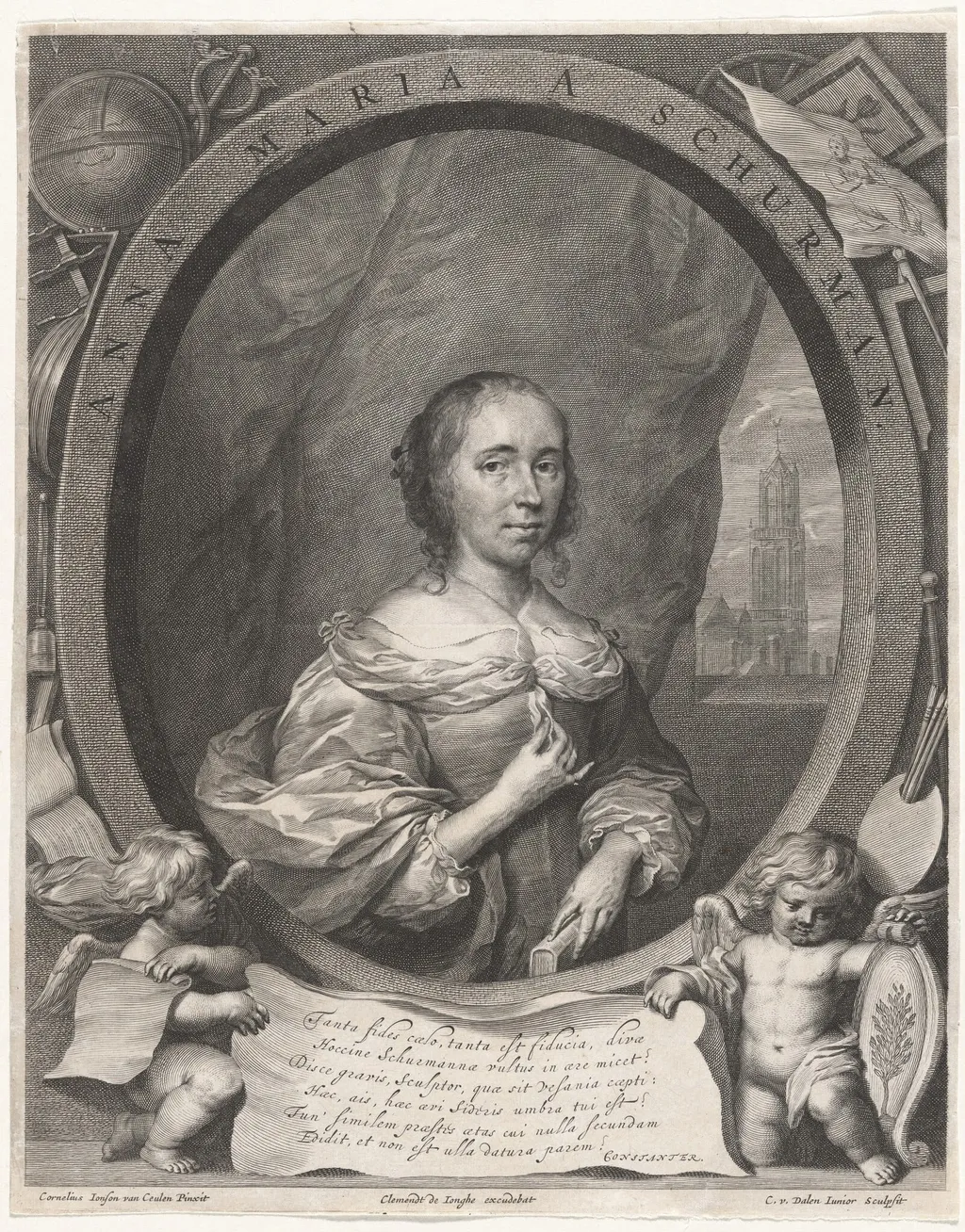
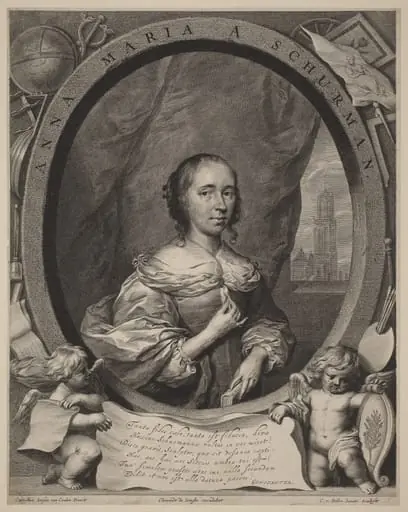
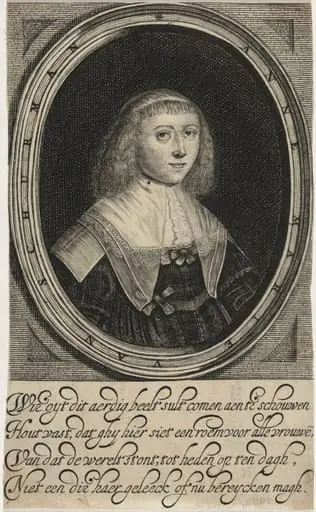
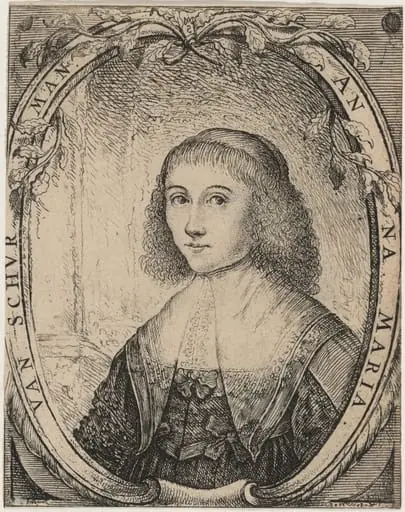
Anna Maria van Schurman is an ink print by the Baroque artist Cornelis van Dalen the Younger. It dates from 1657 and is held in the collection of the National Gallery of Art.
About this work
Overview
This 1657 engraving by Cornelis van Dalen the Younger depicts Anna Maria van Schurman, a Dutch scholar and poet, rendered in fine linear detail on laid paper. The composition is formal and restrained, emphasizing intellectual presence over ornamentation. The artist’s signature appears clearly, affirming authorship within a tradition of portrait prints that celebrated learned women of the period.
Subject & Meaning
Anna Maria van Schurman is portrayed as a figure of erudition, flanked by two cherubs holding symbolic objects: a scroll and a book. These attributes suggest her scholarly achievements and literary contributions. Her composed expression and modest attire reinforce the cultural ideal of the virtuous, intellectual woman, aligning her image with humanist values rather than aristocratic display.
Technique & Style
Dalen employed precise engraving techniques to render fine lines and subtle tonal gradations, characteristic of mid-17th-century Dutch printmaking. The dark, swirling oval background isolates the figure, directing focus to her face and gestures. The cherubs are delicately rendered, their forms softened by the medium’s capacity for fine detail, enhancing the portrait’s solemn, contemplative tone.
History & Provenance
The print was produced in 1657 and entered the collection of the National Gallery of Art in Washington, D.C., where it remains today. Its survival reflects the enduring interest in van Schurman’s legacy as a female intellectual. The work likely circulated among scholarly circles, serving both as a portrait and a testament to her reputation in early modern Europe.
Context
In the 17th century, few women were publicly recognized for intellectual pursuits. Van Schurman, fluent in multiple languages and a noted philosopher, was an exception. This engraving emerged during a period when Dutch artists increasingly depicted learned women as symbols of moral and intellectual virtue, aligning with broader humanist ideals in Northern Europe.
Legacy
The engraving endures as a visual record of a woman who challenged gender norms through scholarship. It contributes to a small but significant body of portraiture that elevated female intellect in an era when such representation was rare. Its formal precision and symbolic language continue to inform studies of gender, education, and print culture in the early modern period.
Artist & collection