Artwork
C'est tout d'même flatteur d'avoir
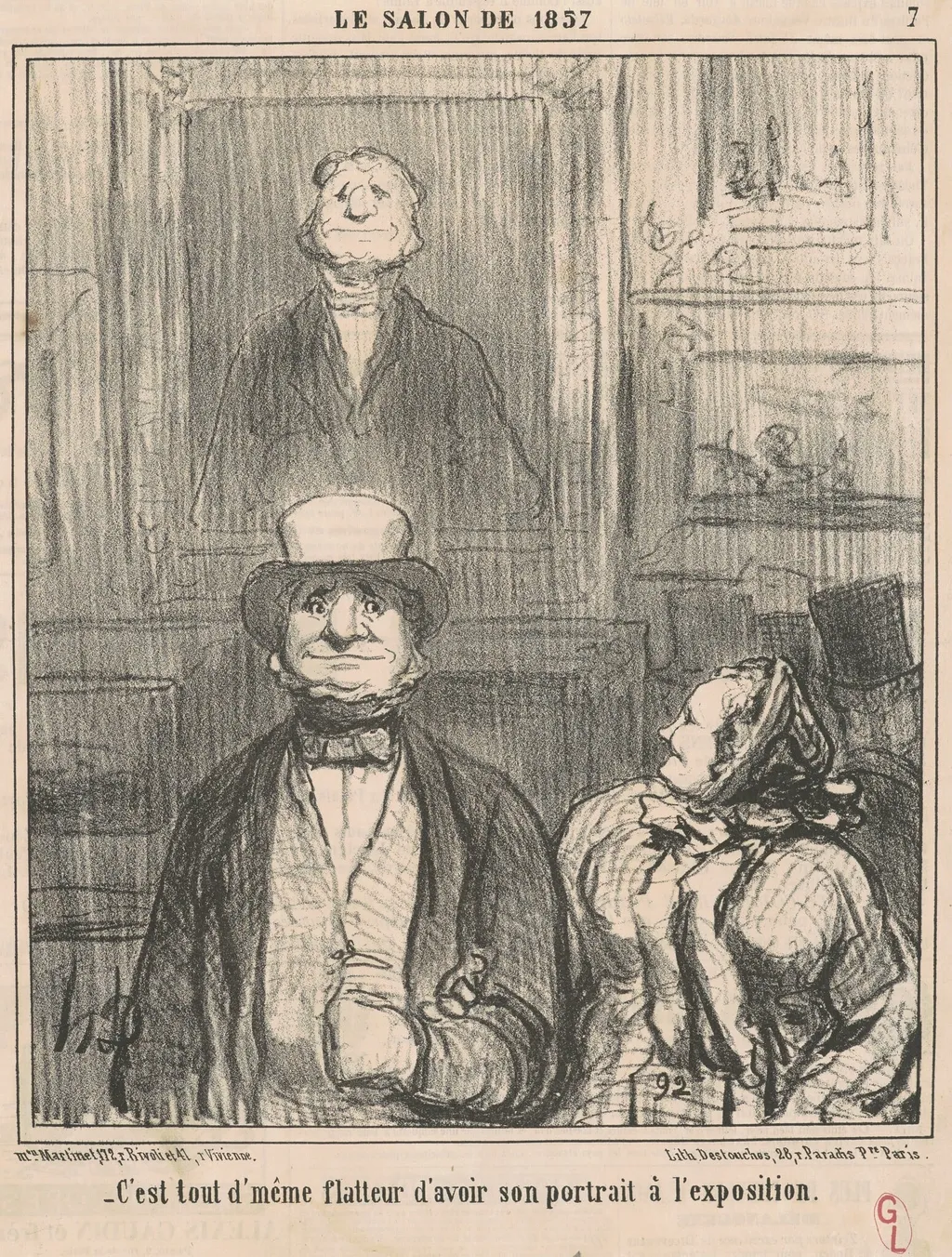
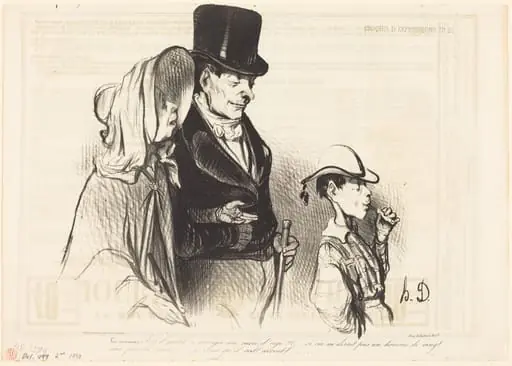
C'est tout d'même flatteur d'avoir is an ink print by the Impressionist artist Honoré Daumier. It dates from 1857 and is held in the collection of the National Gallery of Art.
About this work
Overview
This lithograph by Honoré Daumier captures a quiet moment between a man and woman, their proximity suggesting intimacy. The figures are enclosed by a row of framed portraits, creating a visual cage that frames their interaction. The work belongs to a series of prints Daumier produced for French periodicals, using satire to examine social behavior in mid-19th-century Paris.
Subject & Meaning
The couple, one holding a gloved hand, appears caught between personal connection and public performance. The surrounding portraits imply that identity is shaped by societal expectations — each face a role to be adopted. The title, translating to 'It's still flattering to have,' hints at the vanity underlying social rituals, suggesting the couple's bond may be as much about image as affection.
Technique & Style
Daumier employed lithography, a method allowing rapid reproduction for newspapers and journals. His brushwork is economical yet expressive, using bold lines and tonal contrasts to define form without detail. The figures are rendered with loose, gestural strokes, while the portraits behind are more rigidly outlined, reinforcing the contrast between lived experience and imposed social types.
History & Provenance
Created around 1863–1865, the print was likely published in Le Charivari, the satirical journal where Daumier regularly contributed. It was part of a broader body of work critiquing bourgeois manners during the Second Empire. The print circulated widely among Parisian readers, its accessibility amplifying its social commentary beyond elite art circles.
Context
In mid-19th-century France, rising urban middle classes placed increasing value on appearances and social conformity. Daumier’s work responded to this climate, using domestic scenes to expose the performative nature of relationships. The gallery of portraits mirrors the era’s obsession with status and the pressure to conform to idealized roles, whether in marriage or public life.
Legacy
Daumier’s lithographs, including this one, influenced later artists who sought to depict modern life with psychological nuance. His use of everyday subjects and critical observation helped bridge realism and modern satire. Though not widely exhibited in his lifetime, his prints gained recognition in the 20th century as foundational to the tradition of social commentary in graphic art.
Artist & collection

Artist
Honoré-Victorin Daumier was a French painter, sculptor, and printmaker, whose many works offer commentary on the social and political life in France, from the Revolution of 1830 to the fall of the Second French Empire in 1870.