Artwork
Dites donc, not'maire ... des communistes qué qu'c'est ça?
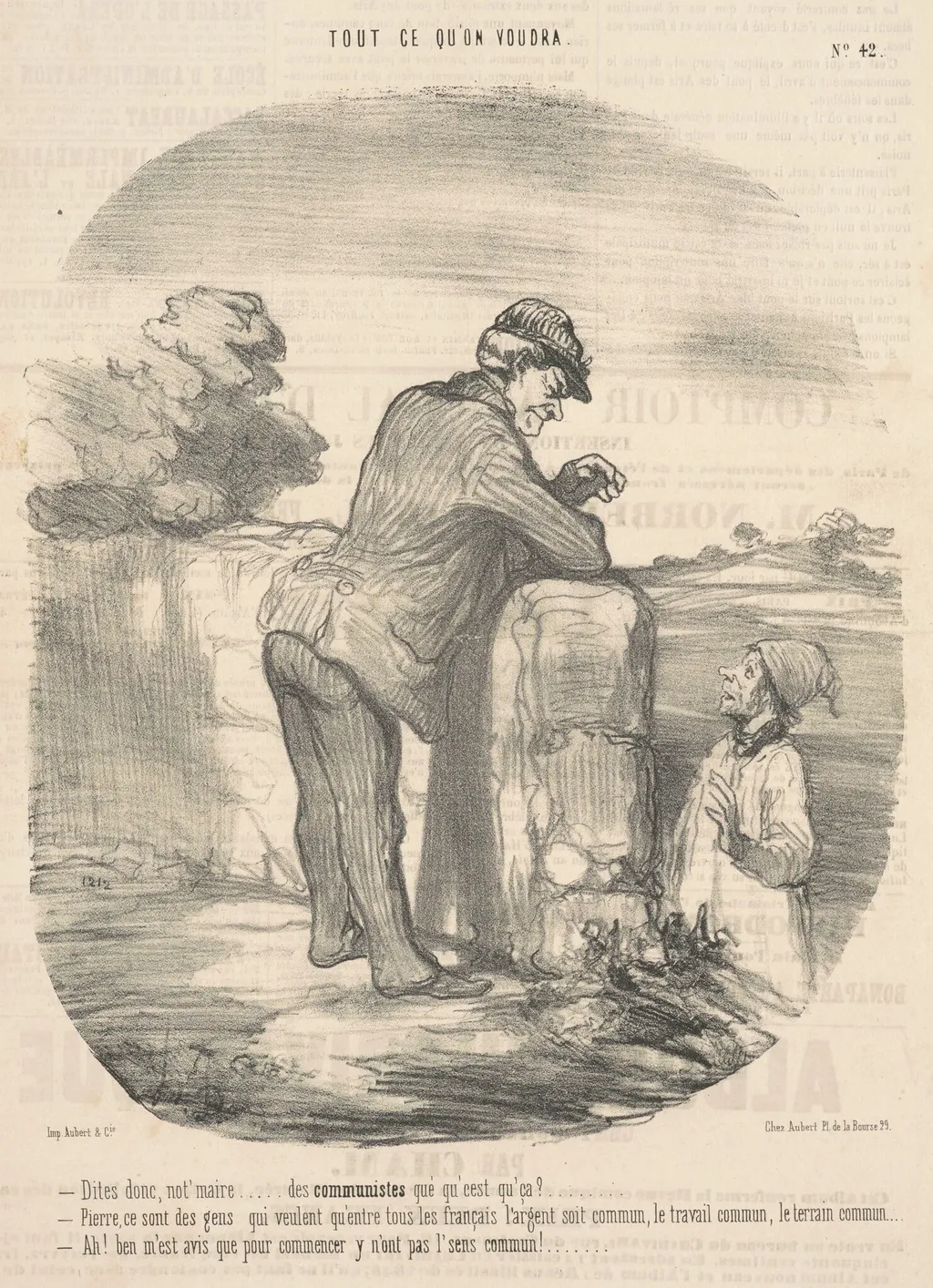
Dites donc, not'maire ... des communistes qué qu'c'est ça? is an ink print by the Romanticist artist Honoré Daumier. It dates from 1848 and is held in the collection of the National Gallery of Art. Dites donc, not'maire .
About this work
Their clothes make them look like different classes—one wears a suit, the other a cap and jacket.
This lithograph shows two men in a field, one pointing at a small group in the distance. Their clothes make them look like different classes—one wears a suit, the other a cap and jacket.
Daumier made this in 1848, right after France’s February Revolution. Back then, people argued over what “communists” even meant. The print pokes fun at confusion over new political ideas.
It’s a quick sketch, but it catches how people reacted to change. Look up Daumier, Honoré if you want to see more of his sharp political cartoons.
Overview
Dites donc, not'maire ... des communistes qué qu'c'est ça? is a lithograph created by Honoré Daumier in 1848, capturing a moment of conversation between two men in a rural landscape.
Subject & Meaning
The print depicts two men, distinguishable by their attire, one pointing towards a distant group, satirizing the confusion surrounding the term 'communists' in the aftermath of France's February Revolution.
Technique & Style
Executed as a lithograph, the work showcases Daumier's ability to convey social commentary through a seemingly simple, sketch-like composition, leveraging the medium's capacity for quick, expressive output.
History & Provenance
Produced in 1848, the lithograph is a product of the tumultuous period following the February Revolution, reflecting the era's political and social upheaval.
Context
The artwork engages with the contemporary debate over the meaning of 'communism', a term that was gaining currency and sparking widespread discussion and confusion.
Artist & collection

Artist
Honoré-Victorin Daumier was a French painter, sculptor, and printmaker, whose many works offer commentary on the social and political life in France, from the Revolution of 1830 to the fall of the Second French Empire in 1870.