Artwork
Hamlet
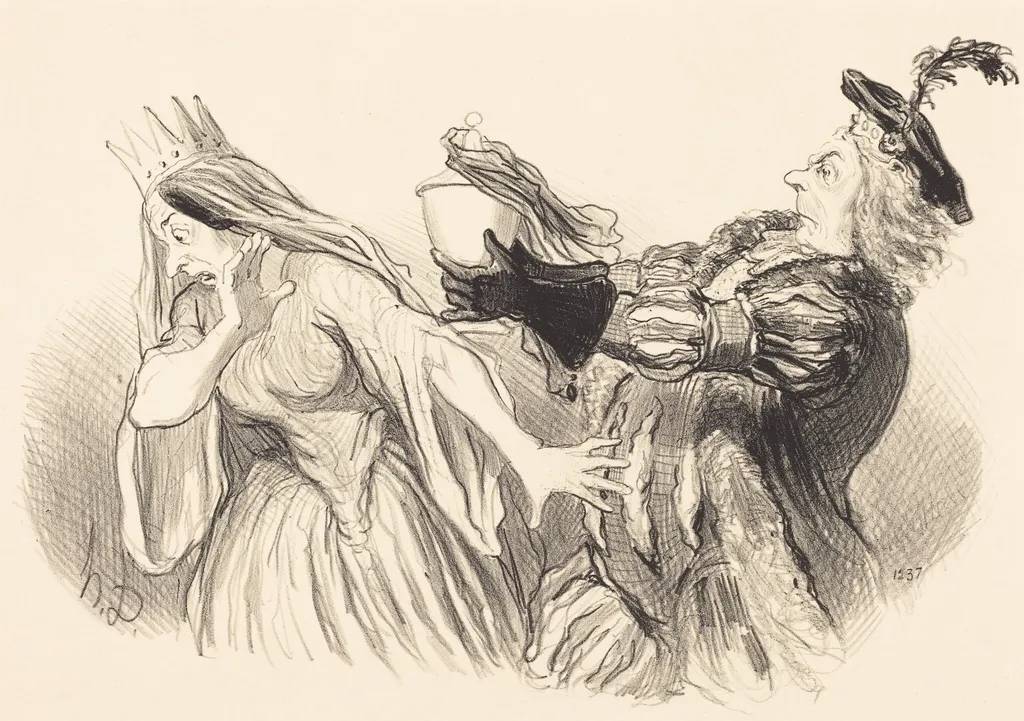
Hamlet is an ink print by the Impressionist artist Honoré Daumier. It dates from 1851 and is held in the collection of the National Gallery of Art.
About this work
Overview
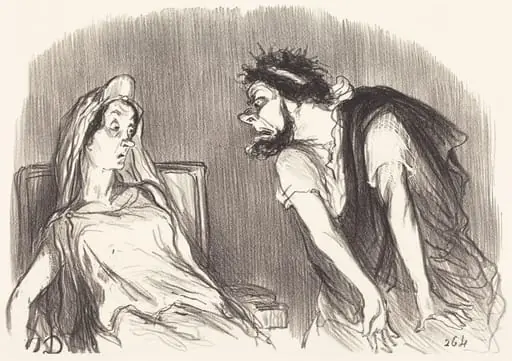
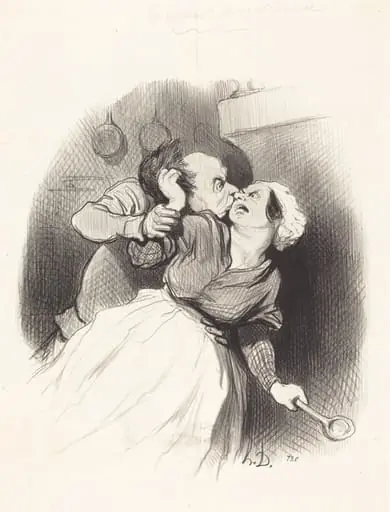
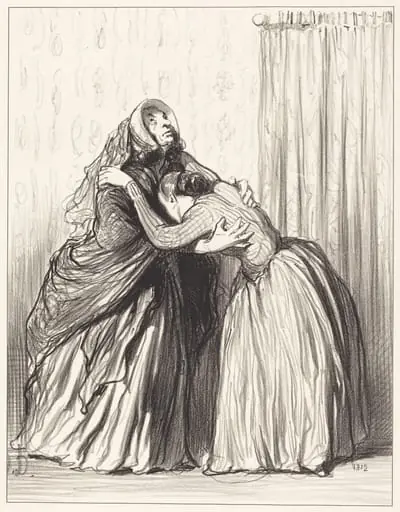
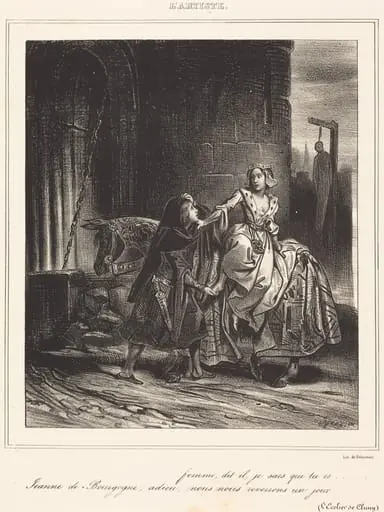
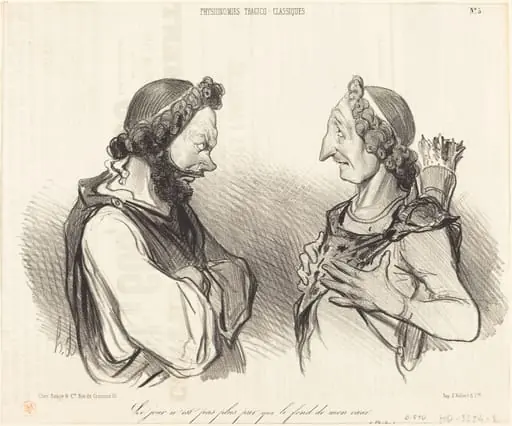
Created in 1851, this lithograph by Honoré Daumier depicts a moment of psychological tension between two figures, loosely inspired by Shakespeare’s Hamlet.
Created in 1851, this lithograph by Honoré Daumier depicts a moment of psychological tension between two figures, loosely inspired by Shakespeare’s Hamlet. Though rooted in literary reference, the work functions more as a study of human emotion than a literal illustration. Daumier, primarily known for his political satire, applied his sharp observational style to theatrical themes, using the medium of lithography to capture fleeting expressions with immediacy.
Subject & Meaning
The two figures convey inner turmoil without narrative clarity. One, hunched with hand to head, suggests contemplation or distress; the other, standing rigidly behind with crossed arms and feathered hat, appears watchful or imposing. Daumier avoids literal costume or setting, focusing instead on posture and gesture to evoke existential unease. The scene reflects broader anxieties of the era—doubt, authority, and isolation—filtered through Daumier’s republican sensibilities.
Technique & Style
Daumier employed rapid, expressive lines typical of his sketch-based lithographic process. The ink flows with urgency, leaving areas deliberately unfinished, as if the moment were caught mid-thought. Contrasts between dense shadows and sparse contours heighten emotional tension. The lack of polish and the rawness of the lines emphasize spontaneity, aligning the work with the immediacy of journalistic illustration rather than formal portraiture.
History & Provenance
Produced during Daumier’s most active period as a printmaker, this lithograph was likely made for private circulation or as part of a series exploring literary themes. Unlike his widely published political cartoons, this piece was not distributed in periodicals, suggesting a more personal or experimental intent. Its survival reflects its value to collectors who appreciated Daumier’s ability to distill complex emotion in minimal form.
Context
In 1851, France was under the shadow of Louis-Napoléon Bonaparte’s coup, which dismantled the Second Republic. Daumier, a vocal critic of authoritarianism, turned increasingly to literary and mythic subjects as political expression became riskier. His engagement with Hamlet may have been a coded response to themes of power, betrayal, and moral paralysis—issues resonant in the political climate of the time.
Legacy
This lithograph exemplifies Daumier’s influence on modern printmaking and expressionist drawing. His fusion of literary allusion with psychological realism paved the way for later artists exploring inner states through simplified forms. Though less known than his political satires, works like this reveal his depth as an observer of human vulnerability, bridging 19th-century realism and 20th-century modernism.
Artist & collection

Artist
Honoré-Victorin Daumier was a French painter, sculptor, and printmaker, whose many works offer commentary on the social and political life in France, from the Revolution of 1830 to the fall of the Second French Empire in 1870.