Artwork
La veille des Thermopyles
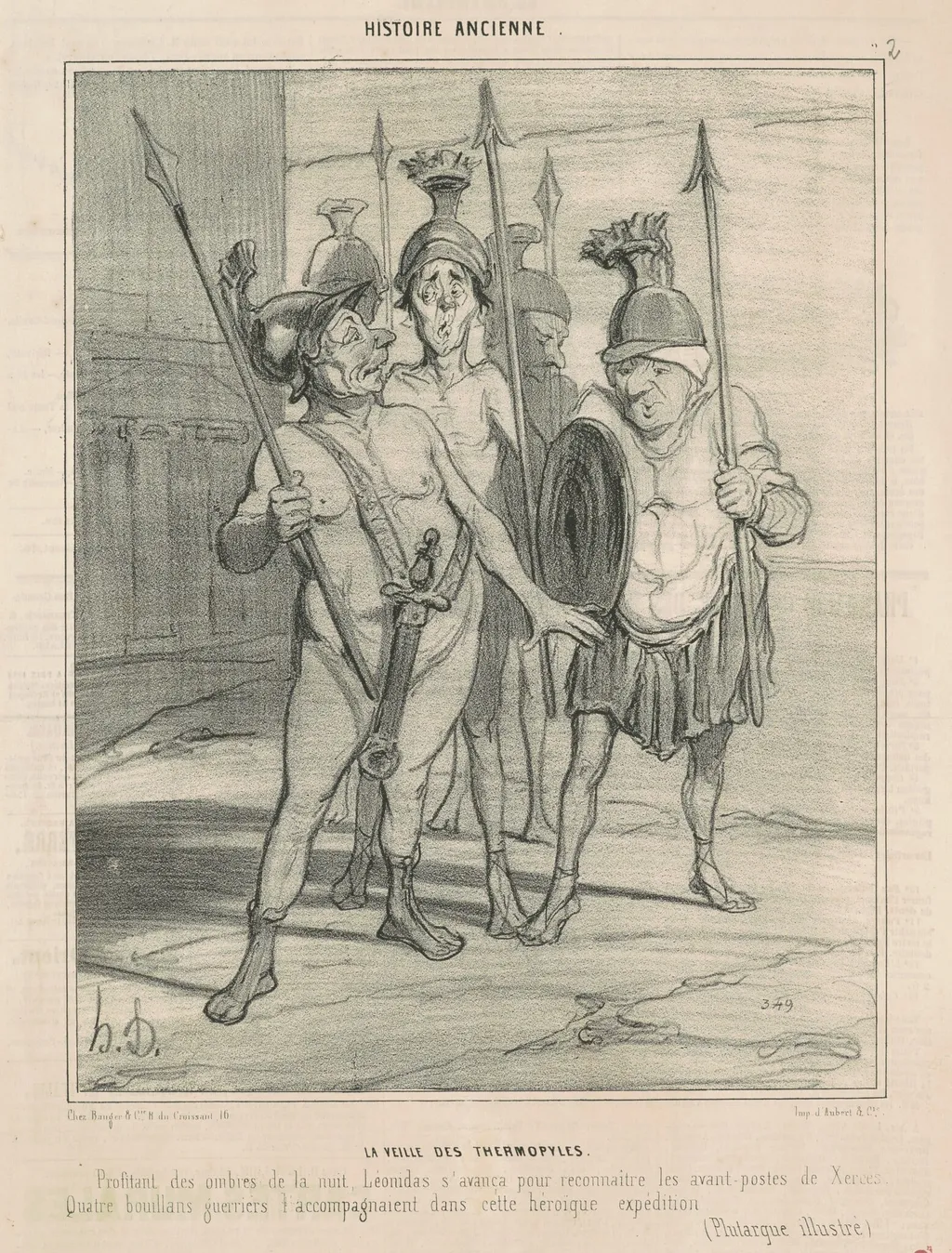
La veille des Thermopyles is an ink print by the Romanticist artist Honoré Daumier. It dates from 1842 and is held in the collection of the National Gallery of Art.
About this work
Overview
Honoré Daumier’s 1842 lithograph titled *La veille des Thermopyles* presents a compact tableau of four soldiers poised on the brink of combat. Rendered in stark black‑and‑white lines, the image captures a moment of collective anticipation, with each figure poised in a classical stance that suggests both individual focus and group cohesion.
Subject & Meaning
The work portrays a quartet of ancient combatants dressed in stylised armour, each gripping a spear and shield. Their faces are rendered with heightened expression, and their bodies are arranged in a dynamic, forward‑leaning configuration, conveying a sense of shared resolve and the tension that precedes battle—a theme Daumier often explored through dramatic human interaction.
Technique & Style
Executed as a lithograph, the piece relies on the contrast of inked lines against the paper to model volume and movement. Daumier’s characteristic exaggeration of facial features and the fluidity of the figures’ gestures are achieved through bold, gestural strokes, emphasizing kinetic energy while maintaining the disciplined clarity typical of early‑19th‑century printmaking.
History & Provenance
Created in 1842, the lithograph reflects Daumier’s engagement with historical and mythological subjects during a period when he was expanding beyond his well‑known caricatures. While the original printing plate’s whereabouts are not documented, surviving impressions have appeared in 19th‑century print collections and continue to be cited in studies of Daumier’s diverse oeuvre.
Artist & collection

Artist
Honoré-Victorin Daumier was a French painter, sculptor, and printmaker, whose many works offer commentary on the social and political life in France, from the Revolution of 1830 to the fall of the Second French Empire in 1870.