Artwork
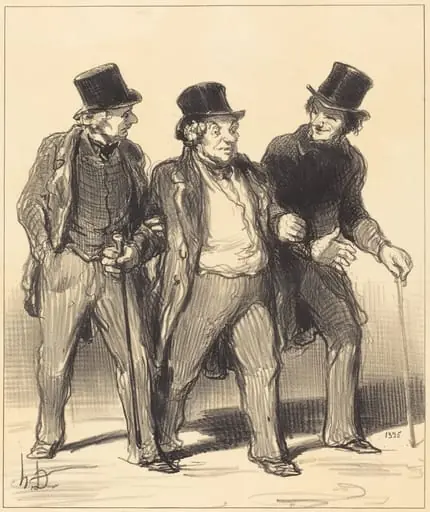
Les Journaux Napoléoniens sortant de l'Assemblée Nationale...
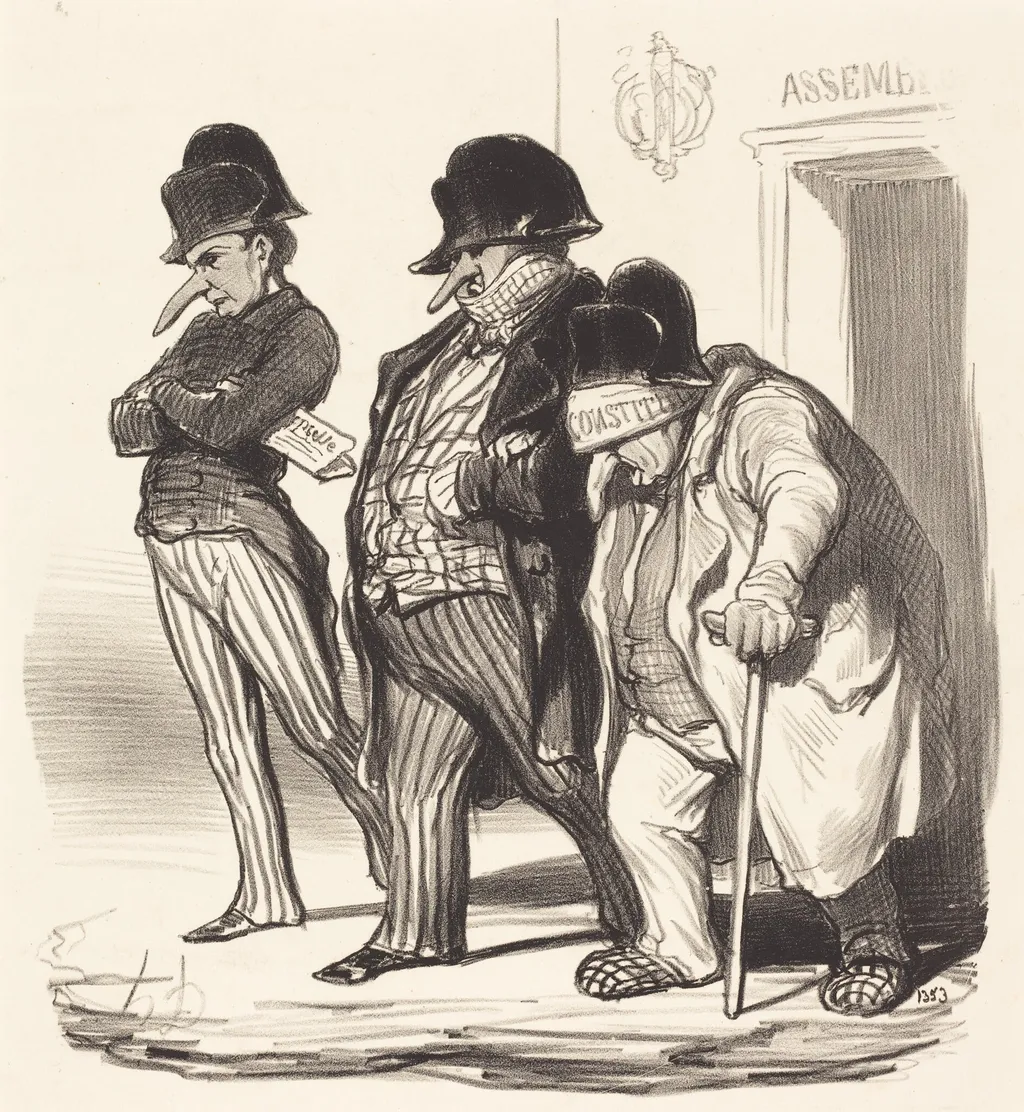
Les Journaux Napoléoniens sortant de l'Assemblée Nationale... is an ink print by the Romanticist artist Honoré Daumier. It dates from 1848 and is held in the collection of the National Gallery of Art.
About this work
Overview
Created in 1848, this lithograph by Honoré Daumier captures a moment of political tension in post-revolutionary France.
Created in 1848, this lithograph by Honoré Daumier captures a moment of political tension in post-revolutionary France. It depicts three figures emerging from the National Assembly, each embodying a different strand of the press. Daumier, known for his sharp social commentary, used the accessibility of lithography to distribute critiques widely, targeting the hypocrisy and performative nature of political journalism during a volatile transition of power.
Subject & Meaning
The three figures represent distinct journalistic voices: one holds a paper labeled 'PEUPLE,' symbolizing populist rhetoric; another wears 'CONSTITUTION' on his back, suggesting hollow adherence to legal ideals; the third, gaunt and cane-supported, evokes decay or exhaustion. Together, they imply that the press, far from serving the public good, is a collection of performative, self-serving entities—each masking manipulation behind the language of democracy.
Technique & Style
Daumier employed lithography to achieve rapid, expressive lines with tonal contrast, ideal for satirical reproduction. His figures are rendered with exaggerated features—skeletal faces, distorted postures—emphasizing moral or ideological decay. The minimal background focuses attention on the characters, while the stark labeling of objects like newspapers and coats turns them into visual puns, blending realism with caricature to heighten critical impact.
History & Provenance
Produced during the Second Republic, the print emerged from Daumier’s long association with satirical journals like *Le Charivari*, where his work often led to legal repercussions. Though originally published in periodicals, this image entered institutional collections later, preserved as part of a broader archive documenting the press’s role in shaping public perception during France’s turbulent 19th-century political shifts.
Context
In 1848, France was redefining governance after the February Revolution toppled the July Monarchy. Newspapers proliferated, each claiming to represent the people while often advancing partisan agendas. Daumier’s image responds to this chaos, portraying the press not as a pillar of democracy but as a troupe of masked actors—each holding a banner of principle while revealing deeper corruption or fatigue.
Legacy
Daumier’s lithographs influenced later generations of political illustrators and cartoonists by demonstrating how visual satire could expose institutional hypocrisy with clarity and wit. This work, among hundreds like it, helped establish the press as a legitimate subject of artistic critique. Its enduring relevance lies in its unflinching portrayal of media as both mirror and manipulator of political culture.
Artist & collection

Artist
Honoré-Victorin Daumier was a French painter, sculptor, and printmaker, whose many works offer commentary on the social and political life in France, from the Revolution of 1830 to the fall of the Second French Empire in 1870.