Artwork
Monsieur, vu l'absence complète ...
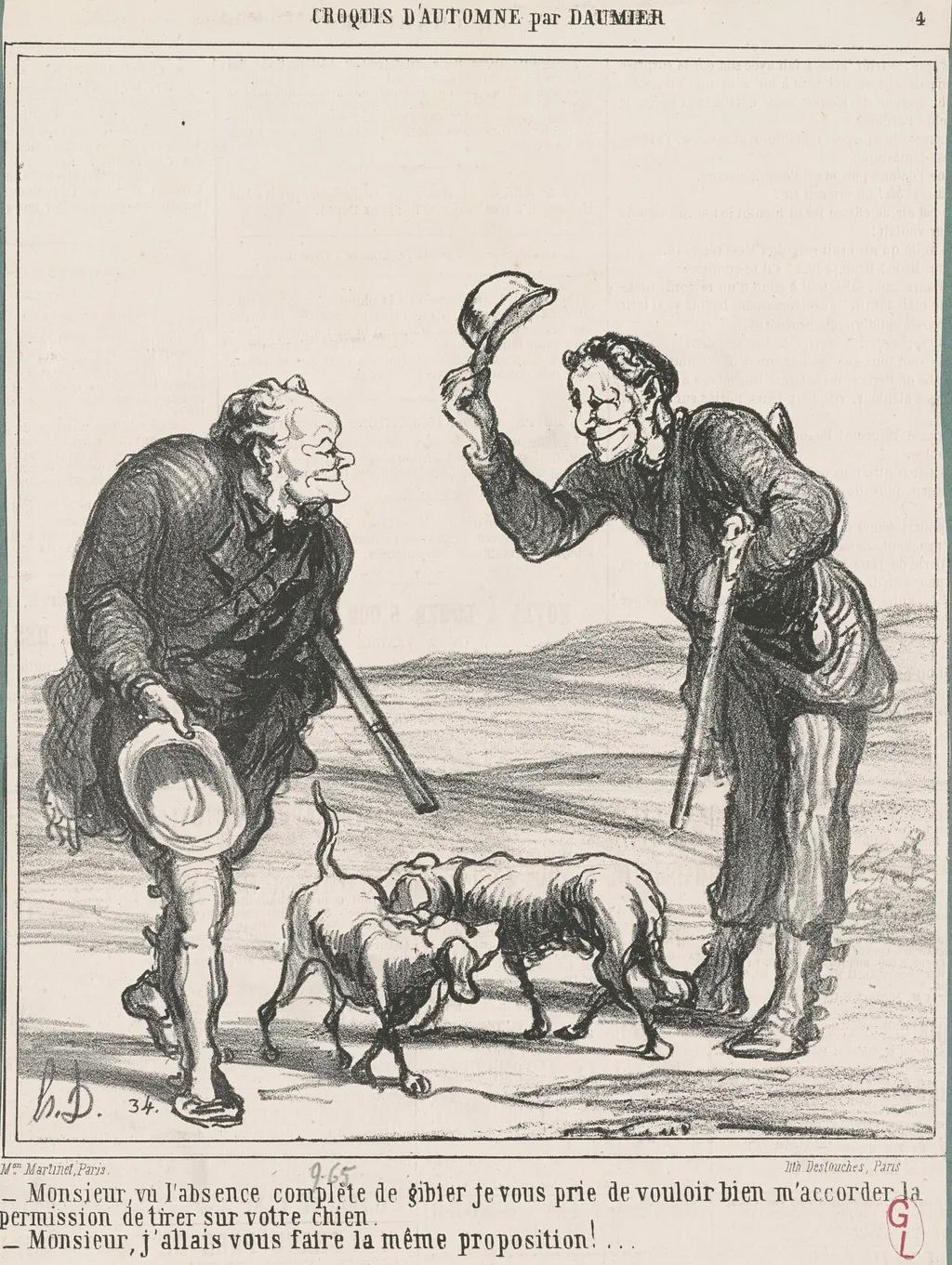
Monsieur, vu l'absence complète ... is an ink print by the Impressionist artist Honoré Daumier. It dates from 1865 and is held in the collection of the National Gallery of Art.
About this work
Overview
This lithograph by Honoré Daumier depicts two men engaged in a quiet, informal exchange, framed by a sparse natural setting. The scene is rendered with minimal detail, focusing attention on the figures’ physical relationship and the subtle dynamics of their interaction. Three dogs roam nearby, adding motion and domestic warmth without distracting from the central human exchange.
Subject & Meaning
The dogs, unbothered and natural, reinforce the ordinariness of the encounter, grounding the scene in everyday life rather than grand narrative.
The two men embody contrasting social postures: one leans forward in approachable familiarity, while the other stands rigidly upright, hat raised in a gesture that borders on theatrical. Their interaction suggests a moment of mutual recognition, perhaps between acquaintances or neighbors. The dogs, unbothered and natural, reinforce the ordinariness of the encounter, grounding the scene in everyday life rather than grand narrative.
Technique & Style
Daumier employs lithography to achieve a loose, expressive line quality, with ink washes suggesting form without heavy shading. The background is reduced to a few strokes, creating a sense of open space that isolates the figures. The figures’ gestures are exaggerated yet plausible, reflecting Daumier’s talent for capturing human behavior with both precision and wit, typical of his satirical yet empathetic approach.
History & Provenance
Created during Daumier’s prolific period in the mid-19th century, this print likely originated as a plate for publication in a periodical, though its exact first appearance remains undocumented. It entered private collections in the decades following its production, eventually finding its way into institutional holdings where it is now studied as part of his broader social commentary on French urban and rural life.
Context
Daumier worked amid rising interest in realism and the depiction of common life, influenced by the political and social shifts following the 1830 Revolution. While many artists focused on idealized subjects, he turned to ordinary people—laborers, clerks, townsfolk—as worthy of artistic attention. This print aligns with his broader project of observing human behavior without overt judgment, capturing nuance in fleeting moments.
Legacy
Daumier’s lithographs, including this one, helped redefine printmaking as a vehicle for social observation rather than mere illustration. His ability to convey character and mood with minimal means influenced later generations of realist and modernist artists. Though not widely exhibited in his lifetime, his work gained recognition in the 20th century as foundational to the depiction of modern life in visual art.
Own this work as a print
Artist & collection

Artist
Honoré-Victorin Daumier was a French painter, sculptor, and printmaker, whose many works offer commentary on the social and political life in France, from the Revolution of 1830 to the fall of the Second French Empire in 1870.