Artwork
Une Imitation bourgeoise du Zéphir de Prudhon
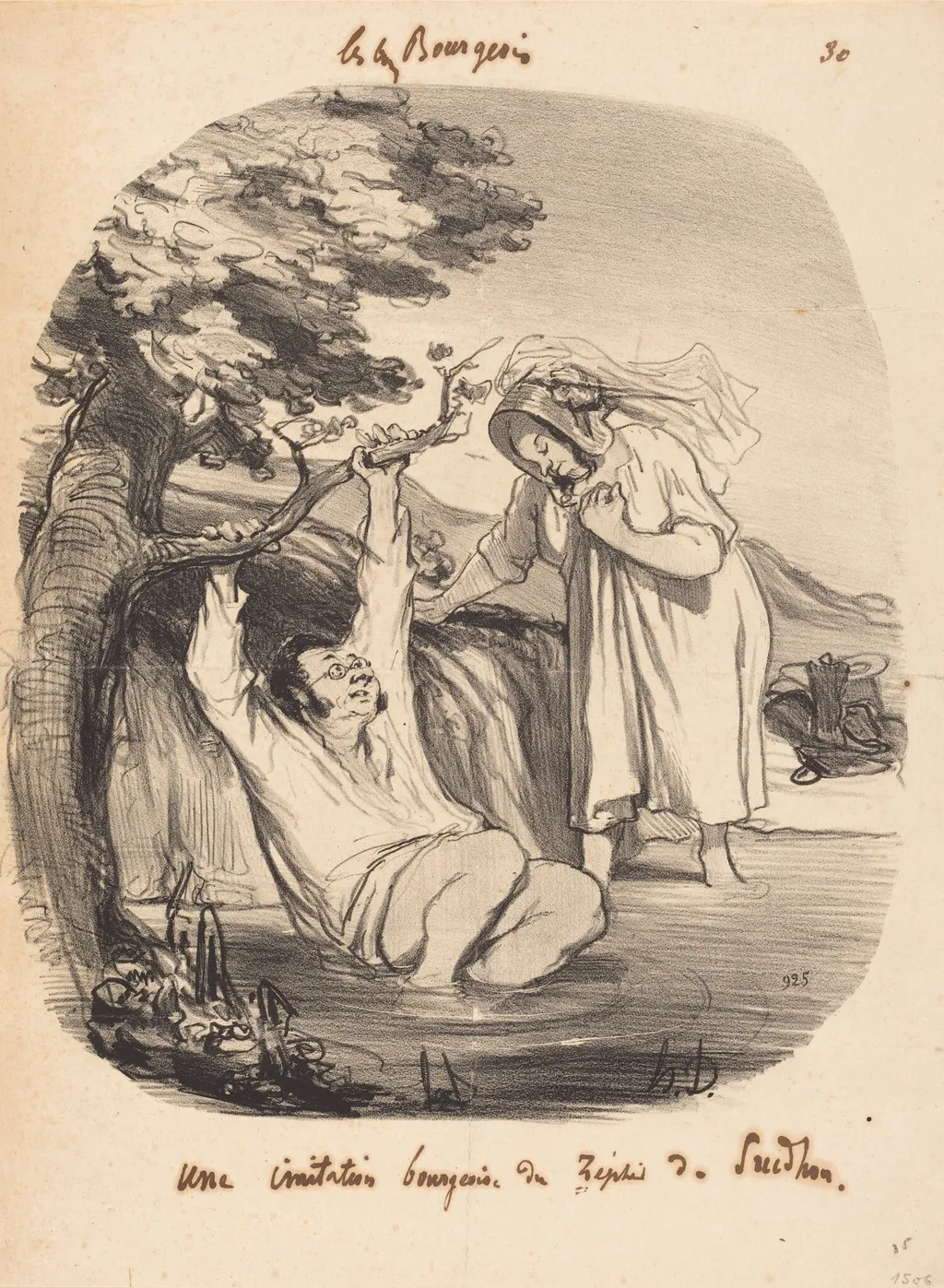
Une Imitation bourgeoise du Zéphir de Prudhon is an ink print by the Romanticist artist Honoré Daumier. It dates from 1847 and is held in the collection of the National Gallery of Art.
About this work
Overview
Created in 1847, this lithograph by Honoré Daumier is a satirical response to a romanticized mythological painting by Pierre-Paul Prud’hon.
Created in 1847, this lithograph by Honoré Daumier is a satirical response to a romanticized mythological painting by Pierre-Paul Prud’hon. As a prolific printmaker for Parisian satirical journals, Daumier used the accessibility of lithography to critique social pretensions. The work belongs to a series that juxtaposes high art with everyday life, exposing the gap between idealized imagery and bourgeois reality.
Subject & Meaning
The scene depicts a woman holding a flower-laden branch, a child reaching from the ground, and a man observing passively—figures that parody the graceful, ethereal forms of Prud’hon’s Zéphir. The composition lacks mythological grandeur, replacing it with mundane gestures and disheveled surroundings. The dog alone in the background underscores isolation, while the title suggests a hollow imitation of elegance, mocking the bourgeoisie’s attempts to mimic aristocratic culture.
Technique & Style
Daumier employed rapid, expressive linework typical of his journalistic lithographs, capturing movement and emotional tension with minimal detail. The sketchy, uneven strokes convey spontaneity and urgency, contrasting with the polished finish of academic paintings. Shading is suggested through hatching rather than smooth gradation, emphasizing the raw, unrefined quality of the scene and reinforcing its critical tone.
History & Provenance
Produced during the final years of the July Monarchy, the print was likely published in *Le Charivari*, where Daumier regularly contributed political and social commentary. Its circulation among urban readers helped disseminate republican critiques of class pretension. Though no early ownership records are widely documented, the work survives in major institutional collections, reflecting its significance in 19th-century print culture.
Context
In 1847, France was on the brink of revolution, with growing unrest against monarchical rule and rising demands for democratic reform. Daumier’s work responded to this climate by ridiculing the cultural aspirations of the middle class, which sought to emulate aristocratic tastes without understanding their origins. His prints functioned as visual journalism, turning art history into a tool for social critique.
Legacy
This lithograph exemplifies Daumier’s influence on modern visual satire, bridging fine art and mass media. His ability to distill complex social commentary into a single, accessible image paved the way for later cartoonists and political illustrators. Though not widely exhibited in his lifetime, the work is now recognized as a key example of how printmaking could challenge cultural hierarchies and democratize artistic discourse.
Artist & collection

Artist
Honoré-Victorin Daumier was a French painter, sculptor, and printmaker, whose many works offer commentary on the social and political life in France, from the Revolution of 1830 to the fall of the Second French Empire in 1870.









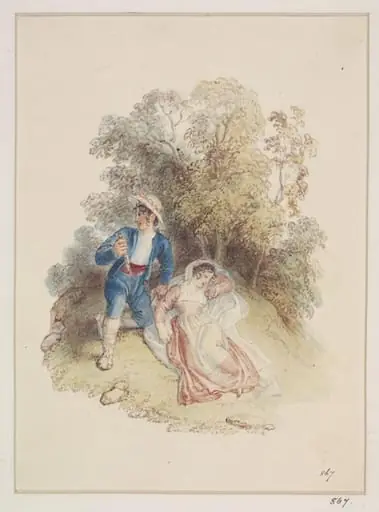 The Young Robber
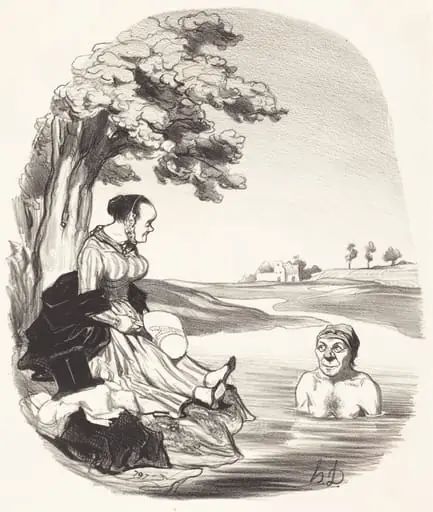 L'Eau est délicieuse... je t'assure...
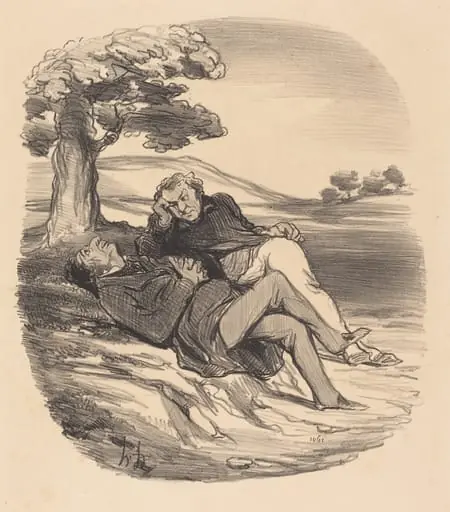 Doux loisir d'un quincailler retiré di commerce...
 Christ on the Mount of Olives
 Christ on the Mount of Olives, The Flagellation, Christ Crowned with Thorns, The Crucifixion
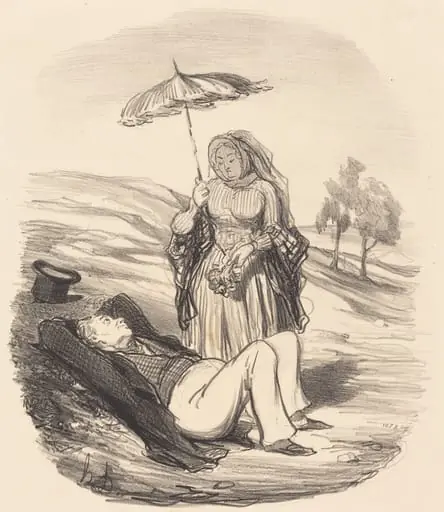 Une Promenade conjugale
 Tobias and the Angel
 Two Fleeing Figures
 Eh! Bien ... mon ami, a quoi penses-tu? ...
 Elegy
Elegy Ne tirez pas!!!
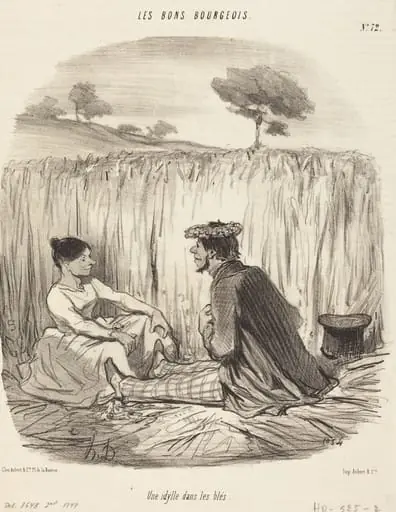 Une Idylle dans les blés