Artwork
Vous avez perdu votre procès c'est vrai...
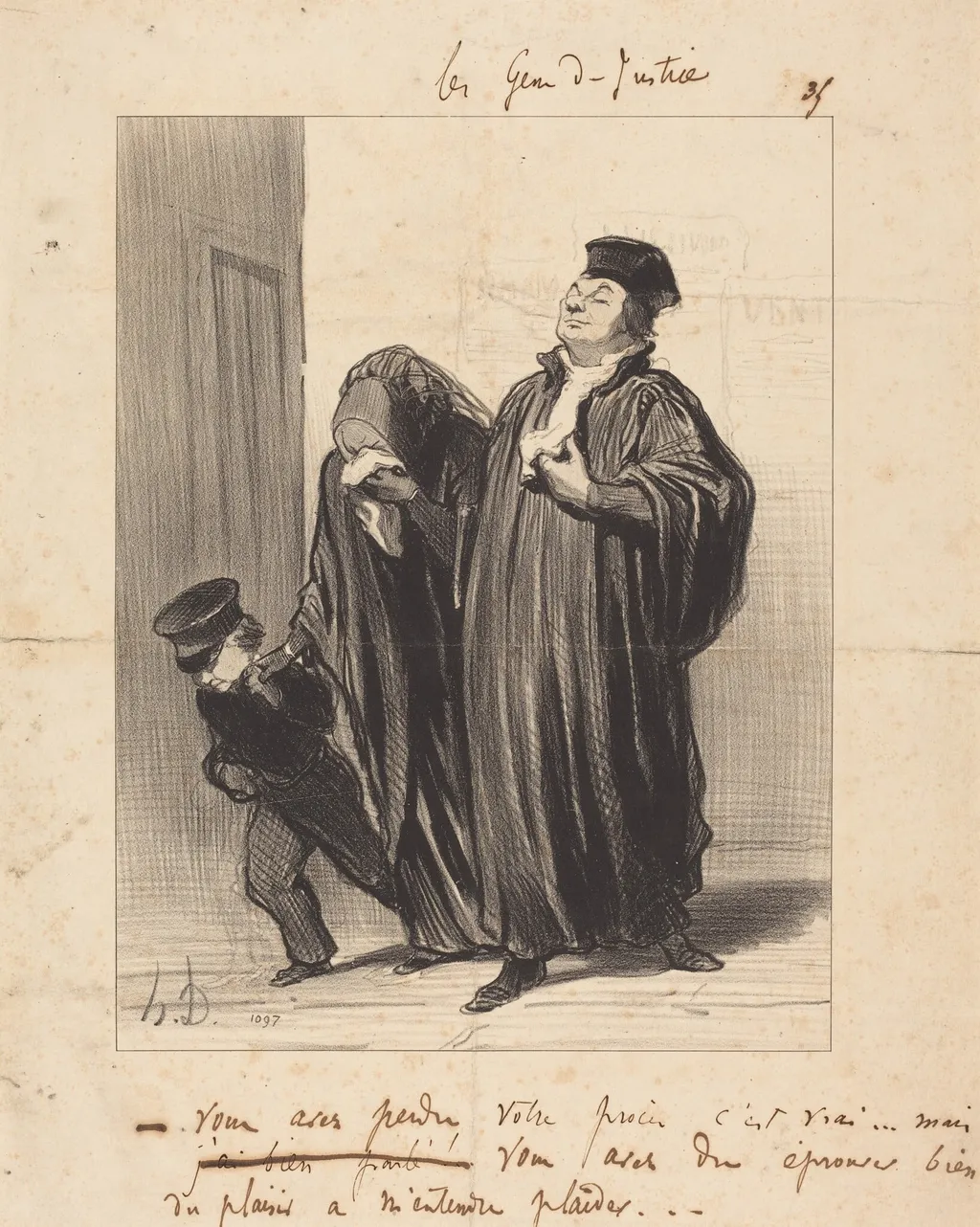
Vous avez perdu votre procès c'est vrai... is an ink print by the Romanticist artist Honoré Daumier. It dates from 1848 and is held in the collection of the National Gallery of Art.
About this work
Overview
The medium of lithography allowed for swift reproduction, making such images widely accessible in periodicals.
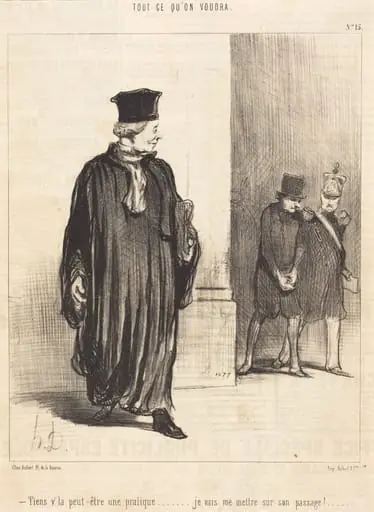
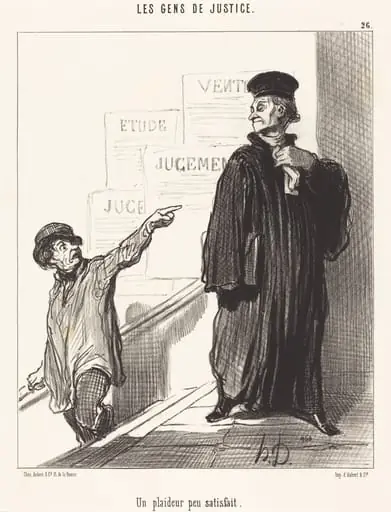
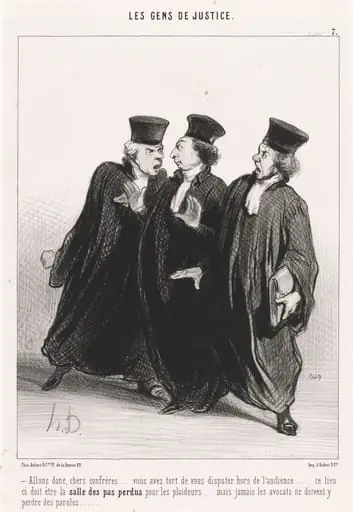
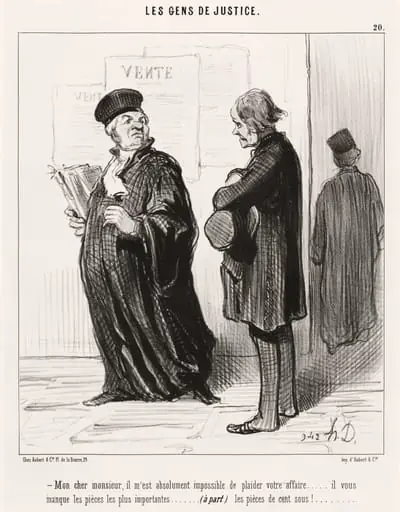
Created in 1848, this lithograph by Honoré Daumier captures a moment in a French courtroom, rendered with rapid, expressive lines typical of his journalistic style. As part of a broader series of social critiques, the work emerged during a turbulent political era, reflecting Daumier’s consistent engagement with institutional power through visual satire. The medium of lithography allowed for swift reproduction, making such images widely accessible in periodicals.
Subject & Meaning
The scene portrays a judge, flanked by a subordinate and a woman, as a client is informed of a lost case. The title, spoken in a detached tone, underscores the inevitability of judicial outcomes. Daumier implies systemic indifference: the judge’s rigid posture, the subordinate’s servile presence, and the woman’s anxious reach suggest a process where justice is performative rather than equitable, targeting public disillusionment with the legal system.
Technique & Style
Daumier employed lithography to achieve a spontaneous, sketch-like quality, using fluid, incised lines to define form without detail. The figures are compressed into a tight space, enhancing the sense of claustrophobia and bureaucratic absurdity. His economy of line conveys movement and emotion—particularly in the woman’s outstretched hand—while avoiding ornamental excess, aligning with the immediacy of political commentary in illustrated press.
History & Provenance
The print was likely published in *Le Charivari*, where Daumier regularly contributed satirical lithographs between 1830 and 1870. Though exact publication records are sparse, its date aligns with his most active period of political critique, following the 1848 Revolution. The work survived through private collections and institutional archives, valued for its historical witness rather than aesthetic novelty.
Context
Produced during France’s Second Republic, the print responds to widespread skepticism toward judicial reforms that failed to curb elite influence. Daumier’s imagery mirrored public frustration with institutions that appeared unchanged despite regime shifts. His work functioned as visual journalism, offering accessible critique to a broad audience through widely circulated prints, bypassing the constraints of formal art institutions.
Legacy
Daumier’s courtroom scenes, including this one, influenced later generations of social realists and political cartoonists. His use of everyday settings to expose institutional hypocrisy became a model for visual dissent. Though not widely exhibited in his lifetime, his lithographs gained scholarly recognition in the 20th century as pivotal documents of 19th-century French civic life and the power of print media.
Artist & collection
Artist
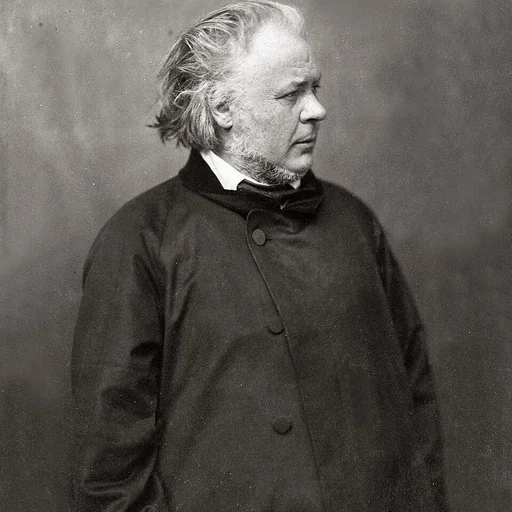
Honoré-Victorin Daumier was a French painter, sculptor, and printmaker, whose many works offer commentary on the social and political life in France, from the Revolution of 1830 to the fall of the Second French Empire in 1870.