Artwork
Christ's Entry into Jerusalem
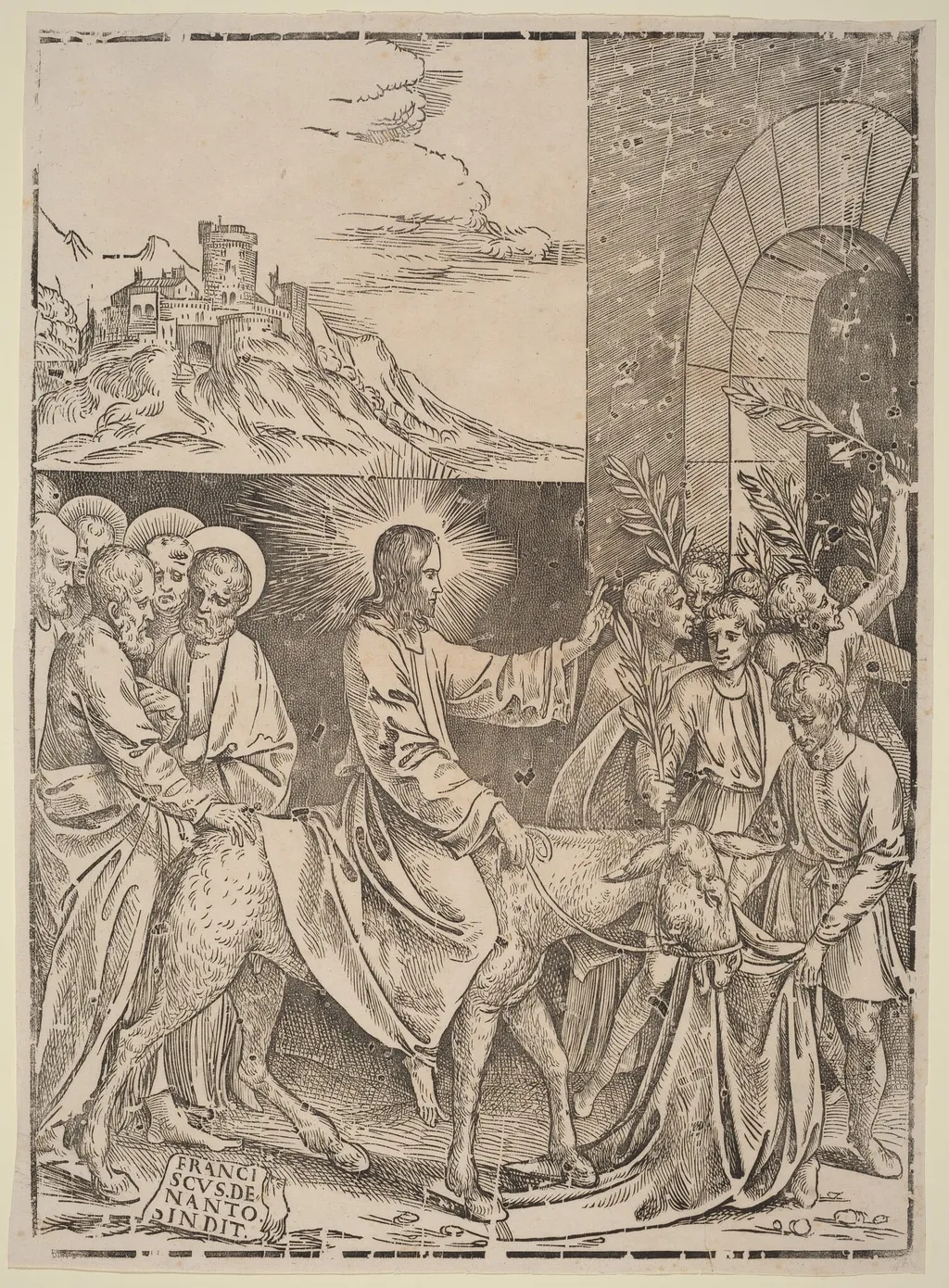
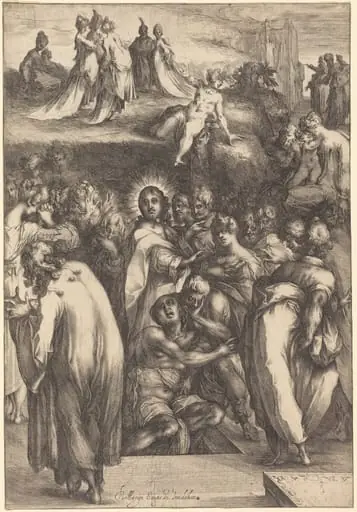
Christ's Entry into Jerusalem is an ink print by the Renaissance artist Francesco Denanto. It dates from 1522 and is held in the collection of the National Gallery of Art.
About this work
Overview
The print’s clarity and rhythmic patterning reflect the conventions of early 16th-century Northern European relief printing.
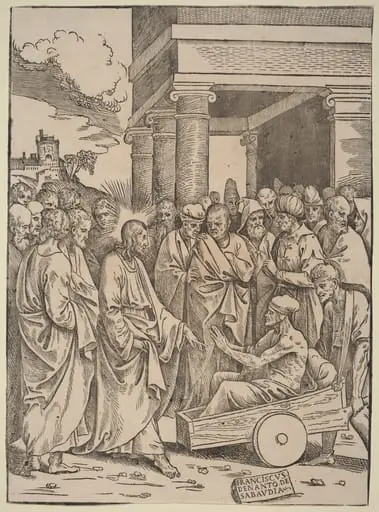
Created in 1522, this woodcut by Francesco Denanto depicts the biblical moment of Christ’s arrival in Jerusalem. Rendered in black ink on paper, the image relies on bold, incised lines to define figures and architecture. The composition centers on a haloed Christ, surrounded by a crowd, with a walled town and a cross visible in the distance. The print’s clarity and rhythmic patterning reflect the conventions of early 16th-century Northern European relief printing.
Subject & Meaning
The scene illustrates the Gospel account of Christ’s triumphal entry, where followers lay palm branches before him. Figures kneel or raise their hands in reverence, while others hold leafy sprigs, signaling celebration. The halo identifies Christ as divine, and the distant cross foreshadows his crucifixion. The inclusion of a fortified town suggests Jerusalem’s earthly and spiritual significance, anchoring the event in a recognizable landscape.
Technique & Style
Denanto employed the woodcut method, carving lines into a wooden block to create a relief surface inked and pressed onto paper. Sharp contours and simplified forms dominate, minimizing detail in favor of legibility and visual rhythm. The contrast between dark lines and the white paper enhances the dramatic lighting, with rays descending from above to illuminate the central figure, reinforcing his sacred role.
History & Provenance
The print was made in Venice during a period of active religious print production. Denanto, active in the early 1520s, worked alongside other artists producing devotional imagery for a growing lay audience. While specific early ownership records are sparse, similar woodcuts from this era circulated widely in Italy and beyond, often used for private devotion or educational purposes in religious communities.
Context
In the early 1520s, the Protestant Reformation was reshaping religious expression, yet Catholic regions like Venice continued to commission devotional prints. Woodcuts offered an affordable, reproducible medium for biblical narratives, bridging literate and illiterate audiences. Denanto’s work aligns with a broader trend of using clear, linear compositions to convey sacred stories with immediacy and emotional weight.
Legacy
Denanto’s woodcut exemplifies the role of printmaking in disseminating religious imagery before the rise of mass media. Though not widely attributed to him today, his technique influenced regional printmakers who prioritized narrative clarity over ornamental detail. The work remains a quiet testament to how simple, carved lines could convey complex theological narratives to a broad public.
Artist & collection