Artwork
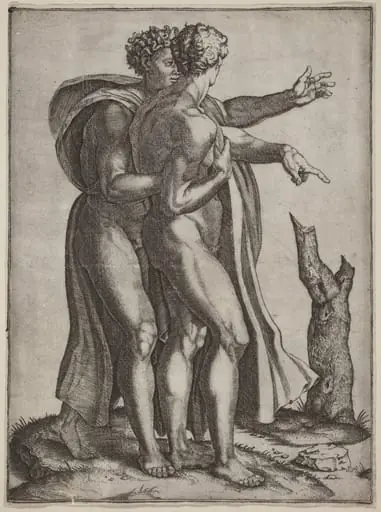
A Young and an Old Bacchant
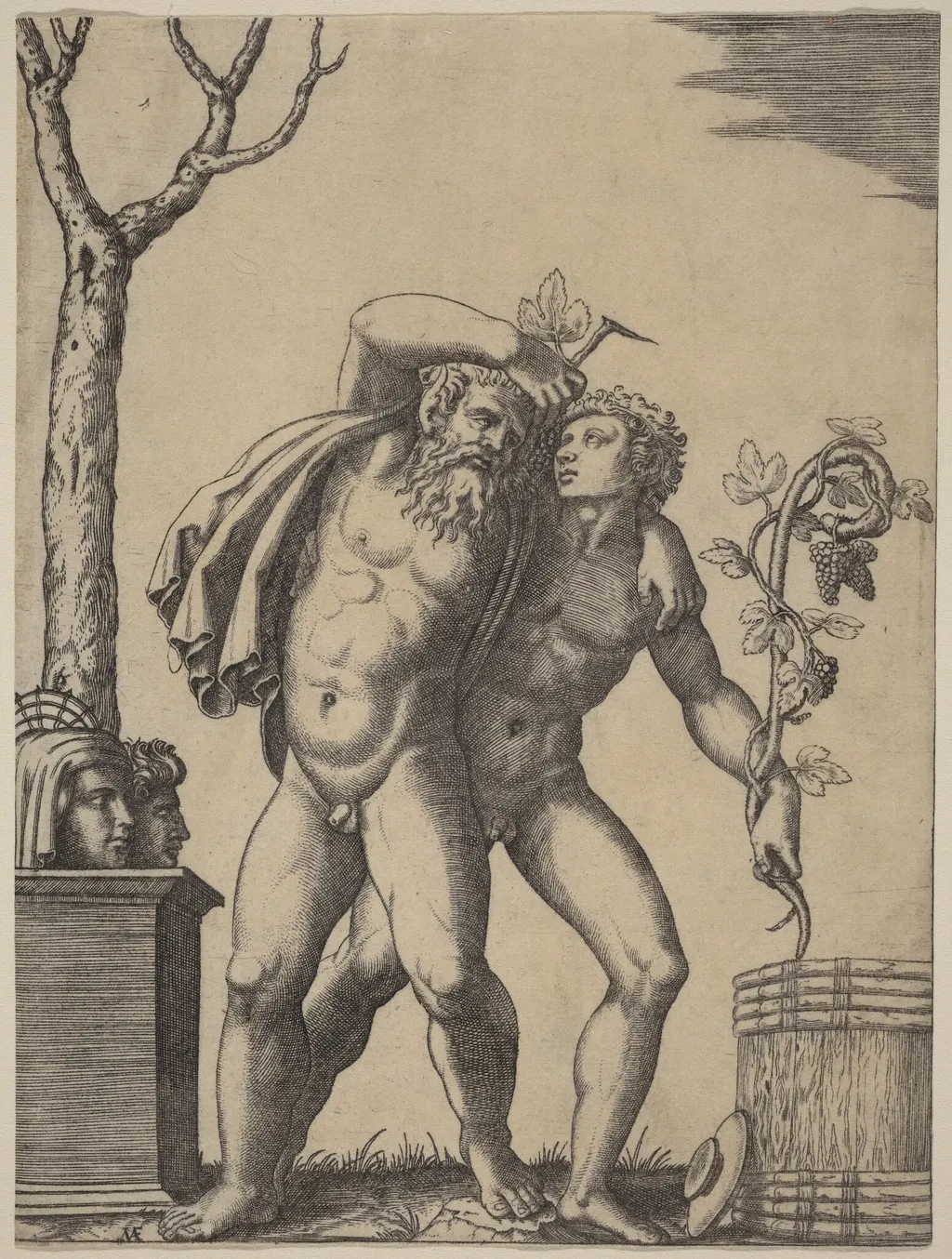
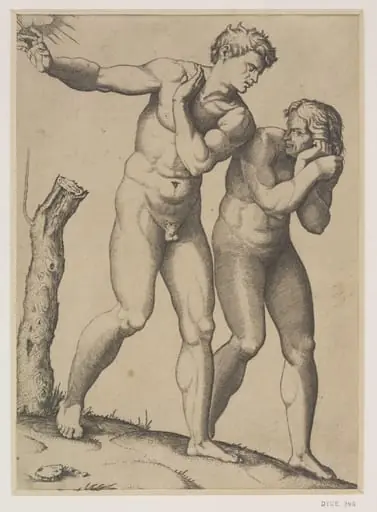
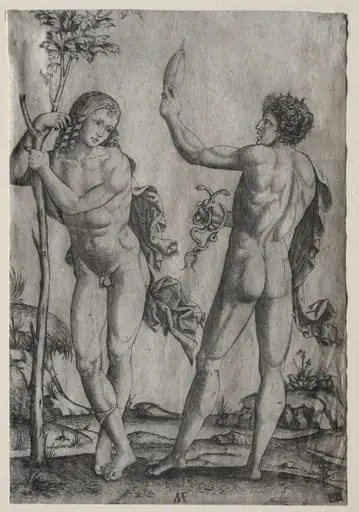
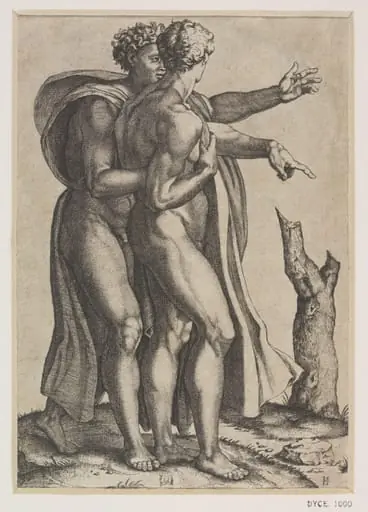
A Young and an Old Bacchant is an ink print by the Renaissance artist Marcantonio Raimondi. It dates from 1525 and is held in the collection of the National Gallery of Art.
About this work
Overview
Created around 1525 by Marcantonio Raimondi, this engraving on laid paper captures two figures engaged in a bacchic ritual.
Created around 1525 by Marcantonio Raimondi, this engraving on laid paper captures two figures engaged in a bacchic ritual. Raimondi, an Italian printmaker known for translating painted compositions into detailed intaglio prints, produced this work during a period when reproductive engraving was becoming a key medium for disseminating Renaissance imagery. The scene draws from classical mythology, rendered with precision through fine linear technique.
Subject & Meaning
The two figures—a youthful bacchant and an aged companion—represent contrasting stages of life within the cult of Dionysus. The older man, bearded and weathered, leans into the younger, whose smooth face suggests vitality. Their leafy wreaths and the vine-wrapped barrel evoke ritual celebration, while the grape clusters and foliage reinforce associations with wine, ecstasy, and the cyclical nature of seasonal rites. The pairing may allude to wisdom passed through generations in sacred revelry.
Technique & Style
Raimondi employed fine, controlled lines to model form and texture, particularly in the aged man’s wrinkled skin and coarse beard. The grapevine curls dynamically around the figures, its tendrils rendered with delicate, flowing strokes. Shadows are built through hatching and cross-hatching, not tone, characteristic of early 16th-century engraving. The composition is tightly framed, focusing attention on the figures’ interaction against a sparse, suggestive background of barrel and stump.
History & Provenance
Raimondi produced this print during his mature period, following his collaboration with Raphael in Rome. While no specific early ownership records are documented, the work aligns with his broader output of mythological engravings circulated across Europe. As a reproductive printmaker, Raimondi’s works were widely copied and collected, helping to standardize visual motifs of the High Renaissance beyond original paintings.
Context
In early 16th-century Italy, classical themes were revived through humanist scholarship and artistic patronage. Bacchic imagery, drawn from ancient texts and sculpture, became a favored subject for artists exploring the body, emotion, and ritual. Raimondi’s prints responded to this trend, translating complex compositions into accessible formats for collectors and artists, thereby anchoring classical iconography in the visual culture of the time.
Legacy
This engraving exemplifies Raimondi’s role in codifying Renaissance visual language through print. His precise line work and compositional clarity influenced generations of engravers across Europe. Though not widely exhibited today, the work remains a reference point in the history of printmaking, illustrating how reproductive techniques helped bridge elite painting and broader public engagement with classical themes.
Artist & collection

Artist
Marcantonio Raimondi, often called simply Marcantonio (c. 1470/82 – c. 1534), was an Italian engraver, known for being the first important printmaker whose body of work consists largely of prints copying paintings. He…