Artwork
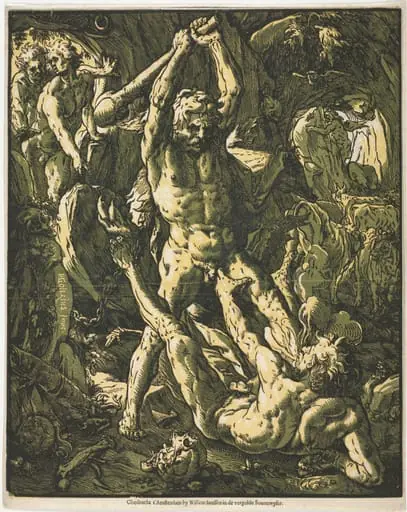
Hercules Killing Cacus
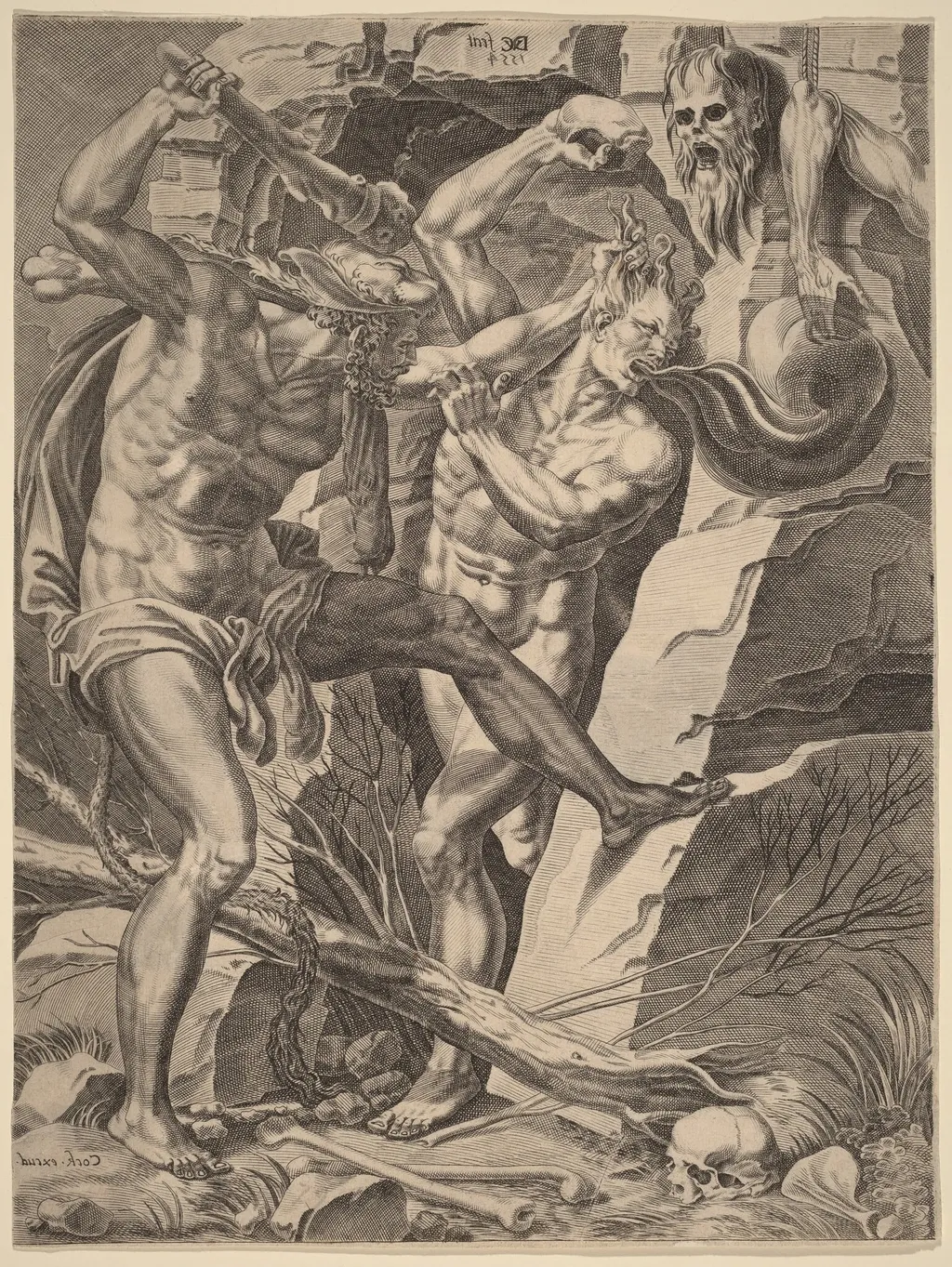
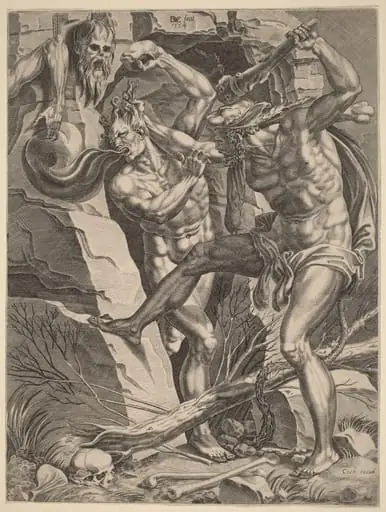
Hercules Killing Cacus is an ink print by the Renaissance artist Dirck Volckertz Coornhert. It dates from 1554 and is held in the collection of the National Gallery of Art.
About this work
Overview
This print is a counterproof—made by pressing ink from the original plate onto another sheet—resulting in a reversed image with softer tonal contrasts.
An engraving on laid paper, created in 1554 by Dirck Volckertz Coornhert, depicts a moment from Roman myth in which Hercules confronts the fire-breathing giant Cacus. This print is a counterproof—made by pressing ink from the original plate onto another sheet—resulting in a reversed image with softer tonal contrasts. Its composition centers on violent motion, rendered through dense line work and dramatic chiaroscuro.
Subject & Meaning
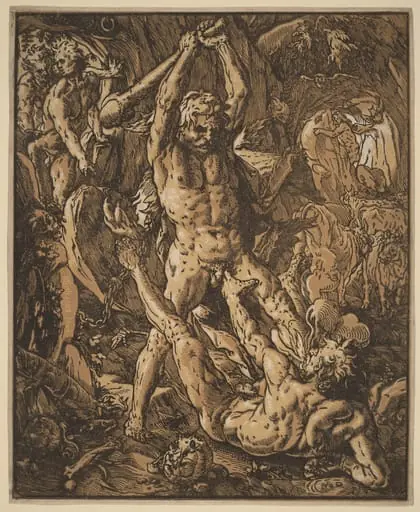
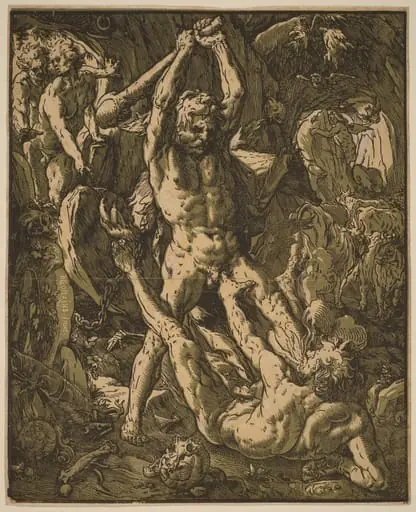
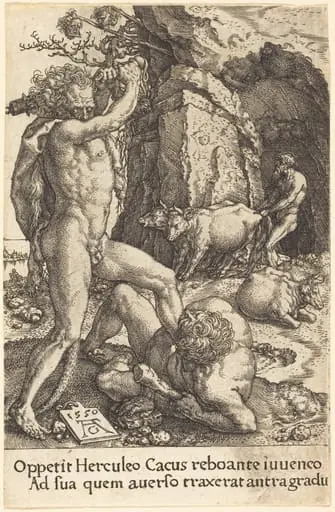
The scene illustrates Hercules’ defeat of Cacus, a thief who stole his cattle and hid them in a cave. Hercules, armed with a club and torch, forces the monster from his hiding place. Cacus, clutching a skull, writhes in agony as the flames consume him. The narrative underscores themes of justice and divine retribution, common in Renaissance moral allegories drawn from classical sources.
Technique & Style
Coornhert employs fine, incised lines to model muscular forms and textured surfaces, with heavy cross-hatching defining shadows and depth. The background recedes into a stormy sky through sparse, angular rock formations. The counterproof’s muted contrast enhances the rawness of the scene, emphasizing tactile immediacy over polished finish, characteristic of Northern Renaissance printmaking practices.
History & Provenance
Created in 1554 during Coornhert’s active years in Haarlem, the print likely circulated among humanist collectors interested in classical revival. As a counterproof, it was probably made for personal study or as a working impression, not for commercial sale. No definitive early ownership records survive, but its survival suggests it was valued within artistic or scholarly circles of the period.
Context
Coornhert was a Dutch humanist and printmaker who engaged with classical literature and visual culture. His work emerged alongside the spread of print technology in the Low Countries, where mythological subjects were popular among educated patrons. This print reflects a broader trend of translating literary narratives into visual form, often with moral or civic undertones.
Legacy
Though not widely reproduced or celebrated in later centuries, the engraving remains a rare example of Coornhert’s graphic work. It contributes to understanding how Northern artists interpreted classical myths through intimate, emotionally charged compositions. Its preservation offers insight into the material practices of 16th-century printmaking beyond major artistic centers.
Artist & collection