Artwork
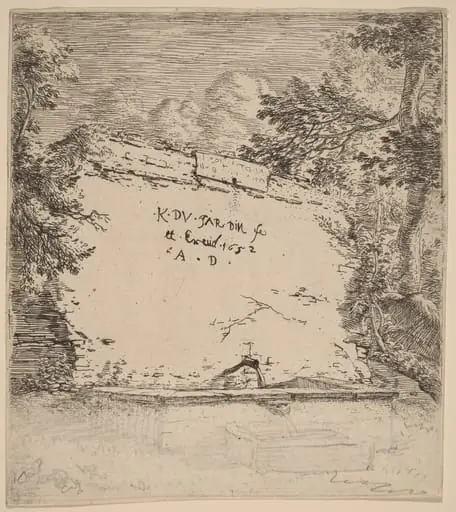
Title Page with Fountain
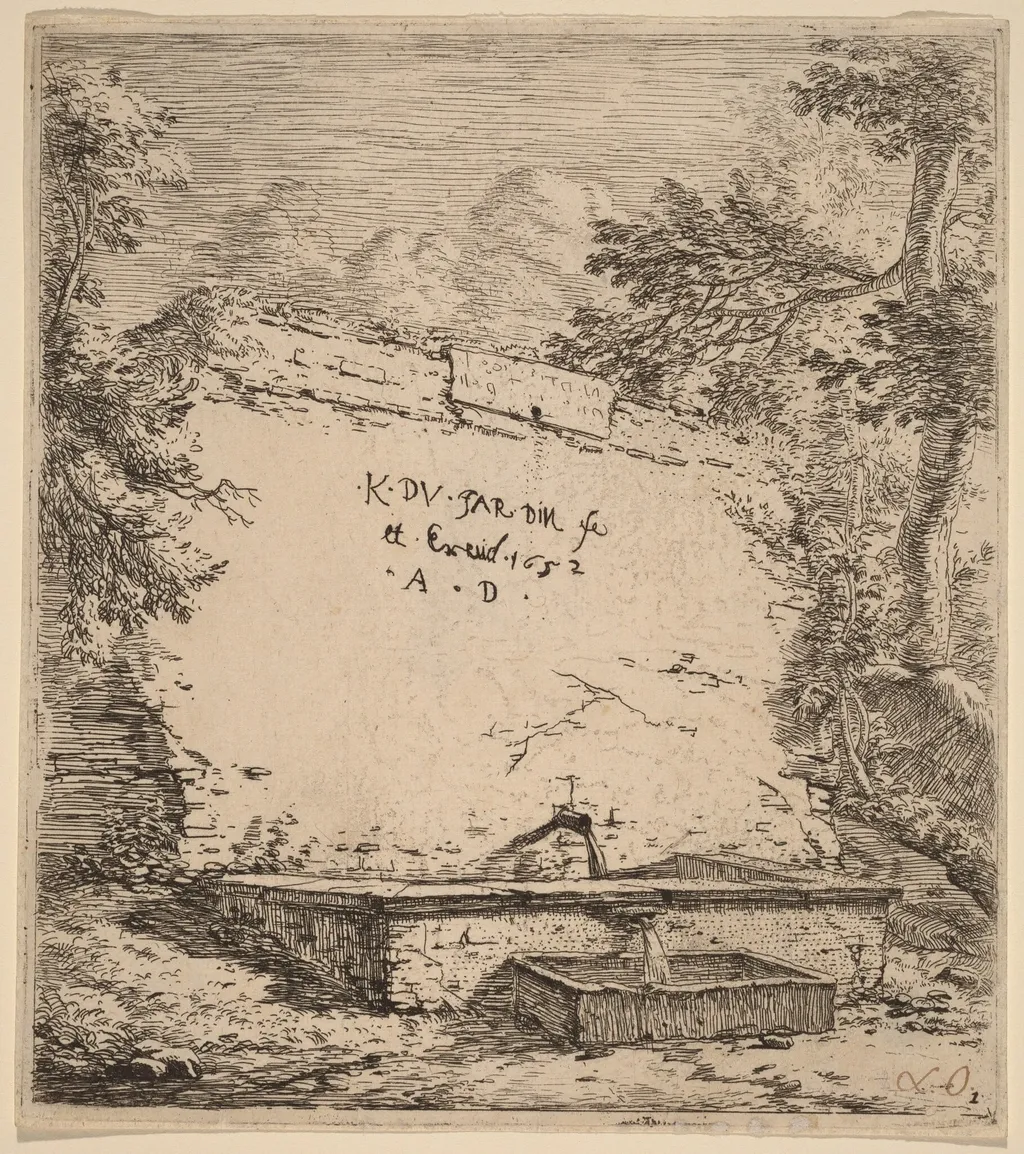
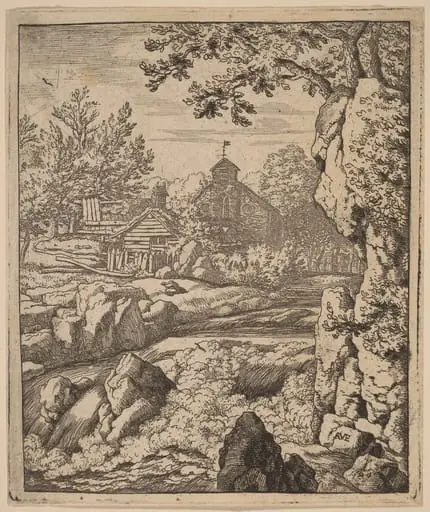
Title Page with Fountain is an ink print by the Baroque artist Karel Dujardin. It dates from 1652 and is held in the collection of the National Gallery of Art.
About this work
Overview
The composition is subdued, with soft contrasts and a sense of atmospheric distance, suggesting a contemplative rather than dramatic intent.
Created in 1652, this etching by Karel Dujardin serves as a title page, likely for a published work. Rendered on laid paper, the print captures a tranquil outdoor scene centered on a fountain. The composition is subdued, with soft contrasts and a sense of atmospheric distance, suggesting a contemplative rather than dramatic intent. The medium’s fine lines and subtle tonal shifts reflect the artist’s precision in etching.
Subject & Meaning
The scene depicts a quiet park with a central fountain, flanked by trees whose branches are rendered in loose, overlapping strokes. A distant structure with classical columns hints at architectural order, contrasting with the organic forms around it. The scattered leaves and uneven ground suggest a natural, unmanicured space. The hazy atmosphere and lack of figures evoke solitude, possibly symbolizing reflection or the passage of time.
Technique & Style
Dujardin employed etching, a process involving acid-bitten lines on a metal plate, to achieve delicate detail and tonal variation. The paper’s textured surface enhances the print’s tactile quality, typical of 17th-century European prints. The brush-like handling of tree foliage and the soft gradations in the background reveal a sketch-like spontaneity, balancing technical control with expressive looseness.
History & Provenance
The print dates to 1652, during Dujardin’s early career in the Dutch Republic. While its original publication context remains unclear, such title pages were often used in illustrated books or collections. The work’s survival in private and institutional collections suggests it was valued for its quiet aesthetic rather than its narrative function, though no definitive early ownership records are widely documented.
Context
In mid-17th-century Holland, landscape etchings flourished as artists turned from grand historical themes to intimate, everyday scenes. Dujardin, influenced by Italianate views and Dutch realism, contributed to this trend. His use of atmospheric perspective and naturalistic detail aligns with contemporaries like Rembrandt and Jan van Goyen, reflecting a broader cultural interest in quiet, observed nature.
Legacy
Though not among Dujardin’s most widely reproduced works, this etching exemplifies his skill in conveying mood through minimal means. It contributes to the understanding of how Dutch printmakers elevated the title page from mere decoration to a nuanced visual statement. Its restrained composition continues to inform studies of early modern print culture and the evolution of landscape as an independent subject.
Artist & collection