Artwork
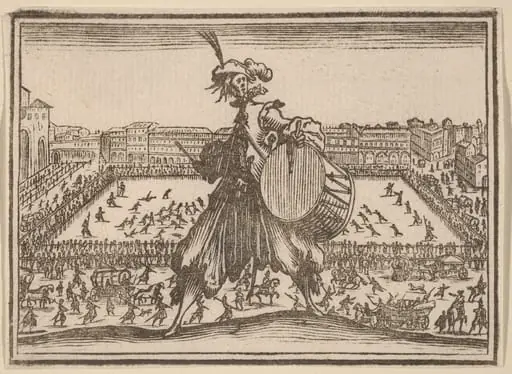
Piazza Presso alla Porta al Prato
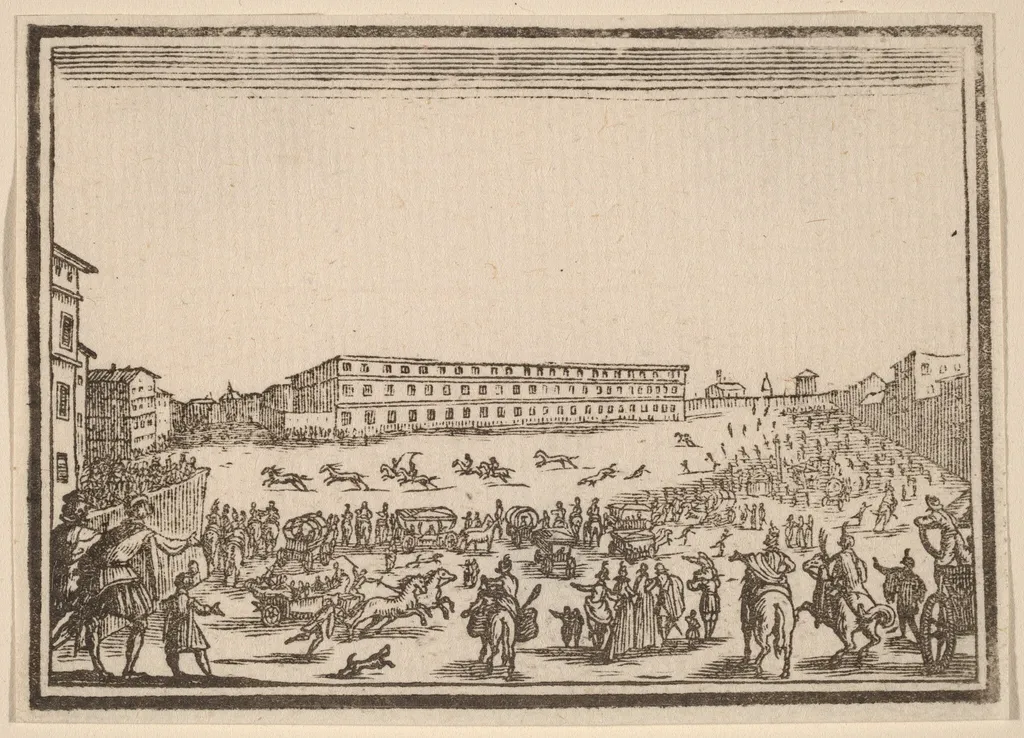
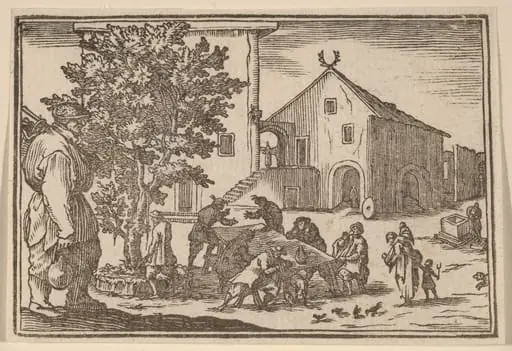
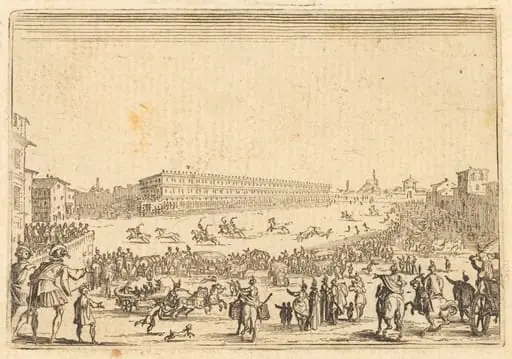
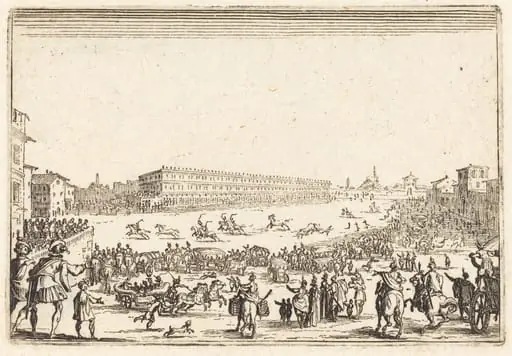
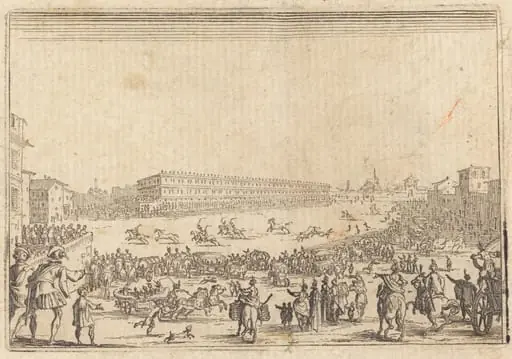
Piazza Presso alla Porta al Prato is an ink print by the Baroque artist Edouard Eckman. It dates from 1621 and is held in the collection of the National Gallery of Art.
About this work
Overview
This technique allowed for multiple impressions and was widely used for disseminating images before the advent of photographic reproduction.
Piazza Presso alla Porta al Prato is a black-and-white woodcut printed in 1621 by Edouard Eckman. The work captures a bustling urban square in Italy, rendered through the traditional method of carving an image into a wooden block, inking it, and pressing paper onto the surface. This technique allowed for multiple impressions and was widely used for disseminating images before the advent of photographic reproduction.
Subject & Meaning
The scene depicts a crowded public square near a city gate, teeming with pedestrians, animals, and architectural elements. Horses and dogs move freely amid the crowd, while figures gather along the periphery, suggesting daily life in a bustling urban center. The composition conveys movement and disorder, possibly reflecting the chaotic energy of a market day or public gathering in early 17th-century Italy.
Technique & Style
Eckman employed the woodcut method, carving lines and shapes into a wooden block to create a relief surface. Ink was applied to the raised areas, then transferred to laid paper under pressure. The resulting image relies on bold contrasts and simplified forms, typical of the medium. Fine details are minimized, emphasizing mass and motion over individual expression, characteristic of early modern printmaking.
History & Provenance
Created in 1621, the print is one of the few known works by Edouard Eckman, whose career remains poorly documented. It likely circulated as a topographical record or decorative print in northern Italian cities. No definitive early ownership records exist, but its survival suggests it was preserved in private or institutional collections interested in urban scenes of the period.
Context
In the early 1600s, woodcuts were commonly used to document cityscapes, religious events, and public spectacles across Europe. This print aligns with a broader trend of visualizing urban life in print form, particularly in regions like Tuscany where civic identity was visually expressed through architecture and public space. Eckman’s work reflects the growing interest in recording everyday environments outside of religious or aristocratic themes.
Legacy
Though Eckman’s oeuvre is limited, this print contributes to the historical record of Italian urban life in the early Baroque era. It stands as an example of how printmakers captured transient moments of public activity before photography. Its preservation offers insight into the visual culture of the time, influencing later topographical studies and the documentation of civic spaces in print.
Artist & collection