Artwork
The Sheep of His Pasture
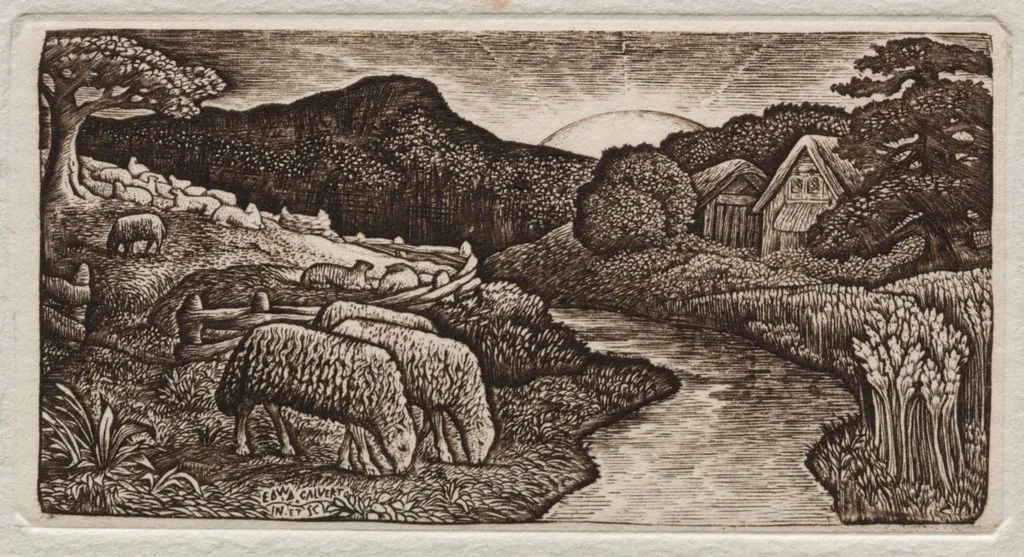
The Sheep of His Pasture is a print by the Romanticist artist Edward Calvert. It dates from 1828 and is held in the collection of the Cleveland Museum of Art.
About this work
Overview
Calvert refined the technique to achieve extraordinary precision, transforming the print into a miniature world of quiet harmony.
The Sheep of His Pasture is a wood engraving by Edward Calvert, created in the early 19th century. It draws inspiration from an illustration in a 1797 edition of Virgil’s Pastorals, itself influenced by William Blake’s style. Calvert refined the technique to achieve extraordinary precision, transforming the print into a miniature world of quiet harmony. The work reflects his fascination with idealized rural life and spiritual symbolism.
Subject & Meaning
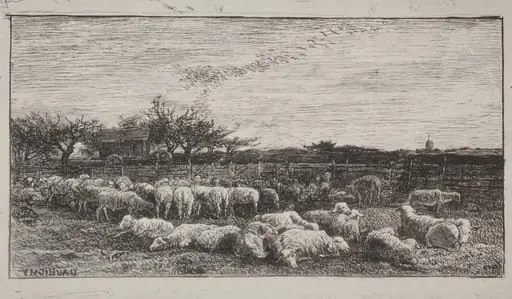
The scene depicts a tranquil pastoral setting with sheep and figures of women, evoking a lost golden age. The imagery blends Christian ideals of innocence with classical notions of harmony and abundance. The women, resembling figures from ancient gems, suggest timeless virtue, while the tree stumps hint at mortality and the impermanence of earthly peace. The composition invites contemplation rather than narrative.
Technique & Style
Calvert employed wood engraving with exceptional finesse, pushing the medium’s capacity for minute detail beyond even Blake’s achievements. His use of fine, controlled lines creates texture in wool, foliage, and skin with remarkable subtlety. The small scale enhances the intimacy of the scene, and the high contrast between ink and paper amplifies the ethereal quality of the forms, giving the print a luminous stillness.
History & Provenance
Created around 1825–1830, the print emerged from Calvert’s circle of Romantic artists and mystics, including Blake and Samuel Palmer. It was not widely distributed during his lifetime, and surviving impressions are rare. The work remained largely within private collections until the late 19th century, when interest in British printmaking revived. Its origins in Virgilian illustration anchor it to a literary tradition of pastoral idealism.
Context
Calvert worked during a period of industrial expansion, when many artists turned to rural themes as a counterpoint to urban change. His vision of pastoral life was not merely nostalgic but spiritual, rooted in esoteric readings of scripture and antiquity. Unlike contemporaries who romanticized labor, Calvert depicted an unspoiled, almost otherworldly harmony, aligning his work with mystical and symbolic traditions rather than realism.
Legacy
Though little known in his time, Calvert’s prints influenced later generations of British printmakers drawn to symbolic and intimate imagery. The Sheep of His Pasture stands as a testament to the expressive potential of wood engraving when used for poetic, rather than illustrative, ends. Today, it is studied for its fusion of classical form, spiritual symbolism, and technical mastery within a distinctly British Romantic context.
Artist & collection