Artwork
London Bridge
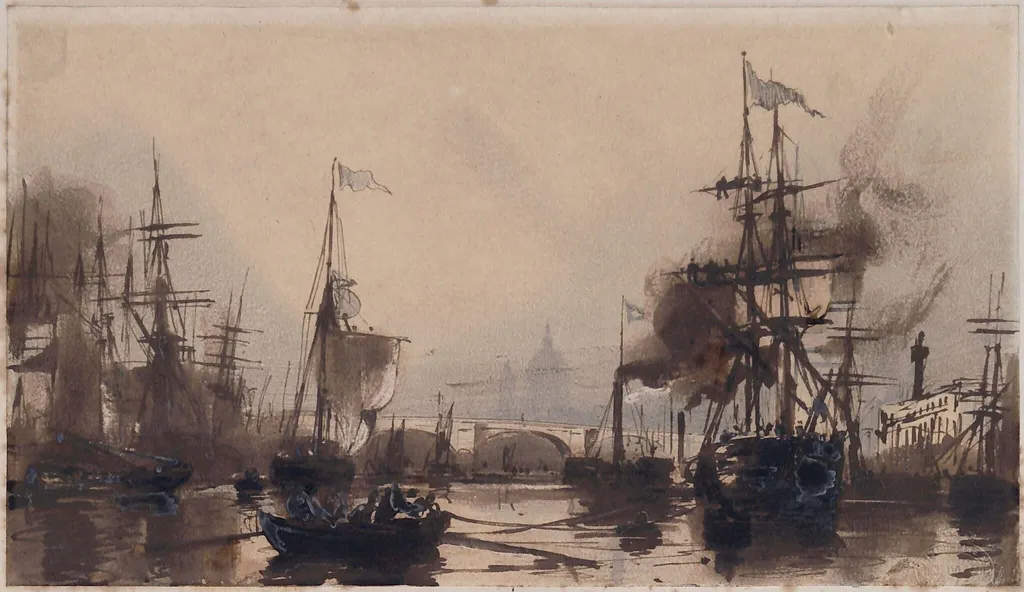
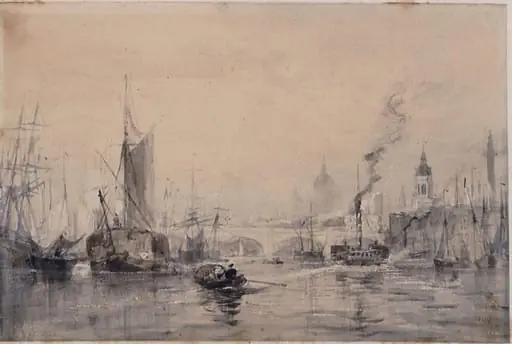
London Bridge is a drawing by Edward William Cooke. It dates from 1850 and is held in the collection of the Victoria and Albert Museum.
About this work
Overview
Created around 1850, this detailed drawing by Edward Cooke depicts London Bridge as it appeared in the mid-nineteenth century.
Created around 1850, this detailed drawing by Edward Cooke depicts London Bridge as it appeared in the mid-nineteenth century. Executed in pencil or ink, the work is part of the Victoria and Albert Museum’s collection. It captures the bridge’s architectural form with precision, reflecting the artist’s interest in topographical accuracy and urban infrastructure during a period of rapid change in London.
Subject & Meaning
The drawing centers on London Bridge, flanked by rows of buildings that line the riverbanks. Small sailing vessels navigate the Thames beneath, suggesting the bridge’s role as both a transit point and a backdrop to commercial river activity. The composition emphasizes stability and order, aligning with Victorian ideals of progress and civic function, rather than romanticizing the scene.
Technique & Style
Cooke employed fine, controlled lines to render the bridge’s stonework, arches, and railings with clarity. Buildings are rendered with measured perspective, and sails on the boats are suggested with minimal yet deliberate strokes. The absence of tone or washes highlights the drawing’s reliance on line and structure, characteristic of topographical draftsmanship of the era.
History & Provenance
The drawing entered the Victoria and Albert Museum’s collection as part of its broader effort to document British design and engineering. While little is known of its immediate provenance, its preservation suggests it was valued for its documentary quality rather than as a fine art piece. It likely served as a reference or study for other works or publications of the time.
Context
In the 1840s and 1850s, London Bridge was undergoing structural scrutiny as newer bridges were planned. Cooke’s drawing captures the bridge before major alterations, preserving its pre-Victorian appearance. Such works were often produced by surveyors or amateur artists documenting the city’s evolving landscape amid industrialization and urban expansion.
Legacy
Though Edward Cooke was not a widely known artist, this drawing contributes to a body of visual records that help historians understand London’s infrastructure before modernization. Its presence in a major museum underscores the value placed on precise, observational drawings as historical evidence, rather than solely as aesthetic objects.
Artist & collection