Artwork
New York Movie
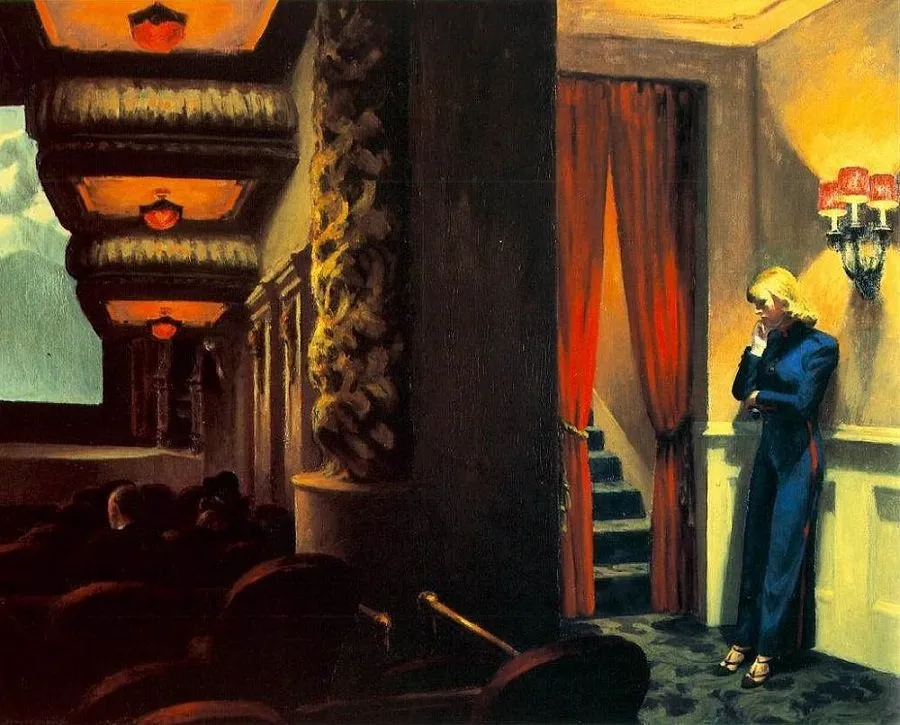
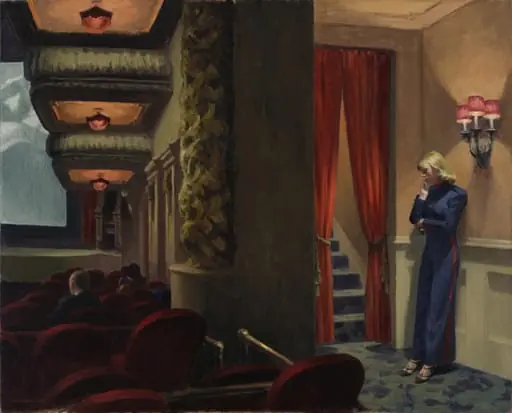
New York Movie is an oil painting by the Realist artist Edward Hopper. It dates from 1939 and is held in the collection of the Museum of Modern Art.
About this work
Overview
Hopper’s careful arrangement of light and shadow defines the spatial depth and emotional tone, transforming an ordinary setting into a meditation on solitude.
Painted in early 1939, New York Movie is an oil-on-canvas work by Edward Hopper that captures a quiet moment in a nearly vacant cinema. The scene centers on a solitary usherette, her posture and gesture suggesting introspection amid the stillness of the theater. Hopper’s careful arrangement of light and shadow defines the spatial depth and emotional tone, transforming an ordinary setting into a meditation on solitude.
Subject & Meaning
The painting portrays a woman in a dark blue coat, standing alone in the aisle, holding a white handkerchief near her face. She is the sole human presence actively engaged, while the rows of empty seats and dimmed screen imply the end of a screening. Her stillness contrasts with the implied movement of the film just passed, evoking a sense of displacement and quiet melancholy after the spectacle ends.
Technique & Style
Hopper employs chiaroscuro to isolate the usherette against the theater’s deep shadows, using warm ambient light from the back wall and a single wall sconce to define form and space. The red curtain and muted tones ground the composition, while the contrast between illuminated surfaces and surrounding darkness enhances the painting’s stillness. Brushwork is restrained, emphasizing clarity over texture.
History & Provenance
Commissioned by the Museum of Modern Art in 1939, the painting was completed shortly after Hopper began work in December 1938. It entered MoMA’s collection the same year and has remained there since. Its acquisition reflected the institution’s interest in American realism during a period of growing cultural self-awareness in the late 1930s.
Context
Created during the Great Depression, the painting reflects a broader societal mood of isolation and quiet resilience. Movie theaters, once bustling social spaces, had become places of temporary escape and solitary contemplation. Hopper’s depiction aligns with his recurring themes of urban alienation, capturing the liminal space between public spectacle and private emotion.
Legacy
New York Movie is frequently cited as a defining example of Hopper’s ability to infuse mundane settings with psychological depth. Its influence extends to cinema and photography, where its lighting and compositional restraint have been studied as models for conveying mood through absence. The painting remains a touchstone in American realist art for its emotional precision.
Artist & collection
Artist
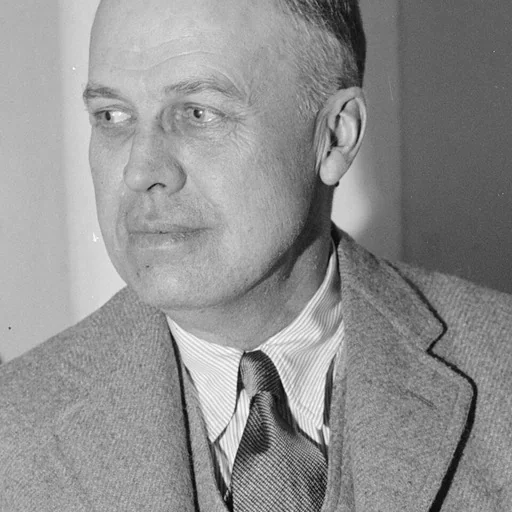
Edward Hopper (July 22, 1882 – May 15, 1967) was an American realist painter and printmaker.