Artwork
East Side Interior
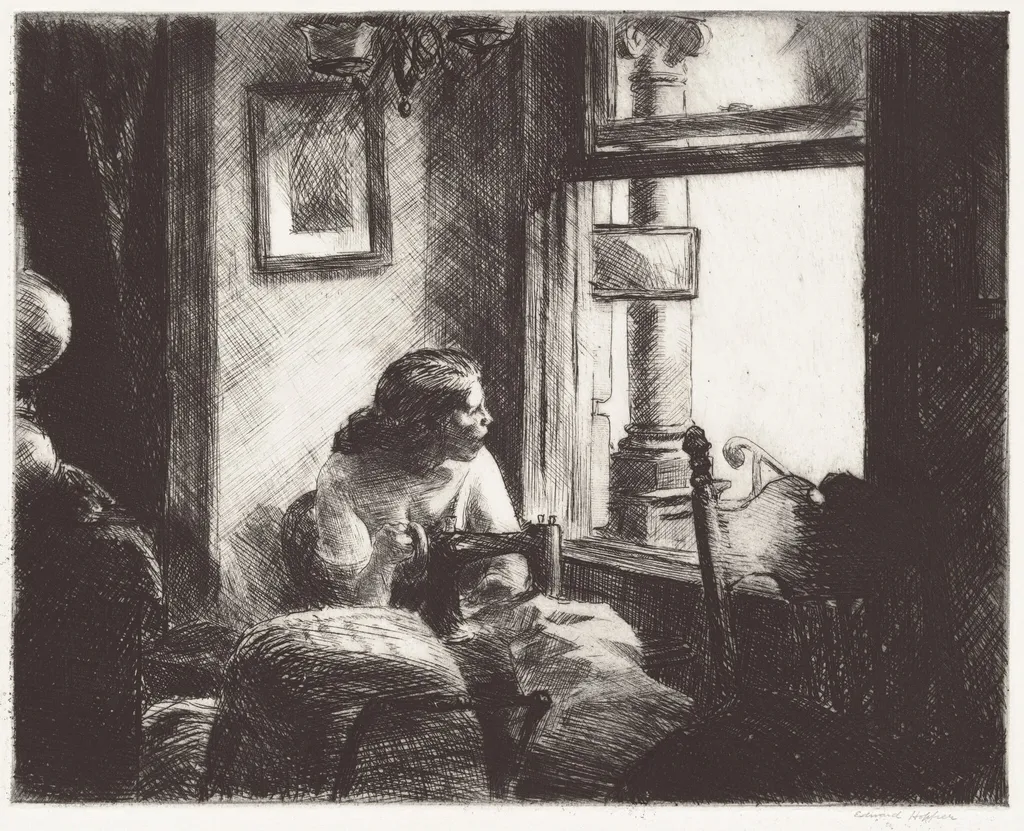
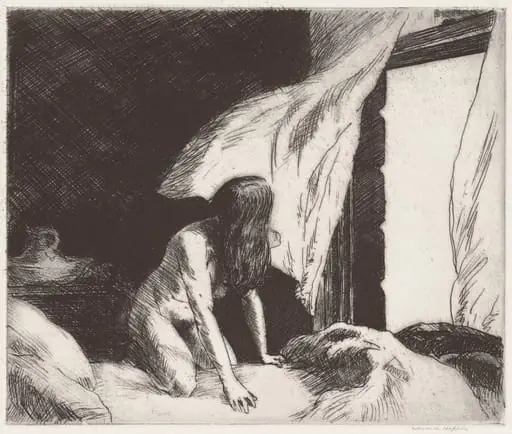
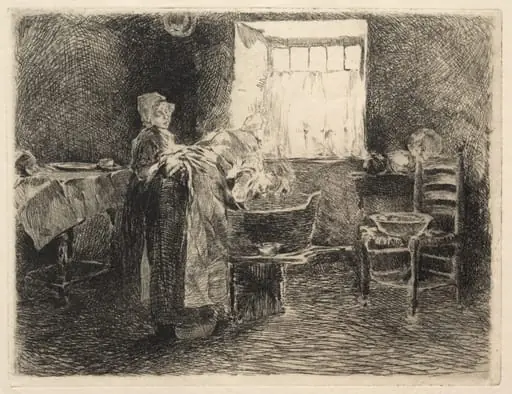
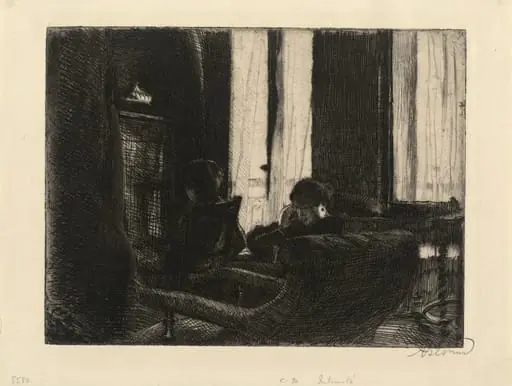
East Side Interior is an ink print by Edward Hopper. It dates from 1922 and is held in the collection of the National Gallery of Art.
About this work
Overview
Created in 1922, *East Side Interior* is an etching by American artist Edward Hopper, part of his early exploration of urban domestic spaces.
Created in 1922, *East Side Interior* is an etching by American artist Edward Hopper, part of his early exploration of urban domestic spaces. Executed in black ink on paper, the work reflects his interest in quiet, everyday interiors. Unlike his later oil paintings, this piece uses the precision of printmaking to isolate moments of stillness within city life, capturing the subtle interplay of light and solitude.
Subject & Meaning
The scene portrays a woman seated near a window, her back to the viewer, gazing outward. Her face is indistinct, emphasizing anonymity and internal reflection. The sparse furnishings—a chair, a table—suggest a modest, unadorned living space. The absence of narrative detail invites contemplation of isolation, the unseen thoughts of urban dwellers, and the emotional distance between individuals and their environments.
Technique & Style
Hopper employed bold, incised lines and controlled tonal shading to model form and depth. The etching’s high contrast between the dark interior and the window’s pale glow creates a dramatic chiaroscuro effect. The lack of fine detail in the figure’s features enhances the sense of detachment, while the sharp edges of furniture and architectural elements ground the composition in tangible space.
History & Provenance
This work emerged during Hopper’s formative years as a printmaker, following his training at the New York School of Art under Robert Henri and William Merritt Chase. He produced numerous etchings between 1915 and 1923, often depicting urban interiors and street scenes. *East Side Interior* was likely made in his New York studio, reflecting his direct observation of tenement life and the quiet rhythms of city dwellers.
Context
In the early 1920s, American artists increasingly turned to everyday urban experiences as subjects. Hopper’s etchings responded to this shift, focusing on the emotional undercurrents of modern life. *East Side Interior* aligns with broader cultural interests in psychological realism and the alienation of city living, even as it avoids overt social commentary, favoring quiet, personal moments.
Legacy
Though less known than his paintings, Hopper’s etchings laid the groundwork for his mature style. *East Side Interior* exemplifies his enduring themes: solitude, light, and the unspoken narratives of ordinary spaces. The work influenced later generations of realist artists and printmakers who sought to convey emotional resonance through restrained, precisely observed scenes.
Artist & collection

Artist
Edward Hopper (July 22, 1882 – May 15, 1967) was an American realist painter and printmaker.