Artwork
William Perkins, D.D.
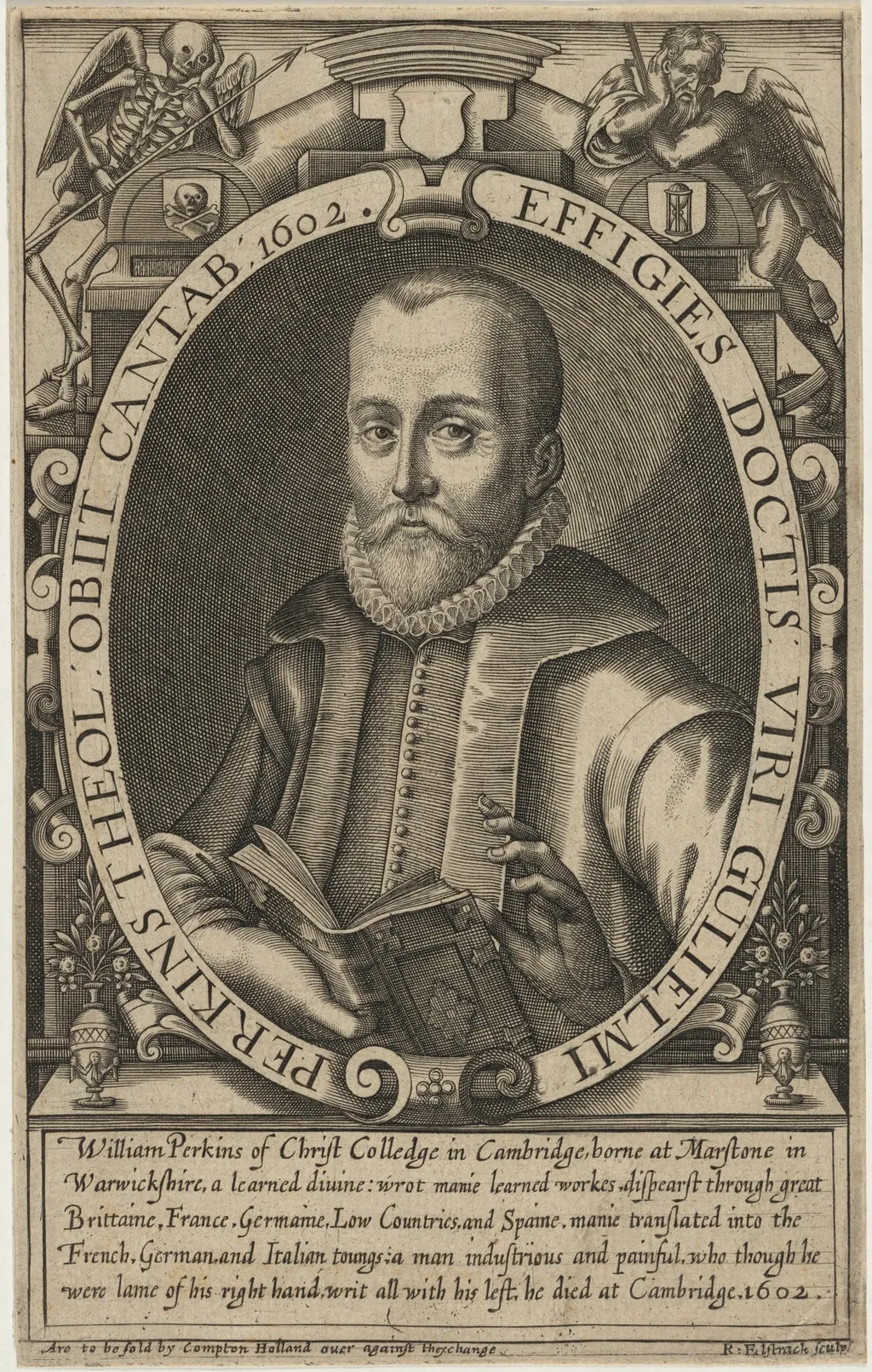
William Perkins, D.D. is an ink print by the Renaissance artist Renold Elstrack. It dates from 1598 and is held in the collection of the National Gallery of Art.
About this work
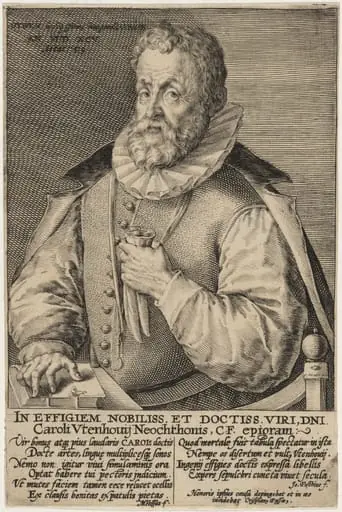
The words below say he was a scholar from Cambridge who wrote widely, even though he had a lame right hand.
This is a black-and-white portrait of a bearded man in a dark, ruffled collar. He’s holding a round object in his right hand, and his left hand rests on a book. Around his head is a decorative border with Latin words like *EFFIGIES DOCTIS VIRIS* and *OBIT 1602*.
The words below say he was a scholar from Cambridge who wrote widely, even though he had a lame right hand. His image is surrounded by small figures and symbols, like a skull and a lamp.
This is an example of engraving, a technique where artists etch lines into metal plates.
Overview
This 1598 engraving by Renold Elstrack depicts William Perkins, a prominent Cambridge theologian, in formal scholarly attire. Rendered in monochrome, the portrait emphasizes his intellectual stature through precise line work and symbolic elements. The composition includes a decorative border with Latin inscriptions and surrounding imagery that allude to his life, death, and intellectual legacy, typical of posthumous commemorative prints of the period.
Subject & Meaning
Perkins is portrayed as a learned divine, holding a book to signify his scholarly output and a round object, possibly a globe or orb, suggesting spiritual or cosmic authority. The skull and lamp at his side evoke mortality and divine illumination, common motifs in Protestant iconography. The inscription notes his physical impairment—lame right hand—yet underscores his prolific writing, framing intellect as transcending bodily limitation.
Technique & Style
Executed in intaglio engraving, the image relies on fine, incised lines on a metal plate to create tonal variation and detail. The texture of the ruffled collar, the beard, and the surrounding symbols are rendered with meticulous precision. The stylistic approach aligns with Northern European portraiture of the late 16th century, blending realism with allegorical elements to convey moral and intellectual character.
History & Provenance
Created shortly before Perkins’s death in 1602, the engraving likely served as a commemorative portrait for his followers and academic circle. It was produced by Renold Elstrack, a known English engraver who specialized in portraits of notable figures. The print circulated among Puritan and academic communities, reinforcing Perkins’s influence as a theological writer in early Jacobean England.
Context
In late 16th-century England, printed portraits of religious scholars were tools of ideological dissemination. Perkins, a leading Puritan voice at Cambridge, was widely read despite limited institutional power. This engraving reflects the growing role of print culture in shaping religious identity, using visual symbolism to elevate theological authority beyond the pulpit and into private study.
Legacy
The engraving preserved Perkins’s image for later generations, becoming a reference for subsequent depictions of Puritan divines. Its combination of biographical detail and symbolic content influenced how intellectual and religious figures were visually represented in Protestant England. Surviving copies in institutional collections attest to its enduring role in documenting early modern scholarly culture.
Artist & collection