Artwork
Dragon
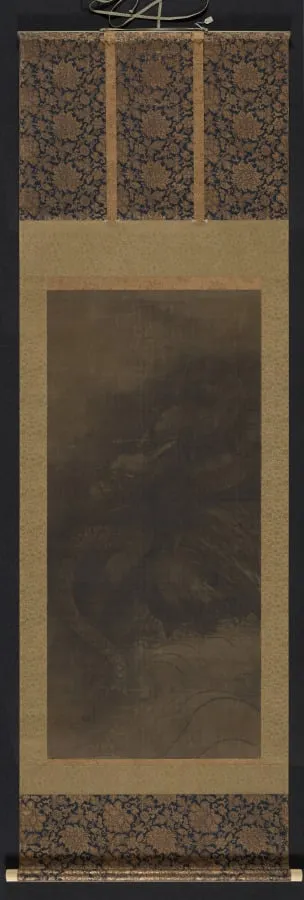
Dragon is an unspecified painting by the Chinese Orthodox School artist Fachang Muqi. It dates from 1264 and is held in the collection of the Cleveland Museum of Art.
About this work
Overview
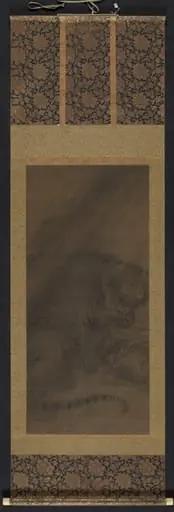
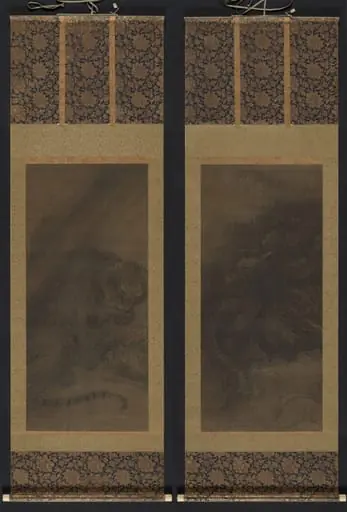
The two silk scrolls present a dragon and a tiger rendered in ink on a darkened fabric. The dragon winds through stylized waves and mist, its luminous head emerging from the shadows, while the tiger is depicted in a close-up pose, head bent to lick its paw and tail coiled in the foreground. Both figures occupy a vertical composition that emphasizes contrast and balance.
Subject & Meaning
The pairing of dragon and tiger embodies the Daoist principle of yin and yang, with the dragon representing airy, luminous qualities and the tiger symbolizing solid, earthly force. Their juxtaposition conveys complementary opposites, a visual metaphor for harmony within the Chan Buddhist setting where the scrolls likely framed a central devotional image such as the Bodhisattva Guanyin.
Technique & Style
Attributed to the monk‑artist Fachang Muqi, the works exhibit rapid, expressive brushwork characteristic of Chan painting. Ink washes suggest the movement of mist and water, while the dragon’s sinuous body and the tiger’s muscular bulk are rendered with loose strokes that capture vitality. Subtle reddish tones once highlighted the tiger’s tongue and nose, now faded with age.
History & Provenance
Created for a Chan Buddhist temple, the scrolls have survived centuries on silk that has progressively darkened, obscuring some original details. The fading of the red pigments on the tiger’s features testifies to the passage of time, yet the overall composition remains legible, allowing continued study of Muqi’s devotional art.
Context
In their original display, the dragon and tiger scrolls would have flanked a central figure, reinforcing the doctrinal balance between enlightenment and worldly existence. This arrangement reflects the integration of Daoist symbolism within Buddhist practice, a common feature of Chinese monastic art during the period in which Muqi was active.
Artist & collection