Artwork
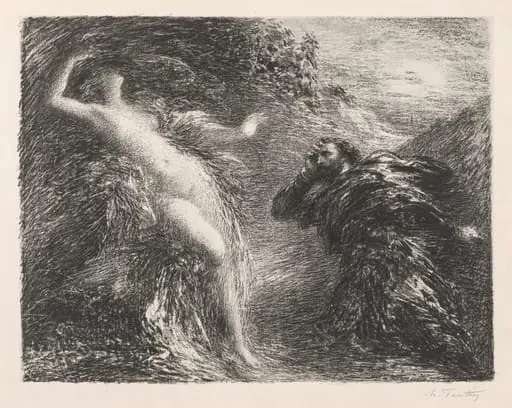
Evocation of Kundry (2nd plate)
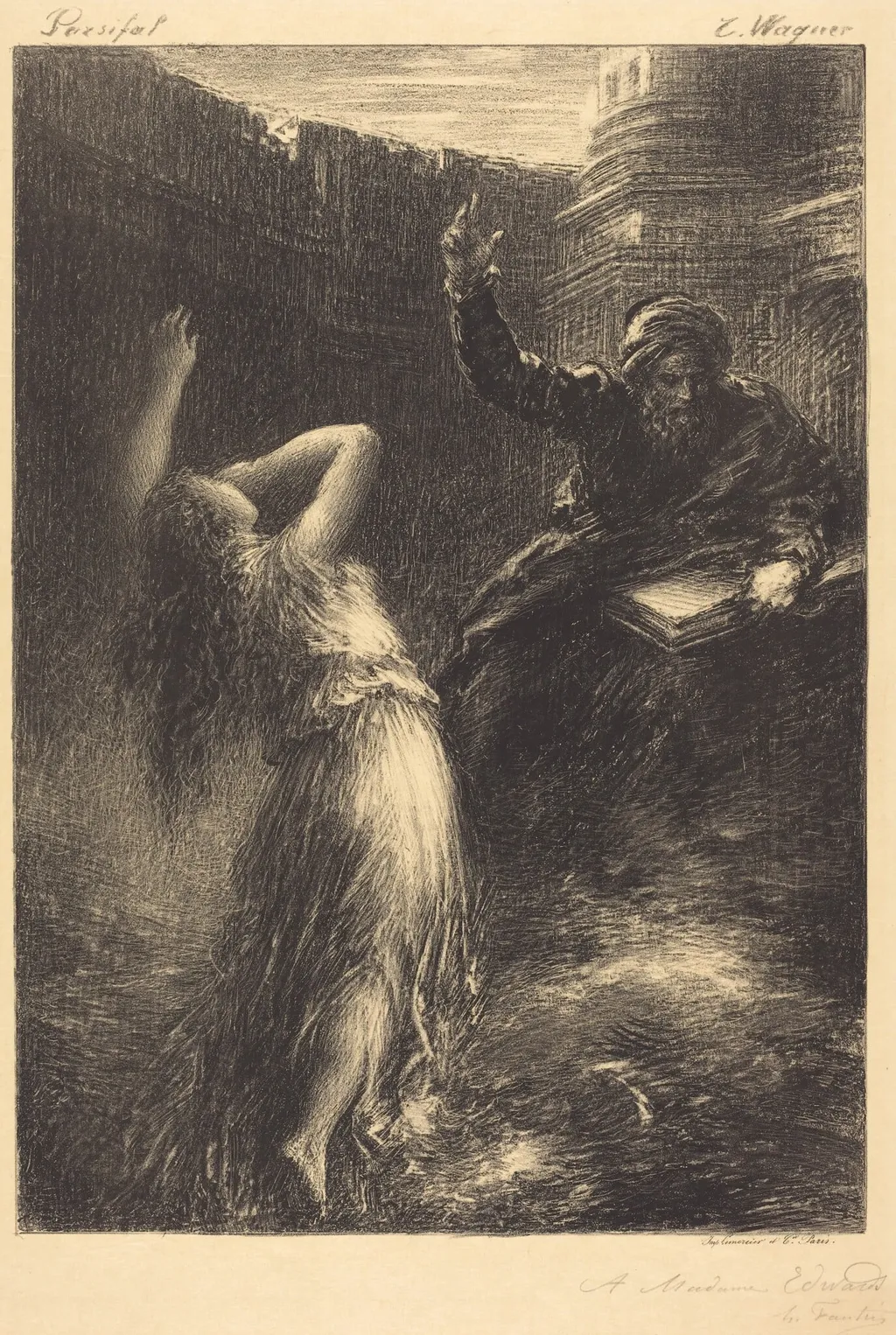
Evocation of Kundry (2nd plate) is an ink print by the Impressionist artist Henri Fantin-Latour. It dates from 1883 and is held in the collection of the National Gallery of Art.
About this work
Overview
The work belongs to a brief but significant phase in his career where he engaged with literary and musical symbolism through the medium of lithography.
Created in 1883, this lithograph by Henri Fantin-Latour is one of two plates produced as part of a series inspired by Richard Wagner’s opera Parsifal. Though best known for quiet still lifes and intimate group portraits, Fantin-Latour turned to printmaking to explore mythic and dramatic themes. The work belongs to a brief but significant phase in his career where he engaged with literary and musical symbolism through the medium of lithography.
Subject & Meaning
The figure represents Kundry, a complex character from Wagner’s Parsifal, associated with redemption and spiritual torment. Her raised arms and obscured face suggest inner turmoil rather than narrative clarity. The dim, cavernous setting and the faint illumination above evoke a liminal space—neither fully earthly nor divine. The half-concealed book beside her may allude to sacred texts or forbidden knowledge, reinforcing the opera’s themes of guilt and grace.
Technique & Style
Fantin-Latour employed lithography to achieve a spontaneous, sketch-like quality. Loose, rapid lines define the figure’s form and the shadowed environment, avoiding precise detail in favor of atmospheric suggestion. The blurred facial features and textured background enhance the sense of mystery. The technique allowed him to translate the emotional intensity of Wagner’s music into a visual language grounded in immediacy and tonal contrast, typical of late-century graphic experimentation.
History & Provenance
The print was produced in 1883 as part of a limited series tied to Fantin-Latour’s interest in Wagner’s operas, which he attended in Bayreuth. Only a small number of impressions were made, and the work remained largely within private collections. Unlike his more widely circulated still lifes, this series received little public attention during his lifetime, reflecting its niche, introspective character and the artist’s own preference for quiet, personal projects over public spectacle.
Context
In the 1880s, French artists increasingly turned to literary and musical sources for inspiration, drawn to the Symbolist movement’s emphasis on emotion and suggestion over realism. Fantin-Latour’s engagement with Wagner placed him among contemporaries exploring myth and psychological depth through print. His lithographs of Kundry stand apart from his earlier work, revealing a shift toward abstraction and symbolic representation in response to broader cultural currents.
Legacy
Though not widely exhibited or reproduced in his time, the 'Evocation of Kundry' plates are now recognized as key examples of how 19th-century printmakers adapted operatic themes into visual form. They illustrate Fantin-Latour’s willingness to depart from his established style and engage with contemporary intellectual currents. Today, they are studied for their fusion of literary reference, emotional restraint, and technical innovation in lithographic practice.
Own this work as a print
Artist & collection
Artist
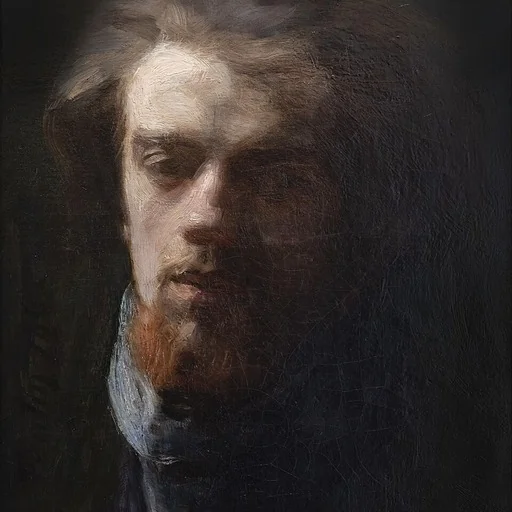
Ignace Henri Jean Theodore Fantin-Latour (French pronunciation: ; 14 January 1836 – 25 August 1904) was a French painter and lithographer best known for his flower paintings and group portraits of Parisian artists and writers.