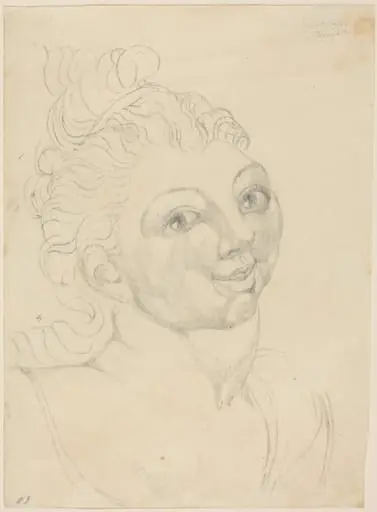
Artwork
An Ascending Spiral of Figures [recto]
![An Ascending Spiral of Figures [recto], by William Blake, graphite, 1820](https://artifactworldgallery.com/img/william-blake--an-ascending-spiral-of-figures-recto--508535a71ee63cd8-w1024.webp)
An Ascending Spiral of Figures [recto] is a graphite drawing by the Romanticist artist William Blake. It dates from 1820 and is held in the collection of the National Gallery of Art.
About this work
Overview
Created around 1820, this graphite drawing on two joined sheets of laid paper captures a continuous spiral of small, simplified human forms ascending in unison.
Created around 1820, this graphite drawing on two joined sheets of laid paper captures a continuous spiral of small, simplified human forms ascending in unison. Executed in London, where Blake lived and worked his entire life, the piece belongs to a series of intimate, exploratory drawings made not for public display but as visual experiments. Its unfinished quality and fluid lines suggest rapid, intuitive execution, characteristic of Blake’s process when developing symbolic concepts.
Subject & Meaning
The figures, rendered with minimal facial detail, move in a single, unbroken spiral upward, evoking themes of spiritual progression and collective ascent. Blake often used such imagery to express the soul’s journey beyond material constraints, aligning with his belief in imagination as a divine force. The absence of individual identity among the figures emphasizes a universal, almost ritualistic movement toward transcendence, consistent with his broader mythological vision.
Technique & Style
Blake employed graphite for its immediacy, allowing swift, flowing lines that curve without interruption to form the spiral. The paper’s texture and the fragility of the medium lend the work a tactile, ephemeral quality. Without shading or refinement, the drawing prioritizes rhythm over detail, reflecting a focus on movement and structure rather than finish. The joined sheets reveal how Blake extended his compositions beyond single sheets to accommodate expansive visions.
History & Provenance
The drawing emerged from Blake’s private studio practice during his later years, a period marked by increasing isolation and diminishing public recognition. It remained in the possession of his circle after his death in 1827, eventually entering institutional collections. Its survival reflects the growing posthumous interest in his unpublished works, which later scholars recognized as vital to understanding his symbolic universe.
Context
Made during the height of the Romantic era, the drawing resonates with contemporary interests in inner vision and the sublime, though Blake’s approach remained distinct from his peers. While others sought inspiration in nature or emotion, Blake turned inward, constructing personal mythologies through line and form. This work aligns with his illuminated books and engravings, where spiritual narratives were encoded in visual rhythm rather than literal representation.
Legacy
Though never exhibited in his lifetime, the drawing now serves as a key example of Blake’s method: using drawing not as preparation for other media, but as an autonomous act of visionary thought. Its emphasis on motion and abstraction influenced later artists exploring non-narrative symbolism. The piece endures as a quiet testament to his belief that true vision emerges from the hand’s unmediated movement.
Artist & collection
Artist
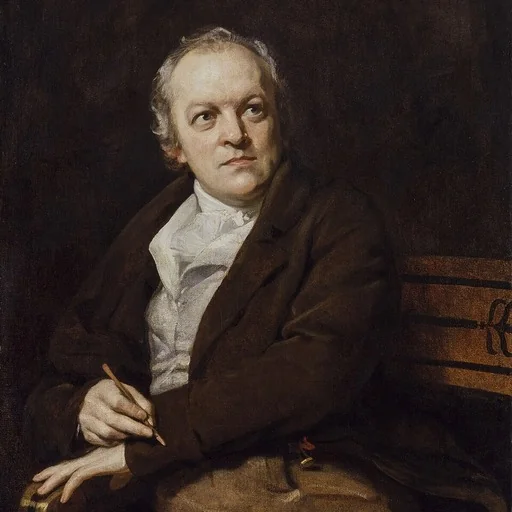
William Blake (28 November 1757 – 12 August 1827) was an English poet, painter and printmaker.


![Standing Figure [verso], by James McNeill Whistler](https://artifactworldgallery.com/img/james-mcneill-whistler--standing-figure-verso--3089b1e67635ba44-w320.webp)