Artwork
David Playing the Harp before Saul
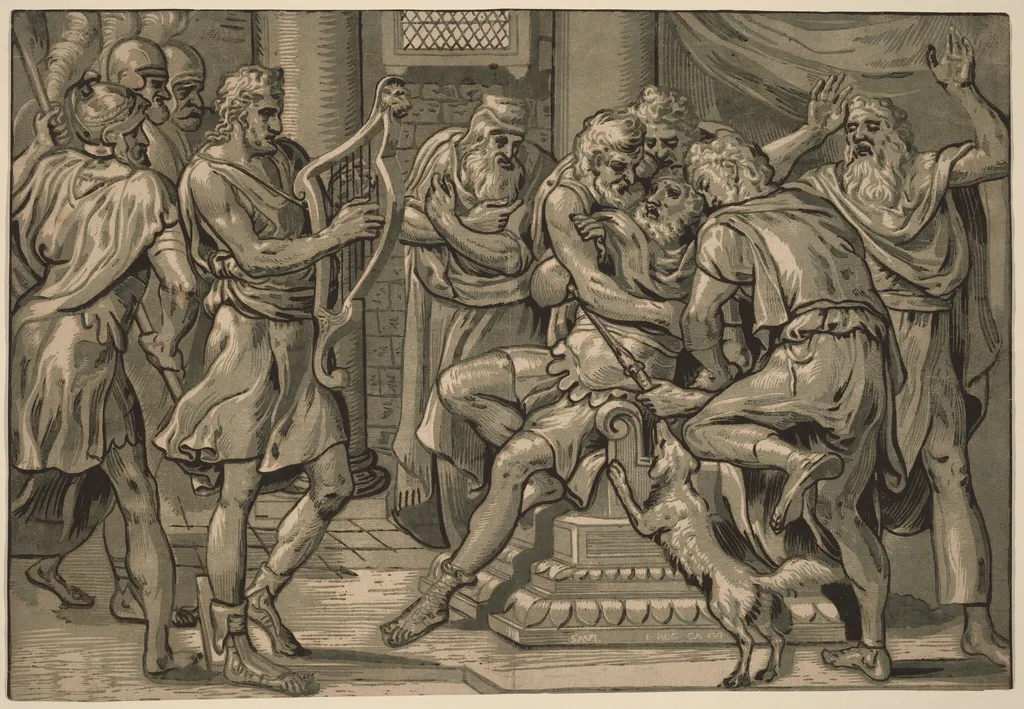
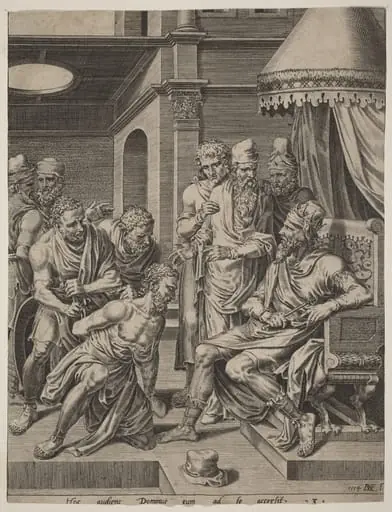
David Playing the Harp before Saul is an ink print by the Renaissance artist Frans Floris I. It dates from 1555 and is held in the collection of the National Gallery of Art.
About this work
Overview
Printed from four separate woodblocks—each carrying distinct tones of black and gray-green—it achieves subtle gradations of light and shadow on laid paper.
Created in 1555 by Frans Floris I, this chiaroscuro woodcut depicts a biblical moment from the First Book of Samuel. Printed from four separate woodblocks—each carrying distinct tones of black and gray-green—it achieves subtle gradations of light and shadow on laid paper. The composition centers on a seated, crowned figure surrounded by attendants, rendered with careful tonal layering to suggest volume and atmosphere.
Subject & Meaning
The scene illustrates David soothing King Saul with music, as described in the biblical narrative where Saul is tormented by an evil spirit. David, identified by his youthful posture and harp, plays while others respond with gestures of concern or reverence. The leaf crown on Saul’s head signals his royal status, and the presence of a dog at his feet adds a quiet note of domesticity to the tense, intimate setting.
Technique & Style
Floris employed a multi-block woodcut technique uncommon in Northern Europe at the time, using one block for outlines and three additional blocks to build up tones in gray-green hues. This method allowed for nuanced modeling of form and space, mimicking the chiaroscuro effects seen in contemporary painting. The texture of the laid paper enhances the print’s tactile quality, reinforcing the dim, enclosed atmosphere of the scene.
History & Provenance
The print was produced during Floris’s mature period in Antwerp, a center of printmaking innovation. While no early ownership records are widely documented, the work reflects the artist’s engagement with Italian Renaissance ideals, absorbed during his time in Rome. Its survival in multiple institutional collections suggests it was circulated among collectors interested in religious subjects and technical experimentation.
Context
In mid-16th-century Flanders, religious imagery remained central to print culture despite growing Reformation tensions. Floris, influenced by Michelangelo and Raphael, adapted Italian compositional principles to Northern printmaking traditions. This work exemplifies how artists merged devotional themes with advanced graphic techniques to appeal to educated patrons seeking both spiritual and aesthetic depth.
Legacy
Floris’s use of multiple tone blocks in woodcut influenced later Northern European printmakers seeking painterly effects without relying on engraving. Though not widely replicated, the technical ambition of this print marked a shift toward greater tonal complexity in the medium. It remains a rare example of how chiaroscuro, typically associated with painting, was successfully translated into the woodcut format.
Artist & collection