Artwork
A Moroccan Woman in Traditional Dress
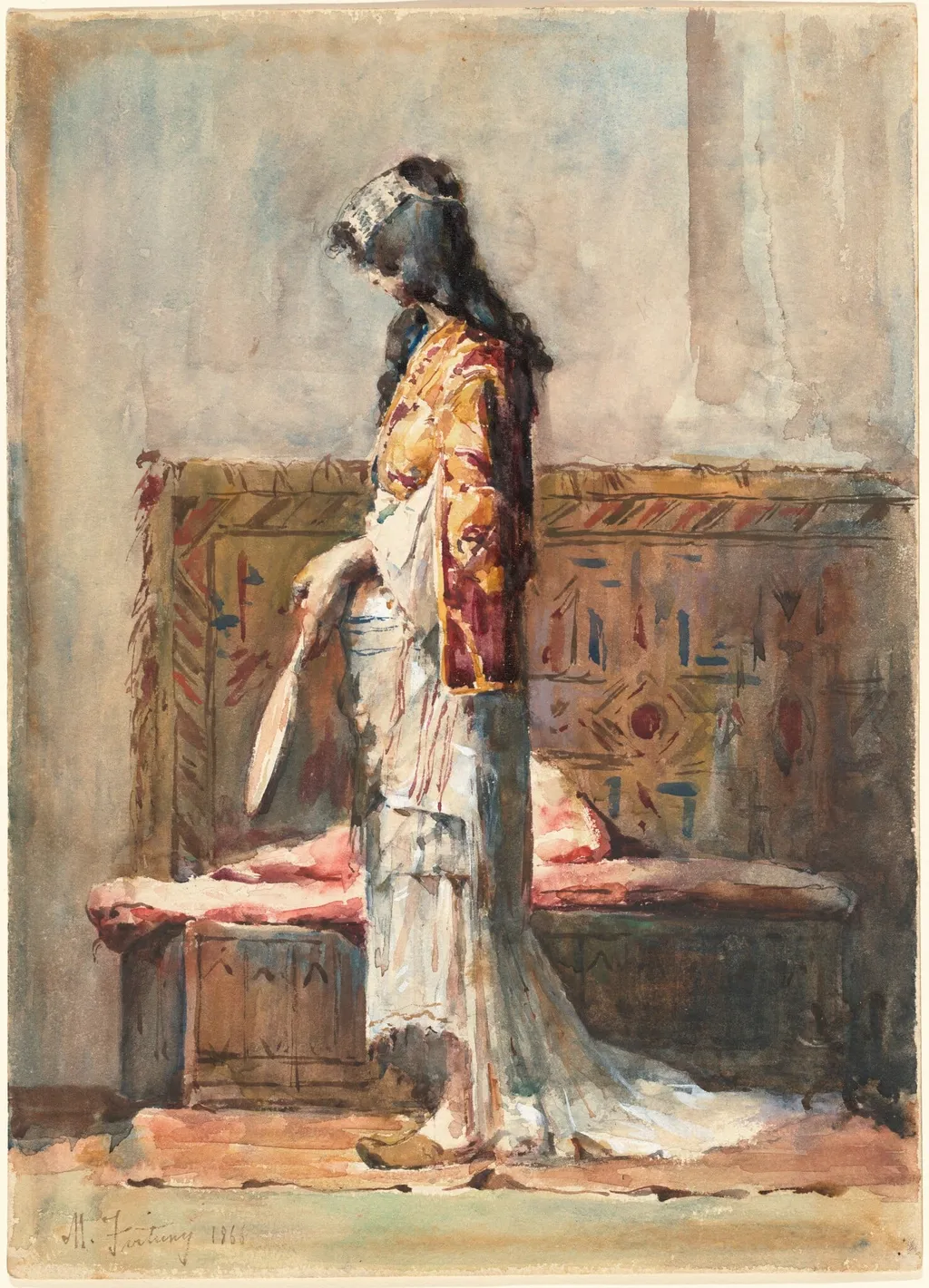
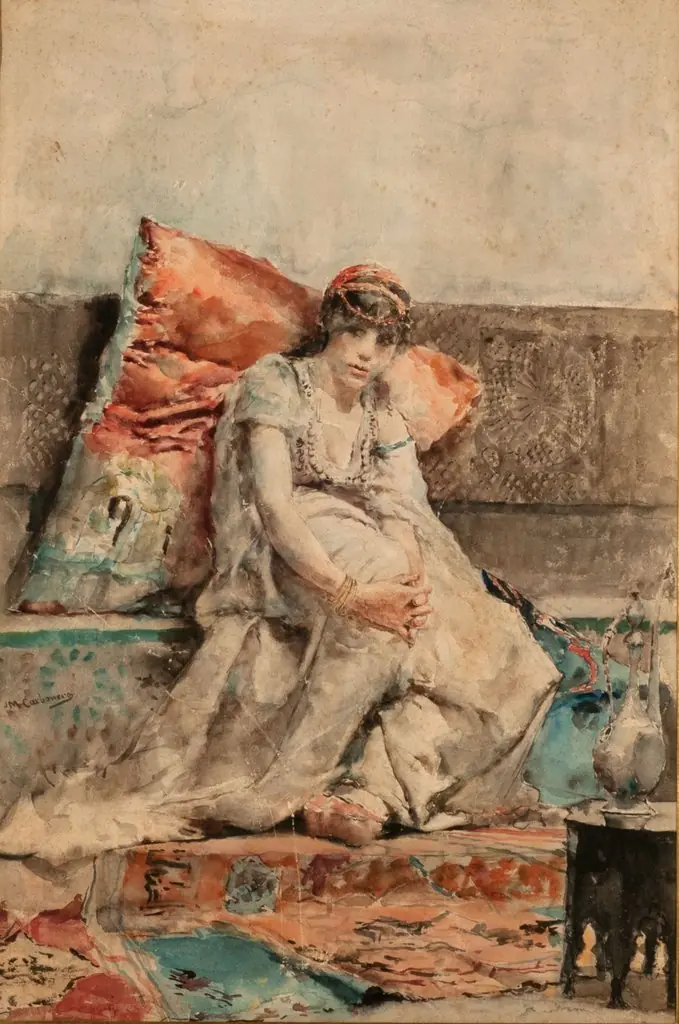
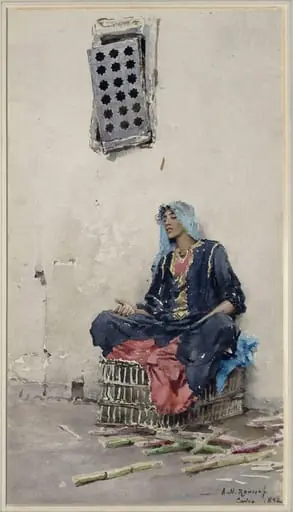
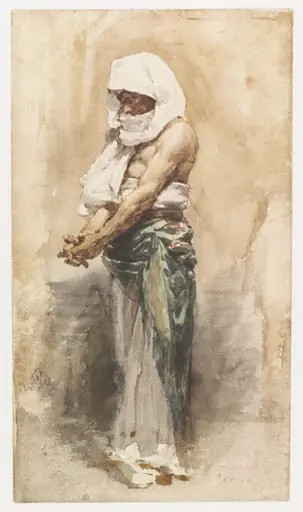
A Moroccan Woman in Traditional Dress is a watercolor drawing by the Impressionist artist Mariano Fortuny Marsal. It dates from 1866 and is held in the collection of the National Gallery of Art.
About this work
Overview
Mariano Fortuny Marsal’s 1866 work, A Moroccan Woman in Traditional Dress, is a small-scale drawing executed on wove paper. The piece combines watercolor with selective applications of white gouache, a technique that enhances the luminosity of the fabric and skin tones. Though modest in size, the image captures a moment of quiet interiority, presenting a solitary figure in a domestic setting.
Subject & Meaning
The composition centers on a woman standing within a modest interior, her posture relaxed as she leans against a wooden chair topped with a striped cushion.
The composition centers on a woman standing within a modest interior, her posture relaxed as she leans against a wooden chair topped with a striped cushion. She is clothed in a long, richly colored robe that incorporates vivid reds, yellows, and blues, suggesting the vibrant textiles typical of Moroccan dress. The surrounding wall, rendered with abstract geometric shapes, frames the figure without distracting from her presence.
Technique & Style
Fortuny employs a fluid watercolor wash to establish the overall tone, then adds precise highlights with white gouache to delineate folds and the sheen of the garment. The brushwork is swift and gestural, lending the drawing a sketch‑like immediacy that was popular among 19th‑century artists seeking to capture fleeting impressions. The interplay of transparent washes and opaque accents creates a subtle depth on the flat paper surface.
History & Provenance
Created in 1866, the drawing reflects Fortuny’s early interest in Orientalist subjects, a trend among European artists of the period. While the work’s subsequent ownership record is limited, it has been catalogued among Fortuny’s studies that document his travels and fascination with North African cultures. The piece remains a representative example of his formative approach to watercolor portraiture.
Own this work as a print
Artist & collection


![Maréchal ferrant au Maroc [Shoeing a Mule in Morocco], by Mariano Fortuny Marsal](https://artifactworldgallery.com/img/mariano-fortuny-marsal--marechal-ferrant-au-maroc-shoeing-a-mule-in-morocco--600c14ddda78f6f4-w320.webp)