Artwork
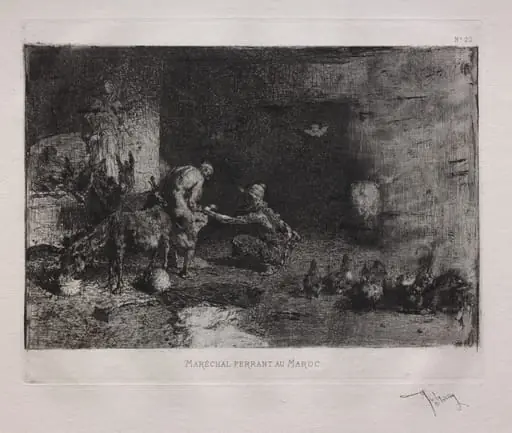
Maréchal ferrant au Maroc [Shoeing a Mule in Morocco]
![Maréchal ferrant au Maroc [Shoeing a Mule in Morocco], by Mariano Fortuny Marsal, ink, 1875](https://artifactworldgallery.com/img/mariano-fortuny-marsal--marechal-ferrant-au-maroc-shoeing-a-mule-in-morocco--600c14ddda78f6f4-w1024.webp)
Maréchal ferrant au Maroc [Shoeing a Mule in Morocco] is an ink print by the Impressionist artist Mariano Fortuny Marsal. It dates from 1875 and is held in the collection of the National Gallery of Art.
About this work
Overview
Executed as an etching combined with aquatint on Japanese paper, the work measures the delicate balance of dark and light that characterises the medium.
Mariano Fortuny Marsal’s print *Maréchal ferrant au Maroc* (1875) depicts a nighttime workshop scene in Morocco. Executed as an etching combined with aquatint on Japanese paper, the work measures the delicate balance of dark and light that characterises the medium. The composition centers on a blacksmith bending over a mule, while an assistant holds the animal’s hoof, all set against a dimly lit interior with a small window and a few birds on the floor.
Subject & Meaning
The image captures a practical moment of animal care, emphasizing the labor involved in shoeing a mule within a Moroccan setting. The presence of the blacksmith and his helper suggests a collaborative effort, while the subdued lighting and quiet atmosphere convey a sense of routine daily life rather than a dramatic event. The birds on the ground add a subtle hint of the surrounding environment.
Technique & Style
Fortuny employed a hybrid printmaking process, first incising lines into a metal plate for the etching, then applying aquatint to achieve tonal variations. The use of Japanese paper contributes a fine, absorbent surface that enhances the contrast between the rough, scratchy lines and the smoother, shaded areas. The interplay of deep blacks and muted grays creates a nocturnal ambience typical of 19th‑century etchings.
History & Provenance
Created in 1875, the work reflects Fortuny’s interest in Orientalist subjects during his early career. While specific ownership records are limited, the print has appeared in several catalogues of Fortuny’s oeuvre and is held in public and private collections that focus on 19th‑century European printmaking.
Context
The piece belongs to a broader trend among European artists of the late 1800s who documented everyday scenes from North Africa and the Middle East. Fortuny’s choice of a blacksmith’s workshop aligns with contemporary fascination for exotic labor and craft, offering viewers a glimpse into a world perceived as both foreign and familiar through the lens of Western print techniques.
Artist & collection


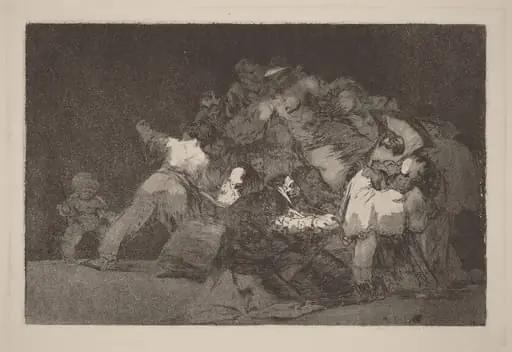 Disparate general (General Folly)
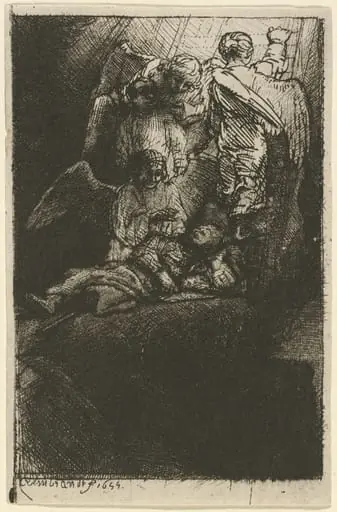 Jacob's Ladder
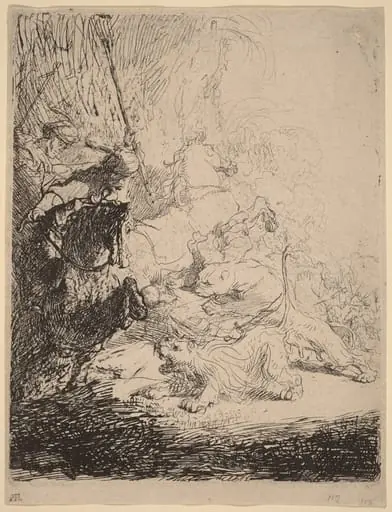 The Small Lion Hunt (with Two Lions)
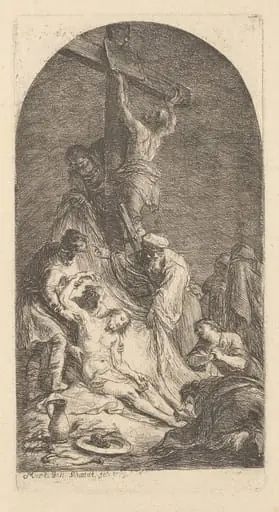 Descent from the Cross
 Various Caprices: The Woman with Tambourine
 Greeting Grandmother (Le Bonjour à la Grand-mère)
 Le Tombeau du Diable (The Devil's Tomb)
 Untitled
 The Entombment
 Jacob's Ladder
 Le muletier
 Shoeing a Mule in Morocco