Artwork
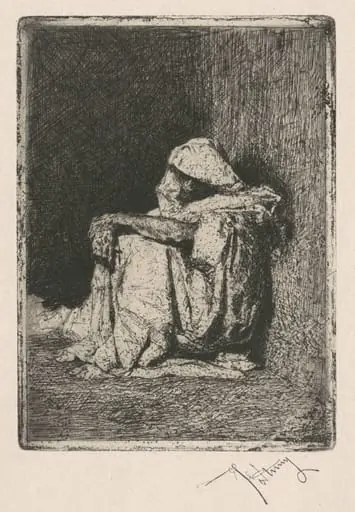
Dead Kabyle (Kabyle mort)
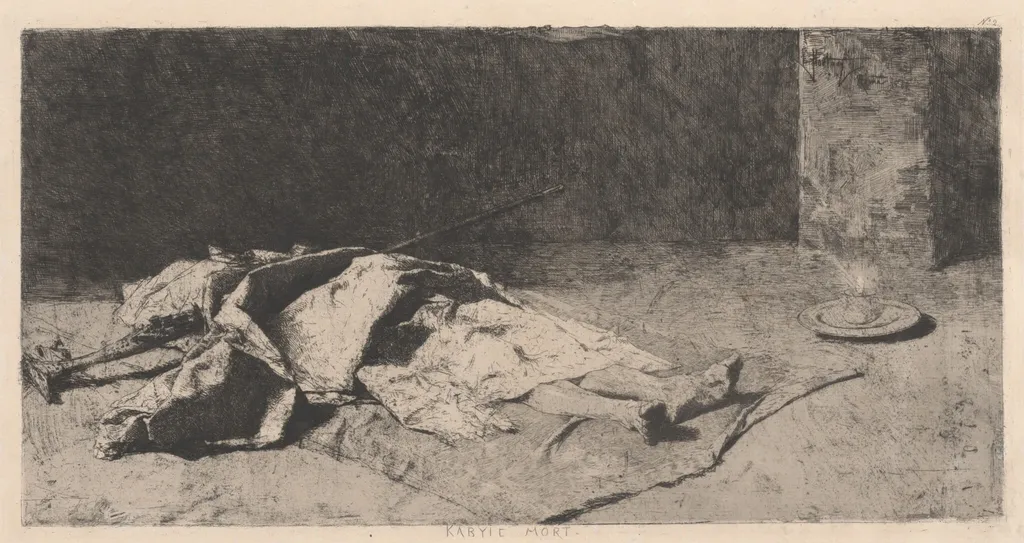
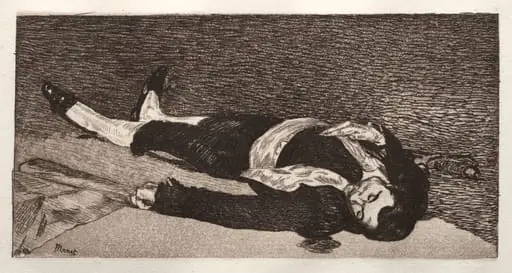
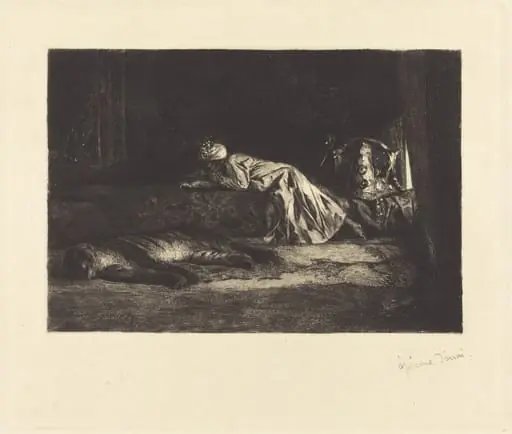
Dead Kabyle (Kabyle mort) is an ink print by the Impressionist artist Mariano Fortuny Marsal. It dates from 1867 and is held in the collection of the National Gallery of Art.
About this work
Overview
Dead Kabyle (Kabyle mort) is a print created in 1867 by Spanish artist Mariano Fortuny Marsal. Executed on buff laid paper, the work combines etching with aquatint, resulting in a monochrome image that measures roughly the size of a typical sheet of drawing paper. The paper has acquired a patina of age, appearing slightly yellowed, which contributes to the somber tone of the composition.
Subject & Meaning
The image depicts a lifeless figure lying on the ground, arms outstretched, dressed in plain, unadorned clothing. The anonymity of the attire and the stark presentation of the corpse suggest a universal meditation on mortality rather than a specific narrative. The composition’s quiet stillness invites contemplation of the human condition and the inevitability of death.
Technique & Style
Fortuny employed a dual printmaking process: traditional line etching to define the figure’s outline and details, and aquatint to generate broad, tonal washes that model the body’s form and the surrounding space. The aquatint produces a soft gradation of gray, giving the surface a velvety depth that contrasts with the crispness of the etched lines, creating a realistic rendering of light and shadow.
History & Provenance
The work was produced in the artist’s early career, shortly after his studies in Barcelona and before his later fame as a painter. Original impressions remain in several European collections, though the exact path of ownership for most prints is not fully documented. The piece is occasionally exhibited in surveys of 19th‑century Spanish printmaking.
Artist & collection


![[Retrato de mujer al pie de su lecho], by Unknown](https://artifactworldgallery.com/img/unknown--retrato-de-mujer-al-pie-de-su-lecho--96c1576d0f3bbaa8-w320.webp)
![[Retrato de religiosa en su lecho], by Unknown](https://artifactworldgallery.com/img/unknown--retrato-de-religiosa-en-su-lecho--8be6e24f4d3d3011-w320.webp)