Artwork
Bradamante Tries to Catch Hold of the Hippogryph [recto]
![Bradamante Tries to Catch Hold of the Hippogryph [recto], by Jean Honoré Fragonard, chalk, 1784](https://artifactworldgallery.com/img/jean-honore-fragonard--bradamante-tries-to-catch-hold-of-the-hippogryph-recto--f9c9ee68fd17e997-w1024.webp)
Bradamante Tries to Catch Hold of the Hippogryph [recto] is a chalk drawing by the Romanticist artist Jean Honoré Fragonard. It dates from 1784 and is held in the collection of the National Gallery of Art. Jean‑Honoré Fragonard’s drawing titled *Bradamante Tries to Catch Hold of the Hippogryph* dates from around 1784.
About this work
Overview
Executed in black chalk with brown and gray washes on laid paper, the work measures a modest sheet size typical of preparatory studies.
Jean‑Honoré Fragonard’s drawing titled *Bradamante Tries to Catch Hold of the Hippogryph* dates from around 1784. Executed in black chalk with brown and gray washes on laid paper, the work measures a modest sheet size typical of preparatory studies. The composition depicts a tumultuous encounter between a human figure and a mythic creature, rendered in a sketch‑like manner that emphasizes motion over detail.
Subject & Meaning
The scene portrays Bradamante, a heroine from the chivalric romances, reaching for a hippogriff—a creature that is half eagle, half horse. The juxtaposition of a determined rider and a fantastical beast suggests a narrative of daring pursuit and the clash between human ambition and untamed nature, themes common in late‑eighteenth‑century literary imagination.
Technique & Style
Fragonard employs loose, gestural lines of black chalk to outline the figures, while brown and gray washes create atmospheric shading and a sense of depth. The drawing’s fluid strokes convey the swirling hair and billowing garments, giving the impression of wind and turbulence. The contrast between solid, dark areas and lighter, evaporating forms enhances the feeling of a fleeting, dream‑like moment.
History & Provenance
Created circa 1784, the drawing belongs to the later period of Fragonard’s career, when he explored more imaginative subjects beyond his earlier Rococo scenes. The work is catalogued as a recto drawing and has remained in private collections before entering a museum holding of 18th‑century French drawings, where it is displayed as an example of the artist’s preparatory studies.
Artist & collection

Artist
Jean-Honoré Fragonard was born on 5 April 1732 in Grasse, the son of a glover, and moved with his family to Paris in 1738.

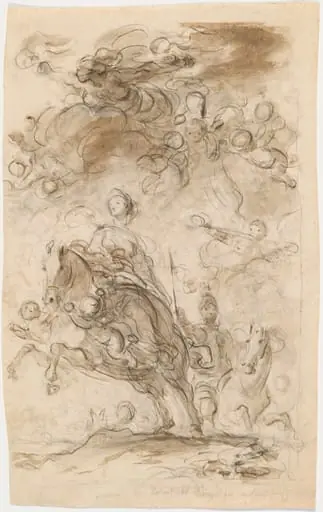 Orlando and Angelica Arrive at Charlemagne's Camp
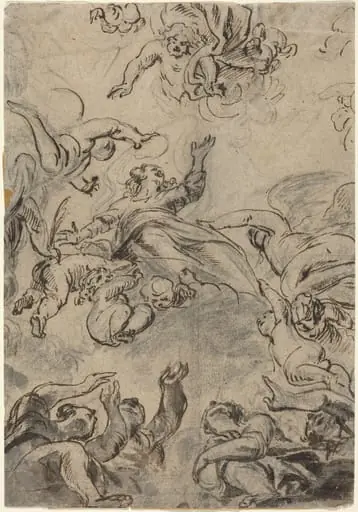 The Assumption of the Virgin
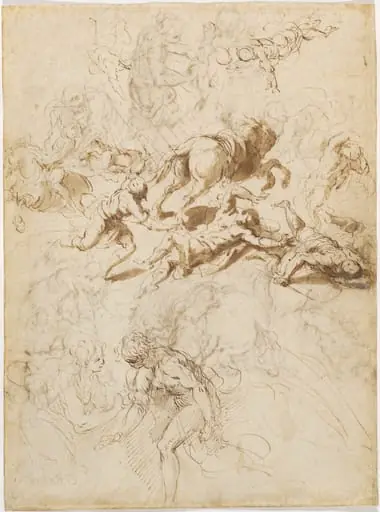 The Conversion of Saint Paul; Adam and Eve
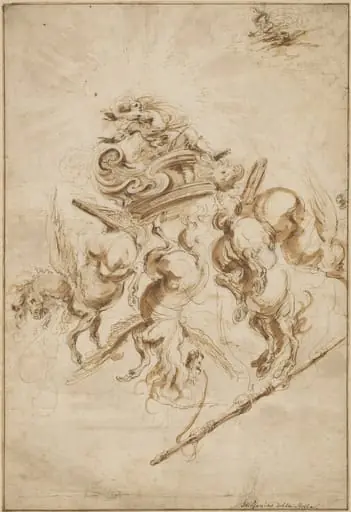 The Fall of Phaeton
 The Sacrifice of Isaac
![The Fall of the Rebel Angels [recto], by Parmigianino](https://artifactworldgallery.com/img/parmigianino--the-fall-of-the-rebel-angels-recto--e9b082b33c001c66-w320.webp) The Fall of the Rebel Angels [recto]
The Fall of the Rebel Angels [recto] The Stigmatization of Saint Francis
 Virgin of the Immaculate Conception
 Angelica Is Exposed to the Orc
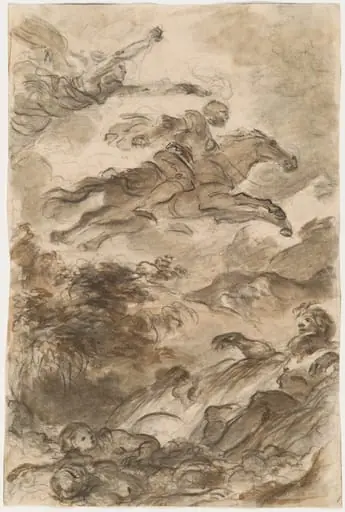 Rinaldo, Astride Baiardo, Flies Off in Pursuit of Angelica
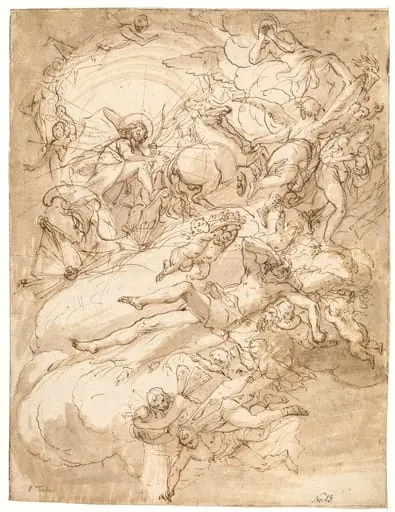 Apollo in his chariot, design for a ceiling painting
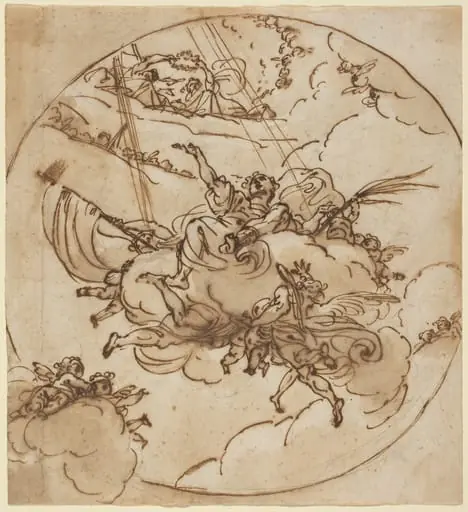 The Apotheosis of San Vitale