Artwork
"Help Him Who Takes up His Burden, Not Him Who Lays It down" [fol. 31 recto]
!["Help Him Who Takes up His Burden, Not Him Who Lays It down" [fol. 31 recto], by French early 16th Century, ink, 1514](https://artifactworldgallery.com/img/french-early-16th-century--help-him-who-takes-up-his-burden-not-him-who-lays-it-down-fo--9f780d6d7fc7a3c2-w1024.webp)
"Help Him Who Takes up His Burden, Not Him Who Lays It down" [fol. 31 recto] is an ink drawing by the Renaissance artist French early 16th Century. It dates from 1514 and is held in the collection of the National Gallery of Art. The work is a pen drawing executed on laid paper, employing brown ink to delineate a complex, bustling composition.
About this work
Overview
Central to the scene is a crucified figure bearing the traditional INRI inscription, while a second figure below bears a heavy bundle of sticks.
The work is a pen drawing executed on laid paper, employing brown ink to delineate a complex, bustling composition. Central to the scene is a crucified figure bearing the traditional INRI inscription, while a second figure below bears a heavy bundle of sticks. To the right, a bearded, haloed individual gestures upward, accompanied by two figures engaged with ropes, suggesting movement and struggle.
Subject & Meaning
Latin captions encircle the figures, including the phrase “Vir tollens onus,” translating to “the man who takes up his burden.” This textual element frames the visual narrative as an allegorical lesson on the virtue of assuming responsibility, contrasting the burden‑bearing figure with the one who bears a cross.
Technique & Style
The artist utilizes pen and brown ink, applying cross‑hatching to build tonal depth and convey the crowded, dynamic atmosphere. The layered lines create a sense of volume and texture, particularly in the rendering of the wooden cross, the bundle of sticks, and the surrounding figures, emphasizing the tension of the scene.
Context
The drawing reflects a didactic tradition common in early modern religious art, where visual and textual components combine to instruct viewers on moral conduct. The inclusion of a haloed, bearded figure suggests a saintly or Christological presence, reinforcing the spiritual dimension of the work’s ethical message.
Artist & collection

Artist
A French draftsman from the early 1500s filled sheets of laid paper with tiny, sharp-tongued instructions—ink sketches paired with warnings like “Do Not Eat Your Heart Out” or “Feed Not Things That Have Sharp Claws.”…

!["Do Not Eat Your Heart Out" [fol. 22 recto], by French early 16th Century](https://artifactworldgallery.com/img/french-early-16th-century--do-not-eat-your-heart-out-fol-22-recto--003887c9850175b9-w320.webp) "Do Not Eat Your Heart Out" [fol. 22 recto]
"Do Not Eat Your Heart Out" [fol. 22 recto]![The Calumny of Apelles [fol. 6 recto], by French early 16th Century](https://artifactworldgallery.com/img/french-early-16th-century--the-calumny-of-apelles-fol-6-recto--037fde9ac8dbd27b-w320.webp) The Calumny of Apelles [fol. 6 recto]
The Calumny of Apelles [fol. 6 recto]!["Do Not Make Water on Clippings from Nails or Hair" [fol. 30 recto], by French early 16th Century](https://artifactworldgallery.com/img/french-early-16th-century--do-not-make-water-on-clippings-from-nails-or-hair-fol-30-rec--03ca31c36e5a66b9-w320.webp) "Do Not Make Water on Clippings from Nails or Hair" [fol. 30 recto]
"Do Not Make Water on Clippings from Nails or Hair" [fol. 30 recto]!["You Are Tying a Dolphin by the Tail" [fol. 17 recto], by French early 16th Century](https://artifactworldgallery.com/img/french-early-16th-century--you-are-tying-a-dolphin-by-the-tail-fol-17-recto--0abe83abfb5ccd1d-w320.webp) "You Are Tying a Dolphin by the Tail" [fol. 17 recto]
"You Are Tying a Dolphin by the Tail" [fol. 17 recto]!["Feed Not Things That Have Sharp Claws" [fol. 38 recto], by French early 16th Century](https://artifactworldgallery.com/img/french-early-16th-century--feed-not-things-that-have-sharp-claws-fol-38-recto--1f28115410528631-w320.webp) "Feed Not Things That Have Sharp Claws" [fol. 38 recto]
"Feed Not Things That Have Sharp Claws" [fol. 38 recto]![A Courtier Standing Between Covetousness and Dissimulation [fol. 14 recto], by French early 16th Century](https://artifactworldgallery.com/img/french-early-16th-century--a-courtier-standing-between-covetousness-and-dissimulation-f--2578f4fe9846edc2-w320.webp) A Courtier Standing Between Covetousness and Dissimulation [fol. 14 recto]
A Courtier Standing Between Covetousness and Dissimulation [fol. 14 recto]![A Fool Feeding Flowers to Swine [fol. 42 recto], by French early 16th Century](https://artifactworldgallery.com/img/french-early-16th-century--a-fool-feeding-flowers-to-swine-fol-42-recto--27579a7c495e1682-w320.webp) A Fool Feeding Flowers to Swine [fol. 42 recto]
A Fool Feeding Flowers to Swine [fol. 42 recto]!["You Are Shooting at Heaven" [fol. 9 recto], by French early 16th Century](https://artifactworldgallery.com/img/french-early-16th-century--you-are-shooting-at-heaven-fol-9-recto--28e4ef6e8d8a696d-w320.webp) "You Are Shooting at Heaven" [fol. 9 recto]
"You Are Shooting at Heaven" [fol. 9 recto]
 Shepherd with a Platerspiel
 Ain Man Schoss seinen nagsten ...
 Descent into Limbo
 The Murder of the Children of Bethel
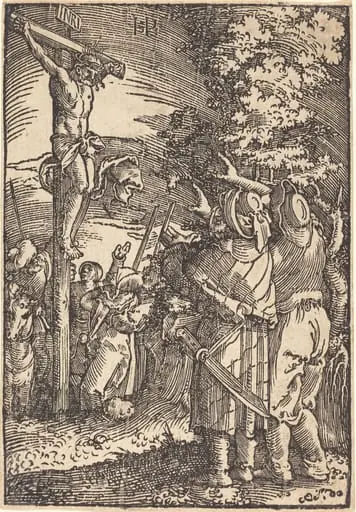 Christ on the Cross
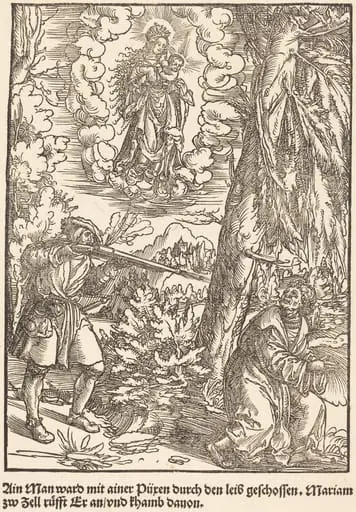 Ain Man ward mit ainer Puren ...
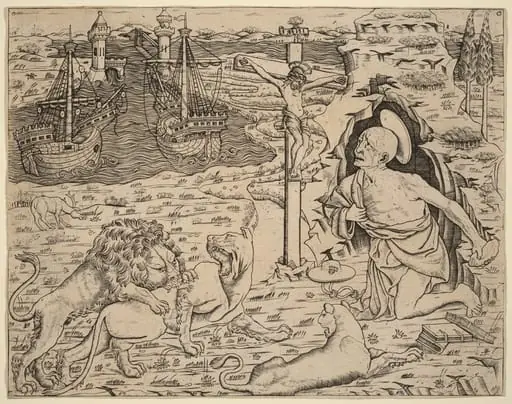 Saint Jerome in Penitence, with Two Ships in a Harbor
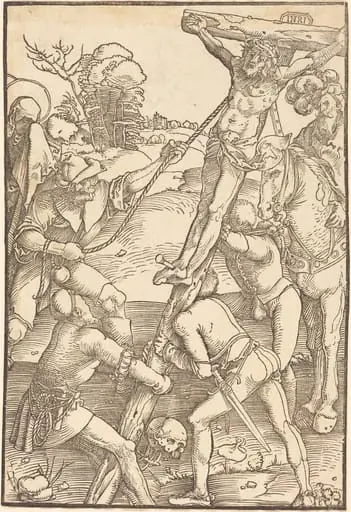 Christ Raised on the Cross
 Nun
Nun The Epileptic Child Healed
 Saints Philip and Bartholomew by a Spring
 Christ Heals a Dumb Man