Artwork
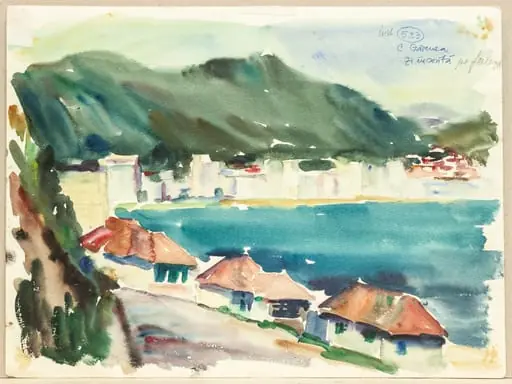
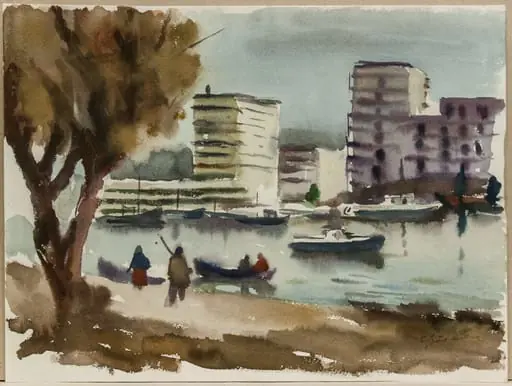
Peisaj de pe faleză
Peisaj de pe faleză is a print by Constantin Găvenea. It dates from 1950 and is held in the collection of the Gavrila Simion Eco-Museum Research Institute Tulcea.
About this work
Overview
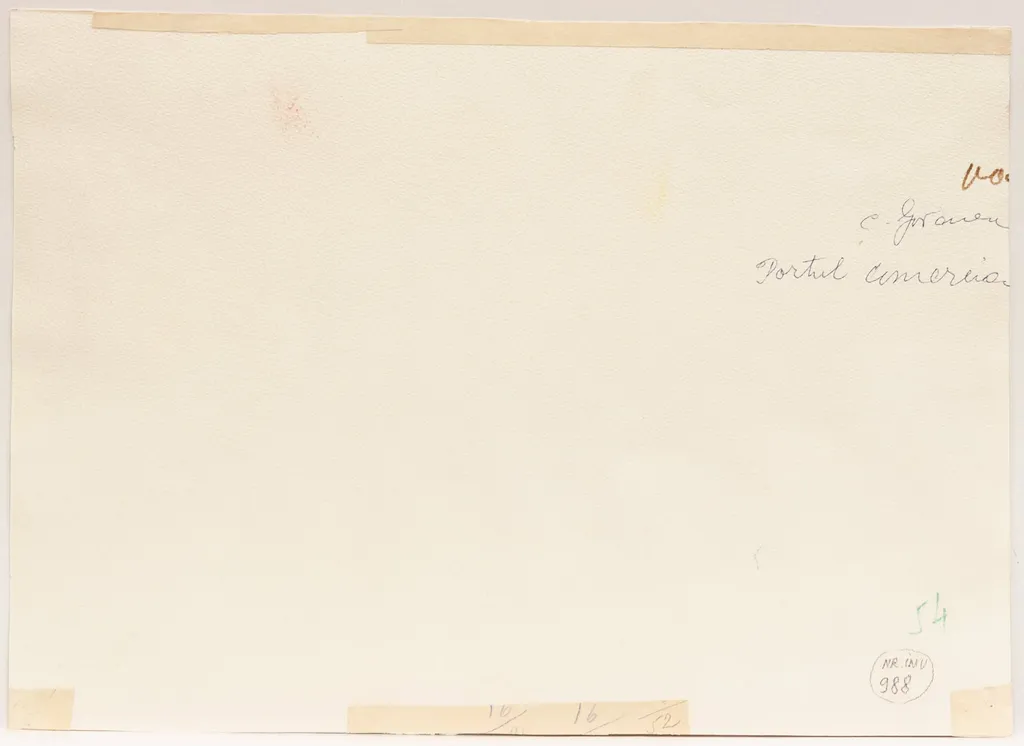
This fragmentary work, attributed to Constantin Găvenea around 1950, consists of a sheet of paper with faded yellow-brown edges. It bears minimal visual content—no image, no drawing—only faint handwriting and a small institutional stamp. The absence of a traditional composition suggests it may have functioned as a label, note, or archival slip rather than a finished artwork.
Subject & Meaning
The handwritten phrase 'Portul Americia' appears in the upper right, possibly referencing a location named 'America Harbor,' though no such place is documented. The phrase’s ambiguity and lack of context make its intent unclear. It may denote a destination, a memory, or a working title tied to Găvenea’s travels or research, but no corroborating records exist to confirm its significance.
Technique & Style
The piece employs no illustrative technique. Its only marks are pencil or ink handwriting and a green ink stamp. The thin adhesive strips along the top and bottom suggest it was once affixed to a larger surface, perhaps a folder or album. The style is utilitarian, reflecting archival practice rather than artistic expression, with no attempt at composition or visual elaboration.
History & Provenance
The stamp 'NR. 190 988' and adhesive remnants indicate this item was cataloged and handled as part of a collection, likely within the Museum of Ethnography. Its survival as a standalone fragment implies it was separated from its original context—possibly during reorganization, damage, or transfer. Its origin as part of Găvenea’s personal or professional archive remains unverified.
Context
In mid-20th century Romania, ethnographers often documented cultural sites through notes, photographs, and ephemera. Găvenea, known for fieldwork, may have used such slips to record locations or observations. This fragment could be a remnant of that practice—a discarded or detached annotation from a larger research effort, now preserved as an artifact of process rather than product.
Legacy
As a non-artifact within an ethnographic collection, this piece challenges conventional notions of artistic value. Its preservation reflects institutional attention to the material traces of research. It endures not for its visual content, but as evidence of how knowledge was gathered, labeled, and stored—offering insight into the quiet labor behind cultural documentation.
Artist & collection
Museum
Gavrila Simion Eco-Museum Research Institute Tulcea
Continue through works from the same source collection.