Artwork
Veterum Romanorum Thermae semirutae
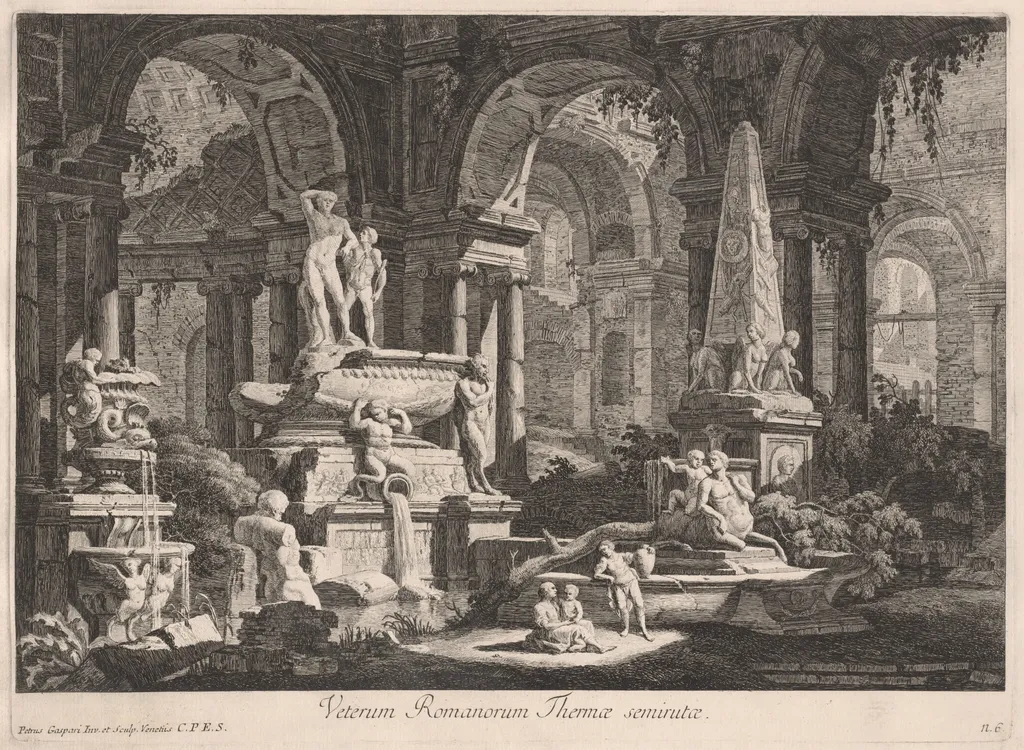
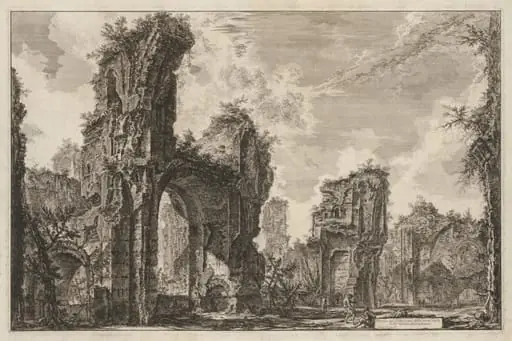
Veterum Romanorum Thermae semirutae is an ink print by the Romanticist artist Pietro Gaspari. It dates from 1771 and is held in the collection of the National Gallery of Art.
About this work
Overview
Pietro Gaspari created this 1771 etching and engraving on laid paper, depicting an imagined Roman bath complex in partial ruin. The work belongs to a tradition of antiquarian prints that blend archaeological interest with artistic invention. Its title, meaning 'half-ruined baths of the ancient Romans,' signals its fictional nature, presenting a romanticized vision rather than a documented site.
Subject & Meaning
The scene portrays a garden-like ruin with statues, fountains, and broken columns, inhabited by nude figures reclining near water features.
The scene portrays a garden-like ruin with statues, fountains, and broken columns, inhabited by nude figures reclining near water features. An obelisk rises in the distance, reinforcing classical associations. The composition suggests a leisurely retreat amid decay, evoking themes of time, beauty, and the passage of empire. The figures, unbothered by their surroundings, imply a harmony between nature and antiquity.
Technique & Style
Gaspari employed fine linear engraving to define textures: rough, weathered stone contrasts with the smooth contours of the human forms. Etching allowed for softer, atmospheric effects in the background, while precise lines delineate architectural fragments. The careful modulation of line and tone creates depth and a sense of aged grandeur, typical of 18th-century topographical prints.
History & Provenance
Produced in 1771, the print emerged during a period of heightened interest in Roman antiquities, fueled by excavations at Pompeii and Herculaneum. Gaspari, an Italian artist active in Rome, contributed to a market for prints that catered to Grand Tour travelers. Though not based on a specific site, the work reflects contemporary fascination with reconstructing lost Roman landscapes.
Context
This print aligns with the 18th-century European taste for idealized classical ruins, popularized by artists like Piranesi. It responds to scholarly and aesthetic trends that sought to revive antiquity through imaginative reconstruction. Unlike topographical records, Gaspari’s work prioritizes poetic atmosphere over accuracy, serving as both visual entertainment and cultural commentary on Roman legacy.
Legacy
The print remains an example of how Enlightenment-era artists reimagined antiquity through artistic license. It influenced later depictions of Roman ruins in print culture and contributed to the visual vocabulary of neoclassical design. While not widely known today, it exemplifies the intersection of archaeology, fantasy, and printmaking in pre-modern European art.
Artist & collection


 Capriccio: Ruins
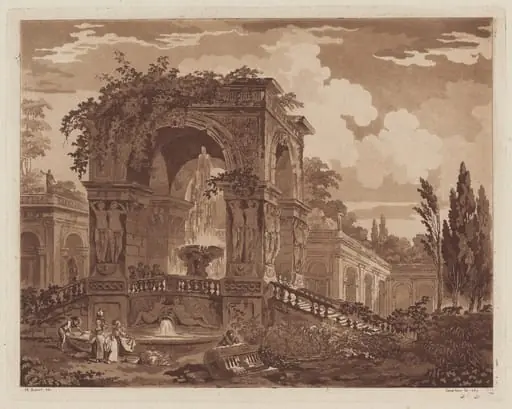 View of an Antique Fountain
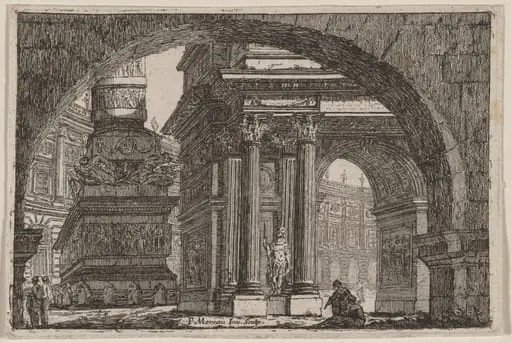 Ancient Forum Seen Beneath an Arch
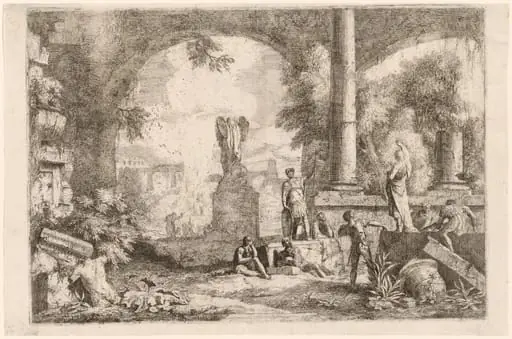 Capriccio of Antique Ruins with Men Gazing at a Classical Orator
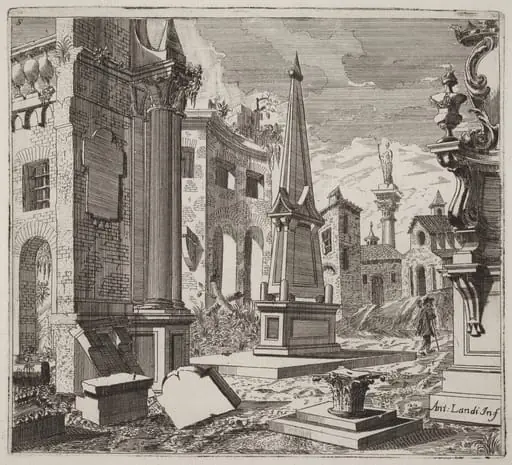 Fantastic Townscape with Ruins
 The Statue before the Ruins
 Views of Rome: Remains of the Temple of Apollo near Hadrian's Villa
 The Statue in Front of Ruins
 Views of Rome: The Arch or Titus
 Views of Rome: Rovine del Sisto o sia della gran sala delle Terme Antoniniane