Artwork
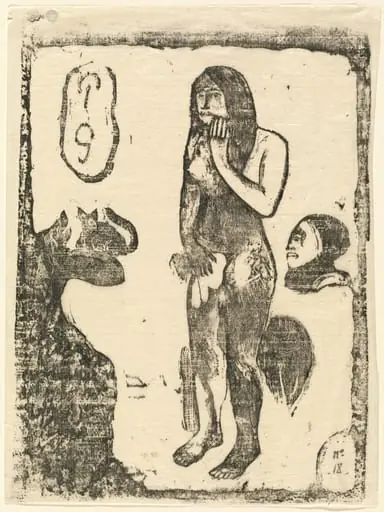
Oviri (The Savage) [recto]
![Oviri (The Savage) [recto], by Paul Gauguin, ink, 1894](https://artifactworldgallery.com/img/paul-gauguin--oviri-the-savage-recto--026f405dcdd65283-w1024.webp)
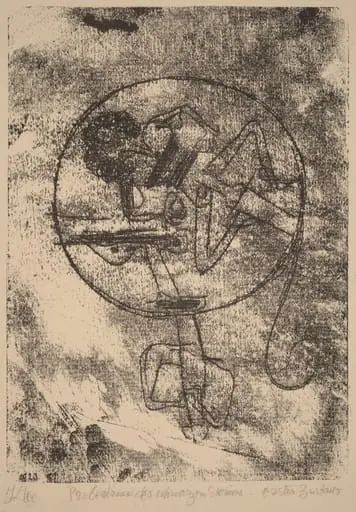
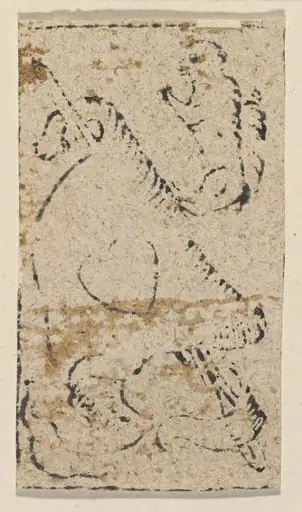
Oviri (The Savage) [recto] is an ink print by the Impressionist artist Paul Gauguin. It dates from 1894 and is held in the collection of the National Gallery of Art.
About this work
Overview
Created in 1894, Oviri (The Savage) [recto] is a woodcut print in brown ink on Japanese paper by Paul Gauguin. It emerged during his time in Tahiti, where he sought to distance himself from European artistic conventions. The work belongs to a series of experimental prints in which Gauguin explored the expressive potential of carved wood surfaces, favoring raw texture over refined detail.
Subject & Meaning
The figure in Oviri is a hybrid, mythic presence—naked, seated, and surrounded by dense vegetation.
The figure in Oviri is a hybrid, mythic presence—naked, seated, and surrounded by dense vegetation. Its mask-like face, with wide eyes and an open mouth, evokes ritual or spiritual intensity. Gauguin drew from Polynesian legends and his own symbolic imagination, presenting Oviri as a force of nature: neither wholly divine nor entirely human, but a vessel for primal energy and cultural transformation.
Technique & Style
Gauguin carved directly into a woodblock, using bold, irregular lines to define form and texture. The print’s brown ink, applied unevenly, enhances the tactile quality of the surface, with grooves and splinters visible in the final impression. The composition avoids perspective and naturalism, instead favoring flattened space and rhythmic patterns, characteristic of his Synthetist approach and interest in non-European visual traditions.
History & Provenance
Made during Gauguin’s second stay in Tahiti, Oviri was part of his effort to forge a new artistic language outside European norms. He produced limited impressions, often distributing them among close associates. The work remained largely private during his lifetime, circulating among collectors and fellow artists before entering institutional collections in the 20th century.
Context
Gauguin’s engagement with woodcut coincided with broader late-19th-century interest in non-Western art and printmaking revival. In Tahiti, he absorbed local myths and material practices, reinterpreting them through a Symbolist lens. Oviri reflects his rejection of academic art in favor of what he perceived as more authentic, primal expressions, even as his interpretations were filtered through colonial perspectives.
Legacy
Oviri contributed to the redefinition of printmaking as a medium for personal and symbolic expression, influencing later Expressionist and Primitivist artists. Its raw aesthetic and mythic subject matter challenged conventional notions of beauty and technique. Though controversial in its cultural appropriation, the work remains a significant example of how non-Western imagery was reimagined in modern European art.
Artist & collection
Artist
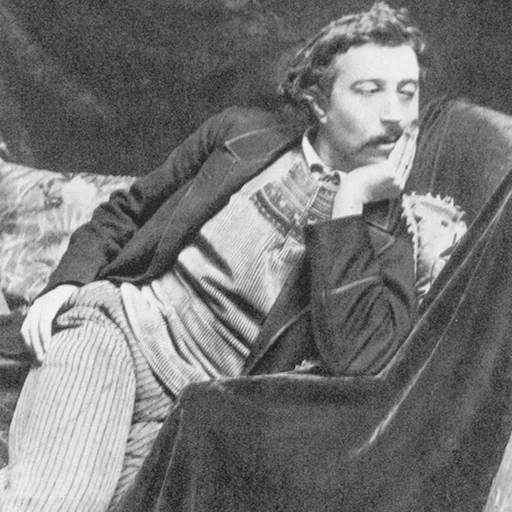
Eugène Henri Paul Gauguin (; French: ; 7 June 1848 – 8 May 1903) was a French painter, sculptor, printmaker, ceramist, and writer, whose work has been primarily associated with the Post-Impressionist and Symbolist movements.

![Mahna no Varua Ino (The Demon Speaks) [verso], by Paul Gauguin](https://artifactworldgallery.com/img/paul-gauguin--mahna-no-varua-ino-the-demon-speaks-verso--4d5371963e3166cc-w320.webp)