Artwork
Les Feste du mois de Janvier (January: the Circumcision)
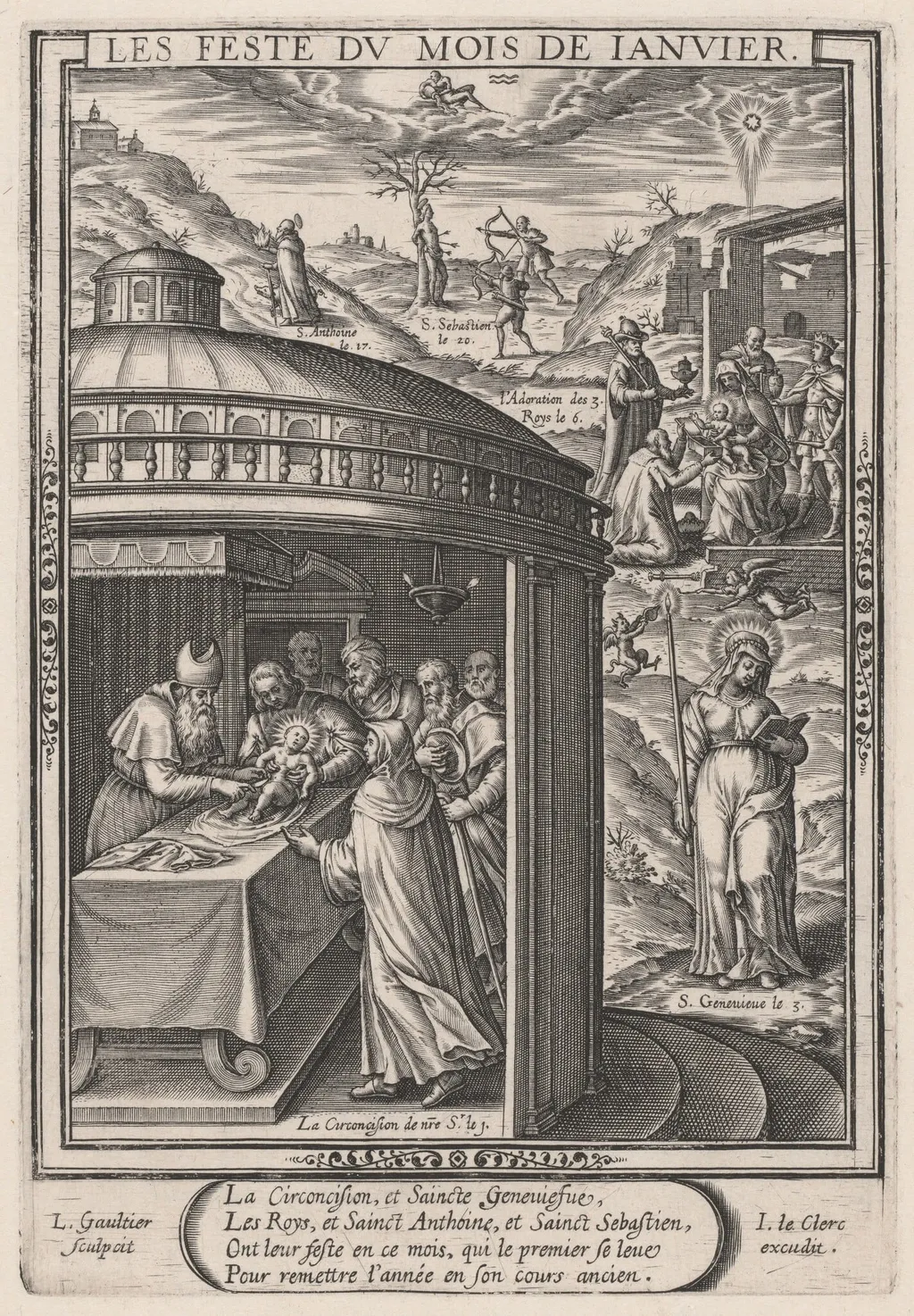
Les Feste du mois de Janvier (January: the Circumcision) is an ink print by the Baroque artist Léonard Gaultier. It dates from 1603 and is held in the collection of the National Gallery of Art.
About this work
This engraving shows a crowded scene from 1603. Christ sits on a table. A priest holds him. Other men stand around. The paper is small—about the size of your palm.
Look close. The lines are sharp. Gaultier used cross-hatching. That means he carved tiny lines to make shadows and shapes. It makes the scene feel busy but clear.
This style feels like old prints you’d find in a museum. Try another artist. Look up Gaultier, Léonard.
Overview
Leonard Gaultier’s 1603 engraving, titled “Les Feste du mois de Janvier (January: the Circumcision),” presents a compact tableau measuring roughly 19 by 13 centimeters. Executed on laid paper, the print captures a liturgical moment with a dense arrangement of figures, each rendered with precise line work that conveys the solemnity of the rite.
Subject & Meaning
The image illustrates the biblical episode of Christ’s circumcision, a ritual observed eight days after his birth. Central to the composition is the infant Christ, supported by a priest, while surrounding participants—elders, witnesses, and attendants—form a semi‑circular crowd, emphasizing the communal aspect of the ceremony and its theological significance within the early Christian calendar.
Technique & Style
Gaultier employs a meticulous cross‑hatching technique, carving fine, intersecting lines to model volume and generate subtle tonal variations.
Gaultier employs a meticulous cross‑hatching technique, carving fine, intersecting lines to model volume and generate subtle tonal variations. This method produces a bustling yet legible scene, where the interplay of light and shadow delineates individual gestures and attire. The engraving’s sharp linear quality reflects the broader aesthetic of early 17th‑century French printmaking, prioritizing clarity of narrative over painterly softness.
History & Provenance
Created in 1603, the print belongs to a series that marked the months of the liturgical year, each depicting a specific feast. While the original publisher remains unidentified, surviving copies are held in several European collections, indicating the work’s circulation among devotional and scholarly audiences during the early modern period.
Artist & collection
Artist
Léonard Gaultier, or, as he sometimes signed himself, Galter, a French engraver, was born at Mainz about 1561, and died in Paris in 1641.

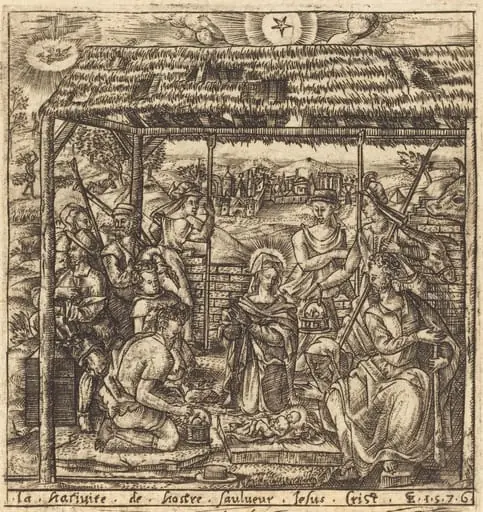

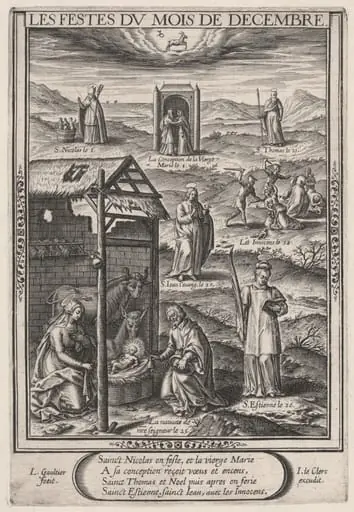 Les Festes du mois de Decembre (December: The Nativity)
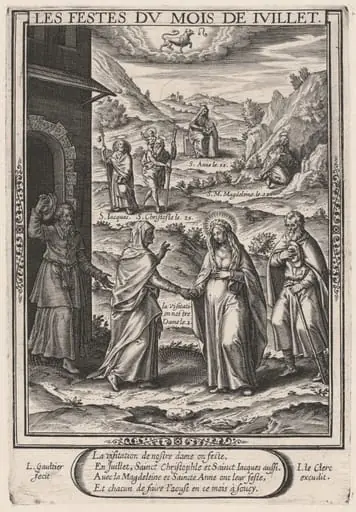 Les Festes du mois de Juillet (July: The Visitation)
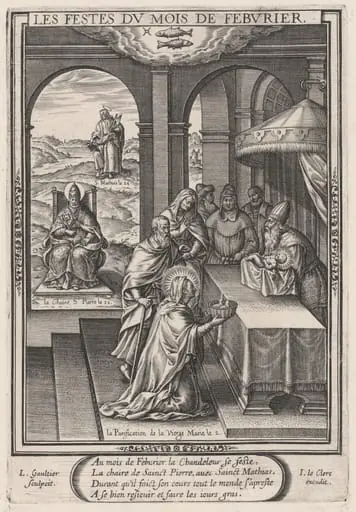 Les Festes du mois de Feburier (February: the Purification of the Virgin)
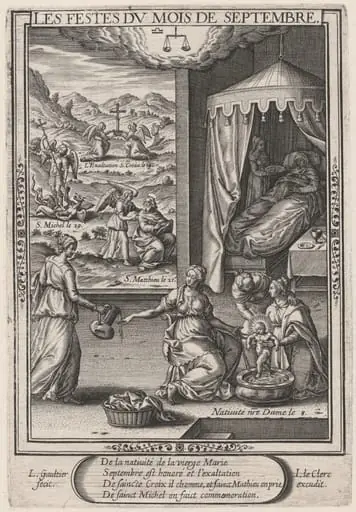 Les Festes du mois de Septembre (September: Birth of the Virgin)
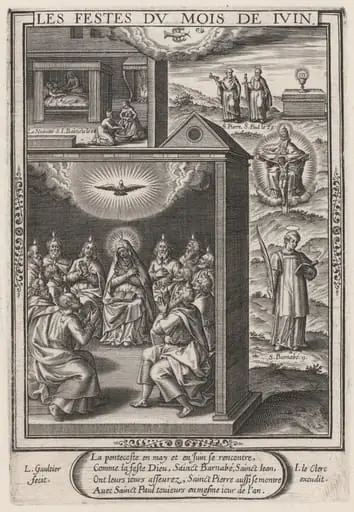 Les Festes du mois de Juin (June: The Pentecost)
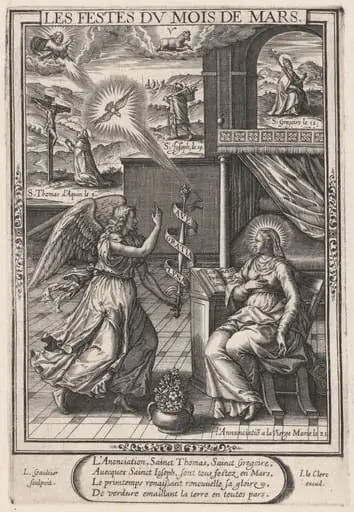 Les Festes du mois de Mars (March: The Annunciation)
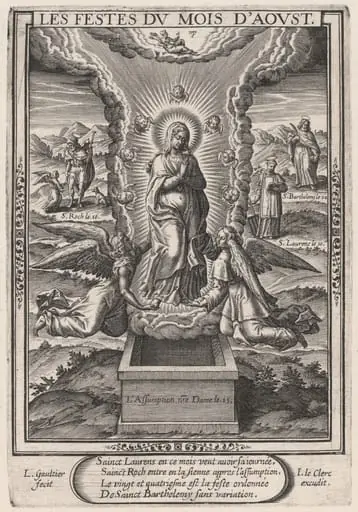 Les Festes du mois d'Aoust (August: The Assumption)