Artwork
Christ as Salvator Mundi
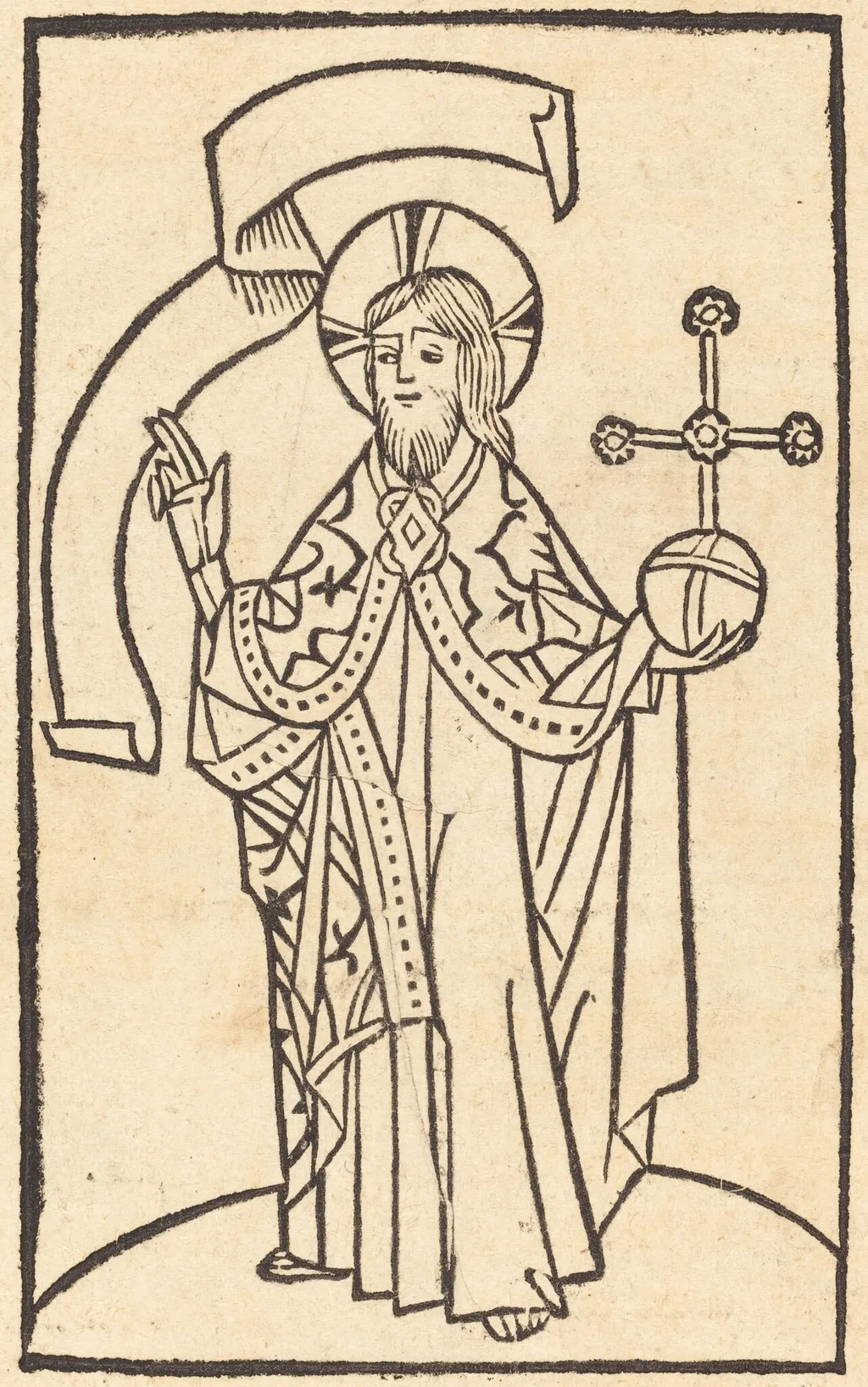
Christ as Salvator Mundi is an ink print by the Renaissance artist German 15th Century. It dates from 1475 and is held in the collection of the National Gallery of Art.
About this work
Overview
Christ as Salvator Mundi is a woodcut print that presents a frontal figure of Christ holding a globe in his left hand and a tall cross in his right. The saint is encircled by a halo, wears a beard, and is robed in flowing garments marked with dotted ornamentation. The background is minimal, reduced to a few linear hints of space, emphasizing the central figure.
Subject & Meaning
The composition identifies Christ as the "Savior of the World" through the globe, a traditional symbol of earthly dominion, and the cross, the instrument of his crucifixion. The halo denotes divinity, while the serene, static pose conveys authority and benevolence, inviting contemplation of his role as universal redeemer.
Technique & Style
Executed as a woodcut, the image was carved in relief on a wooden block, inked, and pressed onto paper. The process yields bold, geometric lines and flat areas of color, evident in the crisp outlines and simplified forms. The dotted patterns on the robes and the stark contrast between figure and background reflect the graphic aesthetic typical of early printmaking.
Context
Woodcut printing was a prevalent method for reproducing religious imagery in the pre‑modern era, allowing relatively inexpensive distribution of devotional images. This work aligns with the broader tradition of using the Salvator Mundi motif to reinforce Christian teachings across diverse audiences, especially in regions where printed material could reach a wider public than painted altarpieces.
Artist & collection

Artist
This 15th-century German artist carved vivid religious scenes into metal and wood, then hand-painted them in bright, symbolic colors.

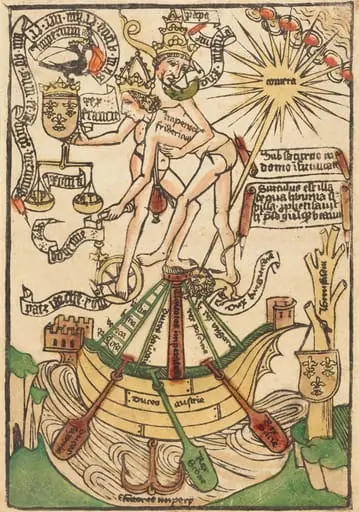 Allegory of the Meeting of Pope Paul II and Emperor Frederick III
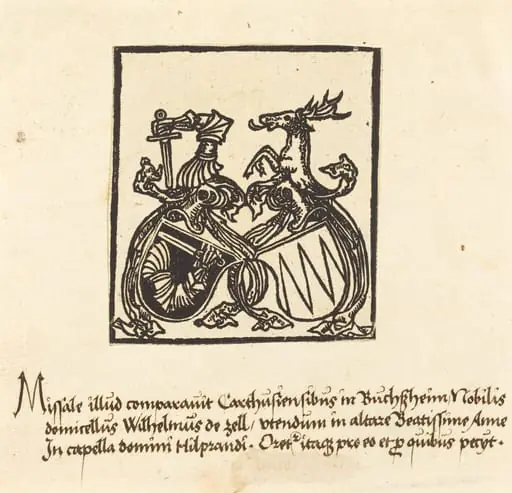 Bookplate of Wilhelm von Zell
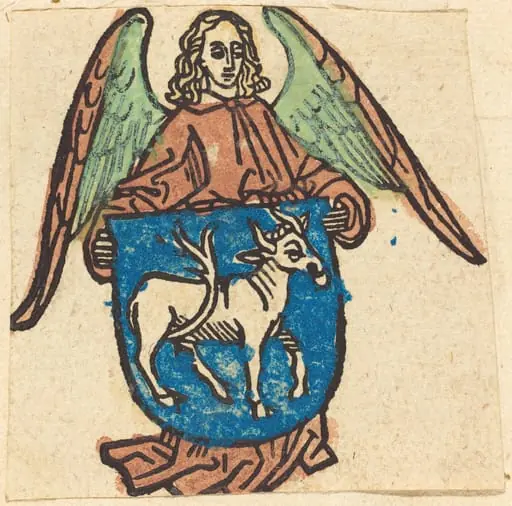 Bookplate of Hilprand Brandenburg of Bibrach
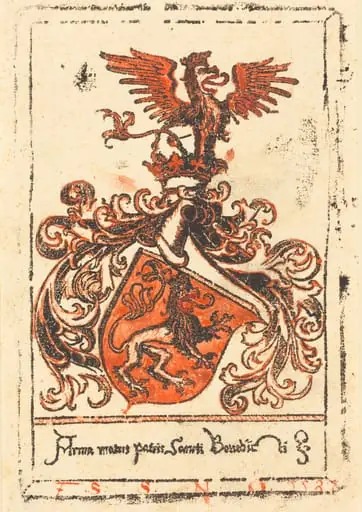 Bookplate of the Abbey of Ottobeuren
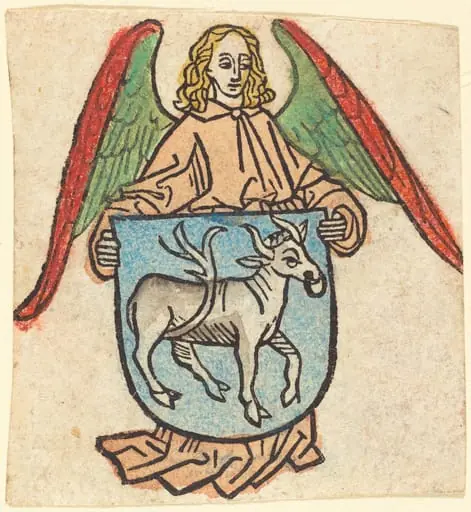 Bookplate of Hilprand Brandenburg of Bibrach
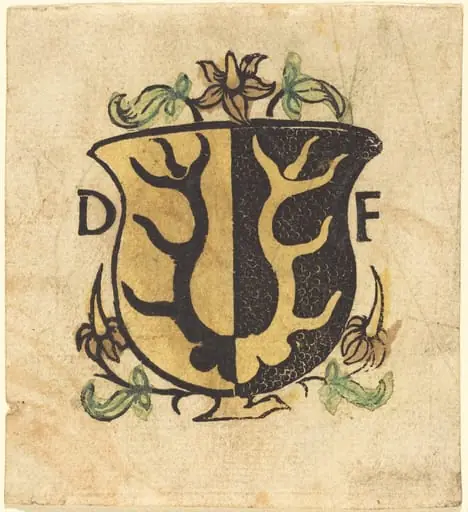 Bookplate of Dominicus Frauenfelder
![Studies for Six Figures (sheet from a model book) [recto], by German 15th Century](https://artifactworldgallery.com/img/german-15th-century--studies-for-six-figures-sheet-from-a-model-book-recto--4837429e0755bc3f-w320.webp) Studies for Six Figures (sheet from a model book) [recto]
Studies for Six Figures (sheet from a model book) [recto]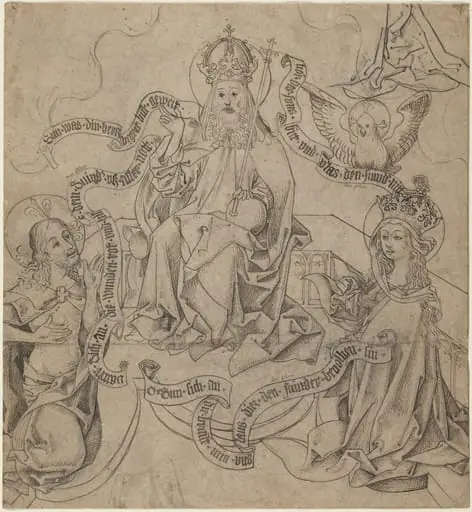 Christ and Mary Interceding with God the Father
![Saint John the Baptist [recto], by German 15th Century](https://artifactworldgallery.com/img/german-15th-century--saint-john-the-baptist-recto--4347da889e7eef62-w320.webp)