Artwork
Little Nell Roused by the Bargeman
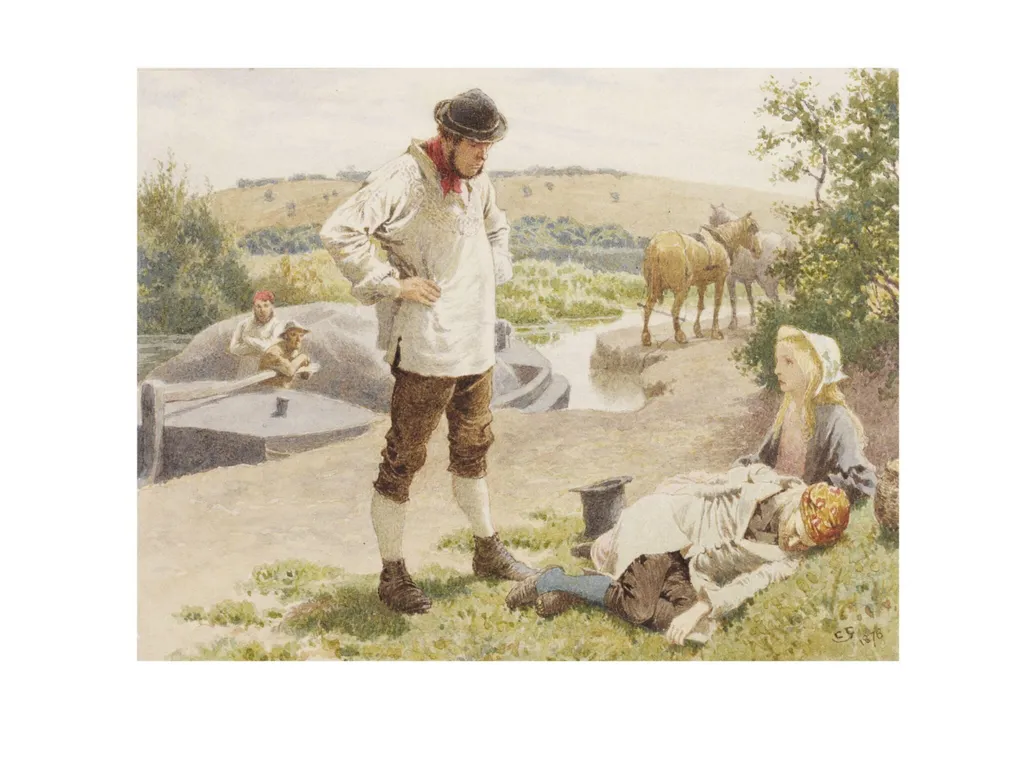
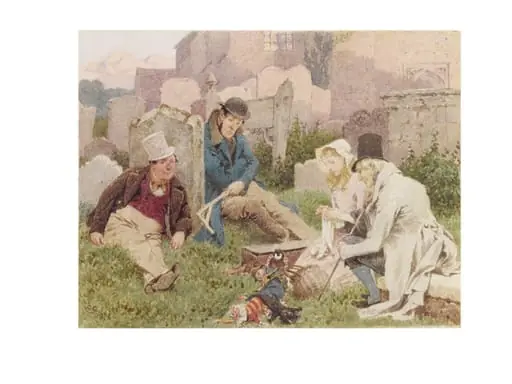
Little Nell Roused by the Bargeman is a watercolor work on paper by the Impressionist artist Charles Green. It dates from 1876 and is held in the collection of the Victoria and Albert Museum.
About this work
Overview
The composition centers on the interaction between the two figures, framed by a rural landscape of distant hills and a moored vessel.
Charles Green’s watercolour captures a quiet moment from Charles Dickens’s *The Old Curiosity Shop*, illustrating the bargeman’s tender awakening of the young girl Little Nell. Rendered in delicate washes, the scene unfolds along a riverbank at dawn, where stillness and restraint define the mood. The composition centers on the interaction between the two figures, framed by a rural landscape of distant hills and a moored vessel.
Subject & Meaning
The scene references a pivotal moment in Dickens’s novel, where Little Nell, exhausted from her journey, is gently roused by a bargeman who offers quiet aid. His posture—leaning slightly, gaze lowered—conveys compassion without intrusion. The setting, removed from urban chaos, underscores themes of innocence, vulnerability, and fleeting kindness in a harsh world, aligning with Dickens’s moral tone.
Technique & Style
Green employs transparent watercolour with soft, layered washes to evoke early morning light and atmospheric depth. The brushwork is restrained, avoiding sharp outlines; forms emerge through subtle tonal shifts. The bargeman’s clothing and the grass are rendered with loose, fluid strokes, while the distant landscape fades into pale blues and greens, enhancing the scene’s hushed, contemplative quality.
History & Provenance
Painted in the mid-19th century, the work emerged during a period when literary illustration in watercolour gained popularity among British artists. It likely originated as a standalone piece intended for private collection rather than publication. Its provenance traces to private British holdings, with no record of public exhibition during Green’s lifetime.
Context
Green’s image reflects a broader Victorian interest in illustrating Dickens’s novels, particularly scenes emphasizing moral sentiment and rural simplicity. Watercolour was favored for its intimacy and association with domestic art, making it suitable for literary subjects. The painting aligns with contemporaneous works that sought to humanize literary characters through quiet, everyday moments.
Legacy
Though not widely reproduced, the watercolour remains a quiet example of how Victorian artists translated literary emotion into visual form. It contributes to the visual culture surrounding Dickens’s novels, offering a non-dramatic, empathetic interpretation that contrasts with more theatrical illustrations of the era. Its preservation underscores the value placed on subtle, narrative-driven watercolours in 19th-century British art.
Own this work as a print
Artist & collection
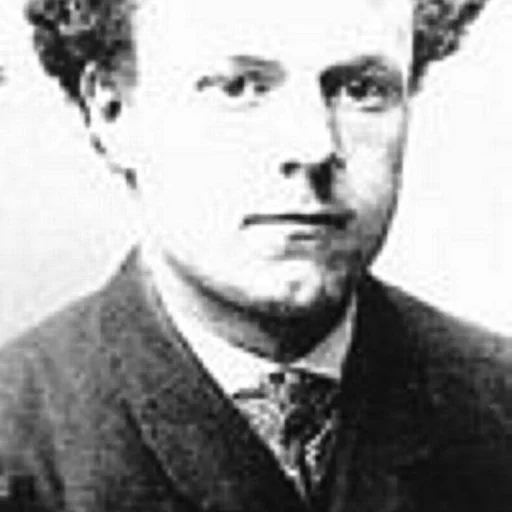
Artist
Charles Green R.I. (1840–1898), was a British watercolourist and illustrator. He was the brother of Towneley Green R.I. (1836–1899).