Artwork
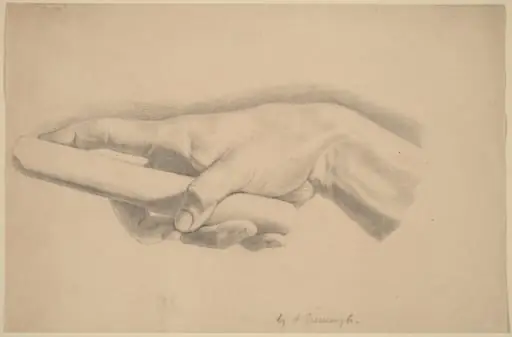
Right Hand Holding Short Rod
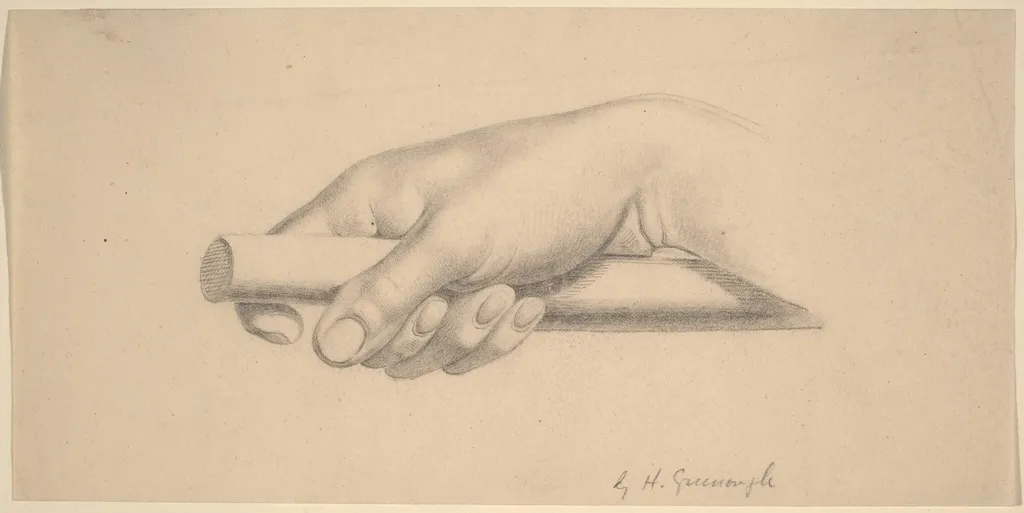
Right Hand Holding Short Rod is a graphite drawing by the Romanticist artist Horatio Greenough. It dates from 1847 and is held in the collection of the National Gallery of Art.
About this work
Overview
Created in 1847, this graphite drawing by Horatio Greenough depicts a human right hand grasping a short, cylindrical rod. Executed on wove paper, the piece is a study in form and gesture, reflecting Greenough’s interest in anatomical precision and the expressive potential of the human body, even in isolated fragments.
Subject & Meaning
The subject is a single hand, rendered without context or connection to a larger figure. The rod, held firmly but without apparent function, suggests an object of utility or ritual, yet its purpose remains ambiguous. The focus on the hand alone invites contemplation of agency, labor, or the physical trace of human action.
Technique & Style
Greenough employed graphite with controlled pressure to model the hand’s musculature and skin texture. The wove paper’s smooth surface allowed for subtle gradations, enhancing the three-dimensionality of the form. Lines are deliberate and restrained, avoiding ornamentation in favor of structural clarity and anatomical fidelity.
History & Provenance
The drawing emerged during Greenough’s time in Italy, where he studied classical sculpture and observed anatomical models. It likely served as preparatory material for larger sculptural projects, though no direct link to a finished work has been documented. The piece remained in private hands until entering a public collection in the 20th century.
Context
In mid-19th century America, artists increasingly turned to direct observation of the body as a foundation for neoclassical ideals. Greenough’s focus on isolated anatomical parts aligned with academic practices in Europe, where studies of limbs and hands were standard for sculptors training in the tradition of Michelangelo and ancient statuary.
Legacy
Though not widely exhibited, the drawing exemplifies Greenough’s commitment to anatomical study as essential to monumental sculpture. It stands as a quiet testament to the artist’s process—prioritizing observation over narrative, and form over symbolism—offering insight into the quiet labor behind larger public works.
Artist & collection

Artist
Horatio Greenough (September 6, 1805 – December 18, 1852) was an American sculptor best known for his United States government commissions The Rescue (1837–1850) and George Washington (1840).

![Study of a Right Hand [recto], by Benjamin Haydon](https://artifactworldgallery.com/img/benjamin-haydon--study-of-a-right-hand-recto--88b544f65d3eb1a7-w320.webp)
![Study of a Hand [recto], by Benjamin Haydon](https://artifactworldgallery.com/img/benjamin-haydon--study-of-a-hand-recto--a1c8376edca59300-w320.webp)