Artwork
Pendant Embellished with Flowers
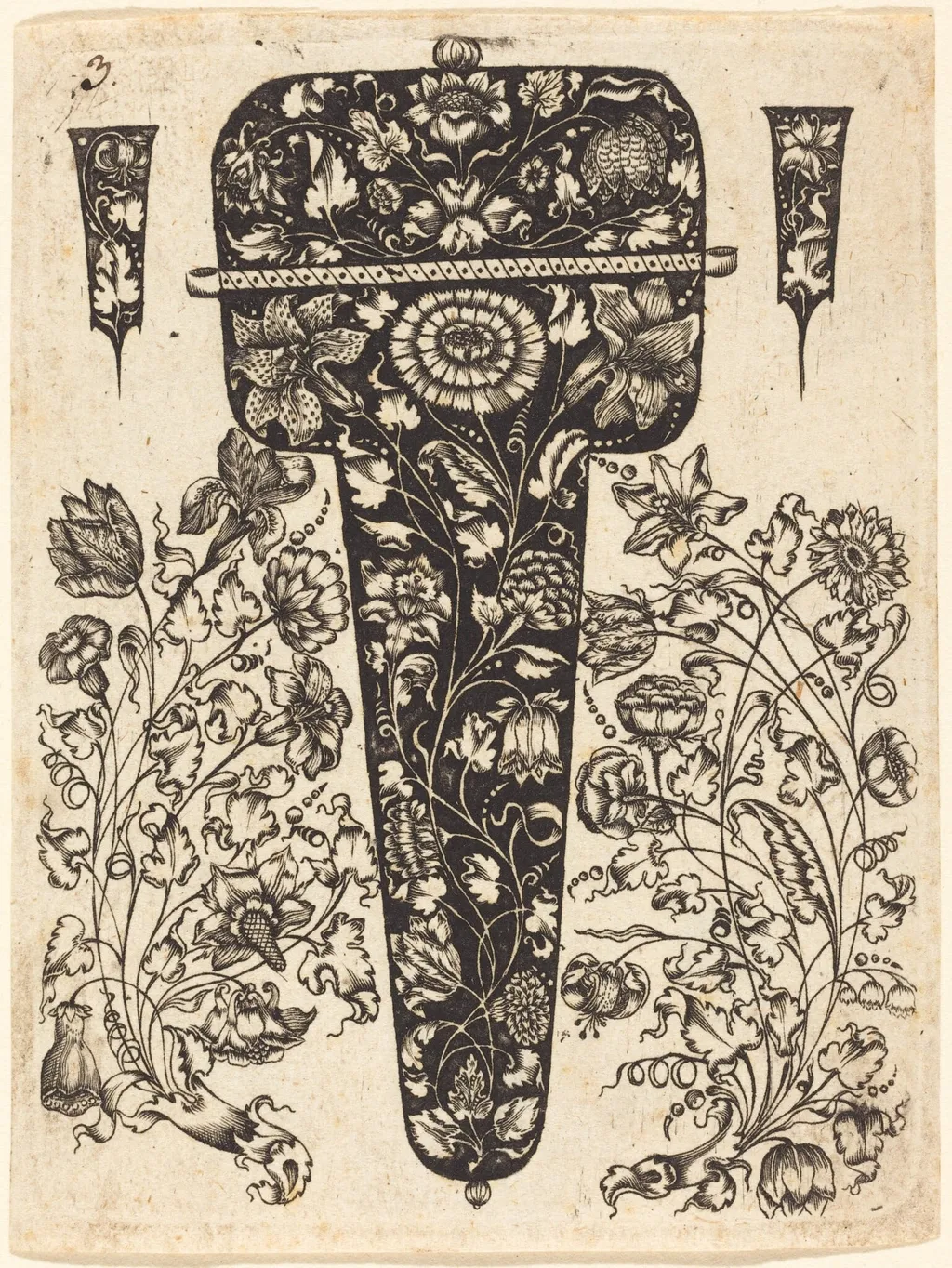
Pendant Embellished with Flowers is an ink print by the Baroque artist Johannes Hanias. It dates from 1650 and is held in the collection of the National Gallery of Art.
About this work
Overview
The work belongs to the printmaking tradition of the mid-seventeenth century, where intricate designs were carved into metal plates and transferred to paper.
Created around 1650 by Johannes Hanias, this engraving on laid paper depicts a decorative collar adorned with floral and vegetal motifs. The work belongs to the printmaking tradition of the mid-seventeenth century, where intricate designs were carved into metal plates and transferred to paper. Its monochrome palette and fine linear detail reflect the precision characteristic of engraving as a technique for reproducing ornamental forms.
Subject & Meaning
The central motif is a stylized collar, likely inspired by fashionable neckwear of the period, but transformed into an ornamental field of blossoms, leaves, and scrolling vines. The abundance of natural forms suggests an idealized representation of beauty and refinement, possibly intended as a design template or decorative study rather than a portrait accessory. The absence of human figures shifts focus entirely to the pattern’s rhythm and craftsmanship.
Technique & Style
Hanias employed engraving, a method involving incised lines carved into a metal plate with a burin. The fine, controlled strokes render delicate petals, slender stems, and swirling tendrils with remarkable consistency. The density of lines creates texture and depth, mimicking the softness of organic forms in black-and-white. This technique demands high manual skill, as each line is permanent and cannot be easily altered once cut.
History & Provenance
The work is attributed to Johannes Hanias, a lesser-known printmaker active in the mid-1600s, likely in the Netherlands or Germany. No documented ownership history is available, and the piece survives as a solitary example in institutional collections. Its function may have been as a pattern book entry or a standalone decorative print, circulated among artisans or collectors interested in textile and lace design.
Context
In the mid-seventeenth century, engraved designs of floral ornamentation were widely used in fashion, embroidery, and metalwork. This piece aligns with a broader European trend of translating natural forms into repeatable graphic patterns. While not a portrait or religious image, it reflects the era’s fascination with intricate surface decoration, often produced for domestic and aristocratic use beyond fine art.
Legacy
Though Hanias’s name remains obscure, this engraving contributes to the archive of early modern decorative arts. It preserves a visual vocabulary of floral motifs that influenced textile and jewelry design in subsequent decades. As a specimen of print-based ornament, it offers insight into how artists and craftsmen shared and adapted patterns before the rise of mass reproduction.
Artist & collection


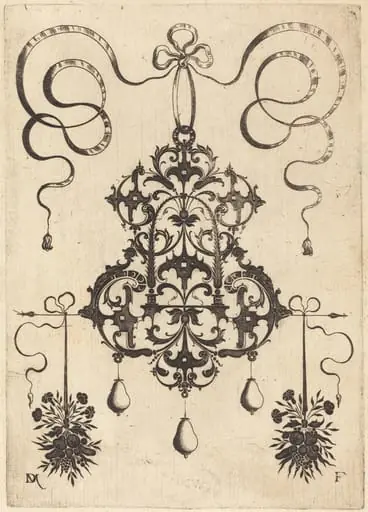 Large Pendant, Lower Left and Right Two Bunches of Grass, Flowers, and Fruit
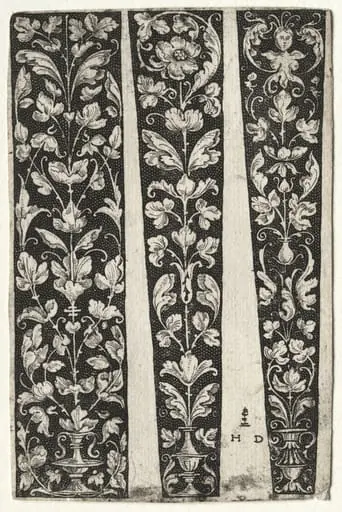 Ornamental Fillet
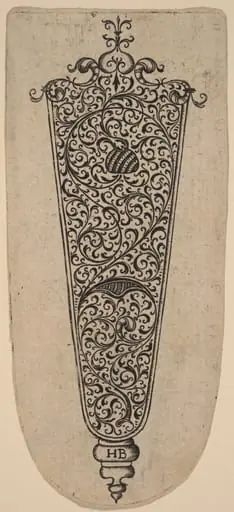 Ornament for Knife Handle
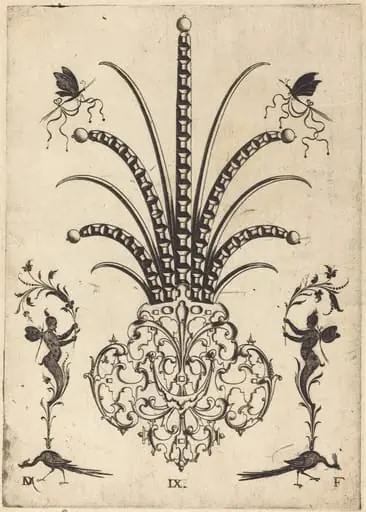 Brooch with Table-Stones, Butterflies at Top, and Peacocks and Hermes at Bottom
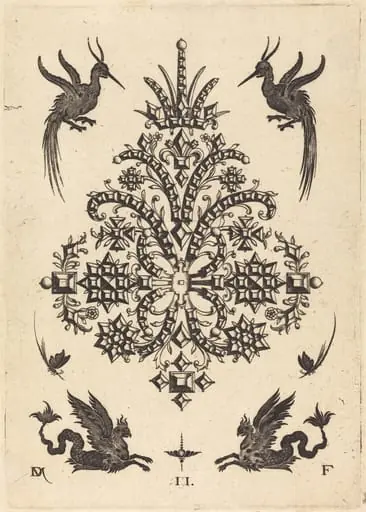 Brooch with Tablestones and Winged Griffins Above and at Bottom
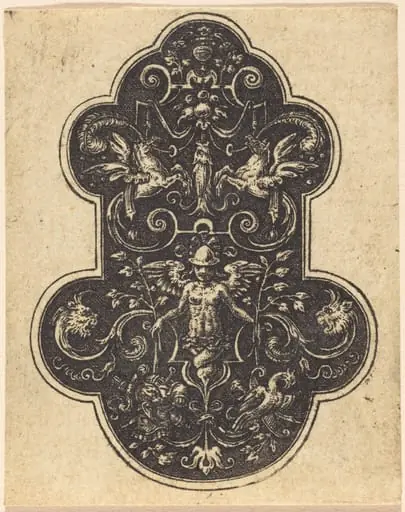 Female Figure
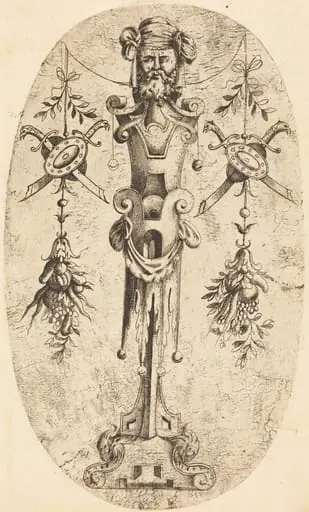 Bearded Head on a Pedestal
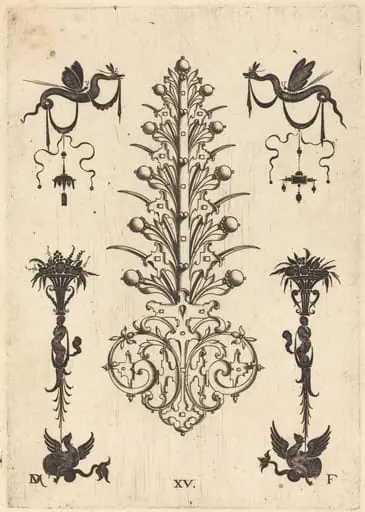 Hyacinth-Shaped Brooch with Winged Snakes at Top and Winged Animals at Bottom
 Ornament
 Brooch with Sprigs at Top and Griffins with Trophies at Bottom