Artwork
Hercules and Telephos
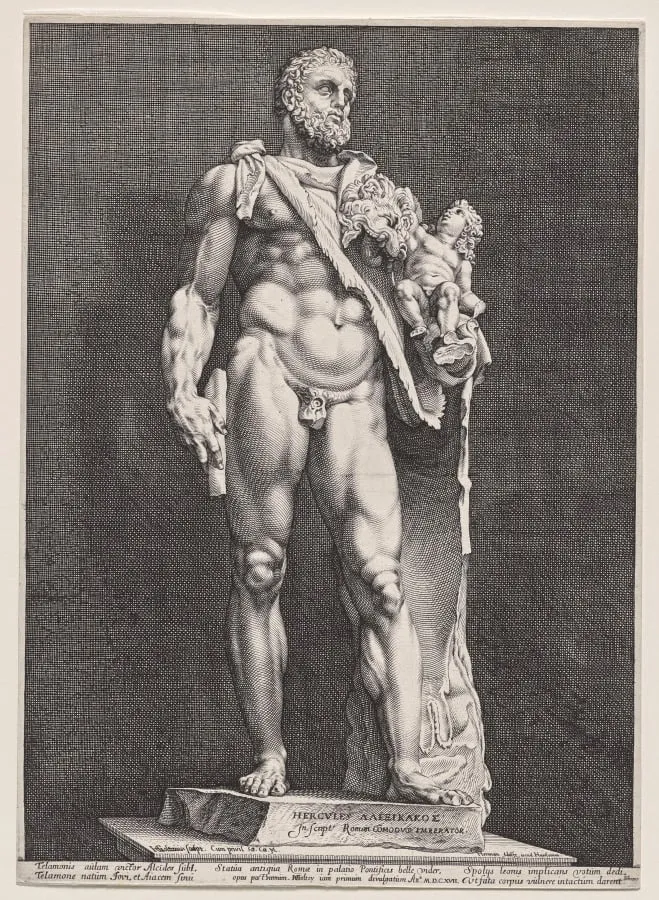
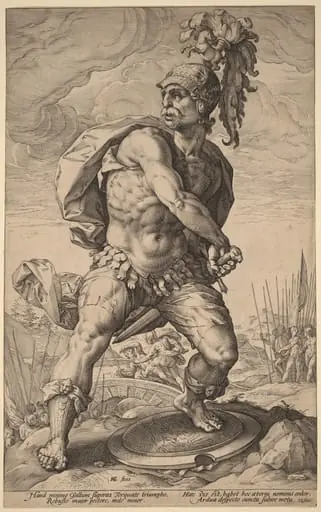
Hercules and Telephos is a print by the Renaissance artist Hendrik Goltzius. It dates from 1592 and is held in the collection of the Cleveland Museum of Art.
About this work
Overview
Hercules and Telephos is a print by Hendrick Goltzius, created after his return to Haarlem in 1591, following an artistic pilgrimage to Italy to study antique sculpture.
Subject & Meaning
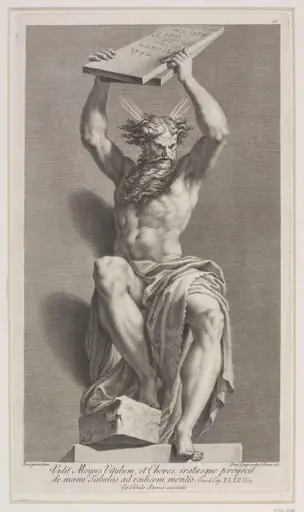
The print depicts Hercules holding his son Telephos, based on an ancient statue Goltzius encountered in Italy. The composition conveys the awe-inspiring presence of the original monument.
Technique & Style
Goltzius employed his distinctive engraving technique, characterized by swelling and tapering lines, to accentuate the heroic musculature of Hercules. Thousands of crossed lines create a dramatic, shadowed niche, utilizing chiaroscuro to project the figure into the light.
History & Provenance
Created in 1591, the engraving is part of Goltzius's post-Italian journey output, reflecting his studies of antique sculpture. Original provenance details are not provided.
Context
This work reflects the late Renaissance practice of artists traveling to Italy for classical inspiration. Goltzius's use of chiaroscuro and emphasis on sculptural form align with contemporary artistic preoccupations.
Legacy
The print demonstrates Goltzius's virtuosic engraving skills, influencing the development of Northern European printmaking. Its masterful use of chiaroscuro contributes to the broader artistic exploration of light and shadow during the Renaissance.
Artist & collection
Artist
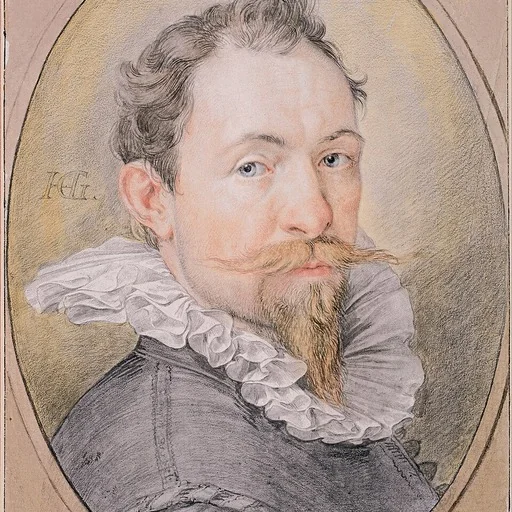
Hendrick Goltzius (German: , Dutch: ; né Goltz; January or February 1558 – 1 January 1617) was a German-born Dutch printmaker, draftsman, and painter.

![The Farnese Hercules, three-quarter view turned to left [plate 3], by François Perrier](https://artifactworldgallery.com/img/francois-perrier--the-farnese-hercules-three-quarter-view-turned-to-left-plate--b0564bebaad016fa-w320.webp)