Artwork
The Legislative Belly
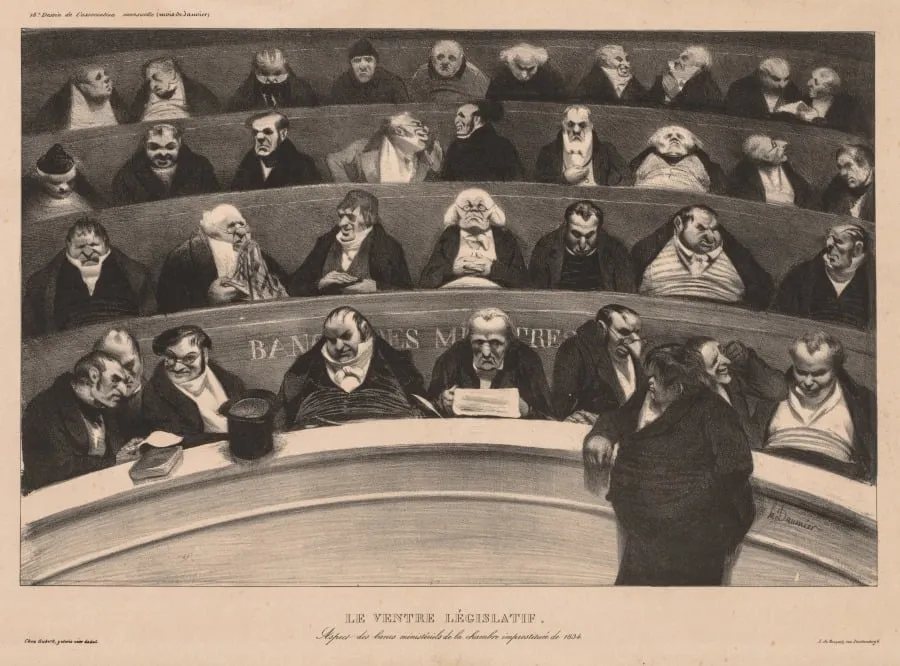
The Legislative Belly is a print by the Romanticist artist Honoré Daumier. It dates from 1834 and is held in the collection of the Cleveland Museum of Art.
About this work
Overview
The work functions as political commentary, using visual satire to critique legislative bodies rather than depict a literal meeting.
This print, numbered as plate 18, was issued as part of a special supplement to the French satirical journal La Caricature, titled L’Association Mensuelle pour la Liberté de la Presse. It was produced in 1835 during a period of heightened censorship under King Louis-Philippe. The work functions as political commentary, using visual satire to critique legislative bodies rather than depict a literal meeting.
Subject & Meaning
The image portrays a group of legislators seated around a long table, their postures and expressions conveying indifference or exhaustion. Their bodies are rendered with exaggerated, bloated forms, suggesting moral or intellectual inertia. The title 'The Legislative Belly' mocks the assembly as a bloated institution, more concerned with self-preservation than public service, reflecting public frustration with political stagnation.
Technique & Style
The print employs fine-line etching and aquatint to achieve tonal depth and texture, characteristic of 19th-century French political caricature. Figures are rendered with sharp, angular contours and minimal detail in facial features, emphasizing symbolic weight over individuality. The composition is tightly packed, reinforcing the sense of oppressive conformity and bureaucratic stagnation.
History & Provenance
Created by Honoré Daumier in 1835, the print was part of a clandestine supplement produced after the government banned La Caricature for its satirical content. The Monthly Association was distributed secretly to circumvent censorship. Daumier’s prints from this period were widely circulated among liberal circles and later collected by institutions such as the Musée d’Orsay and the British Museum.
Context
In 1835, France’s July Monarchy enacted strict press laws following a failed assassination attempt on the king. These laws shut down satirical publications and criminalized political caricature. Daumier’s work, though banned, persisted in underground editions. His depictions of lawmakers as corpulent and apathetic mirrored public disillusionment with a parliament seen as detached from the people’s needs.
Legacy
Daumier’s 'The Legislative Belly' became a defining image of political satire in 19th-century Europe. Its visual language influenced later cartoonists and illustrators who used bodily metaphor to critique authority. The print remains a key example of how art can function as civil resistance, preserving the voice of dissent during periods of repression.
Artist & collection
Artist
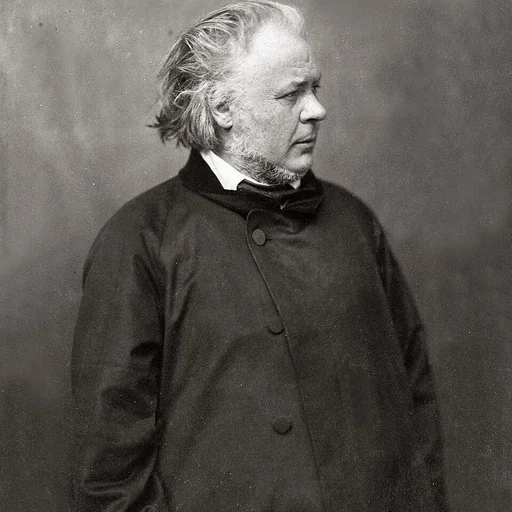
Honoré-Victorin Daumier was a French painter, sculptor, and printmaker, whose many works offer commentary on the social and political life in France, from the Revolution of 1830 to the fall of the Second French Empire in 1870.