Artwork
Tauluhuutokauppa
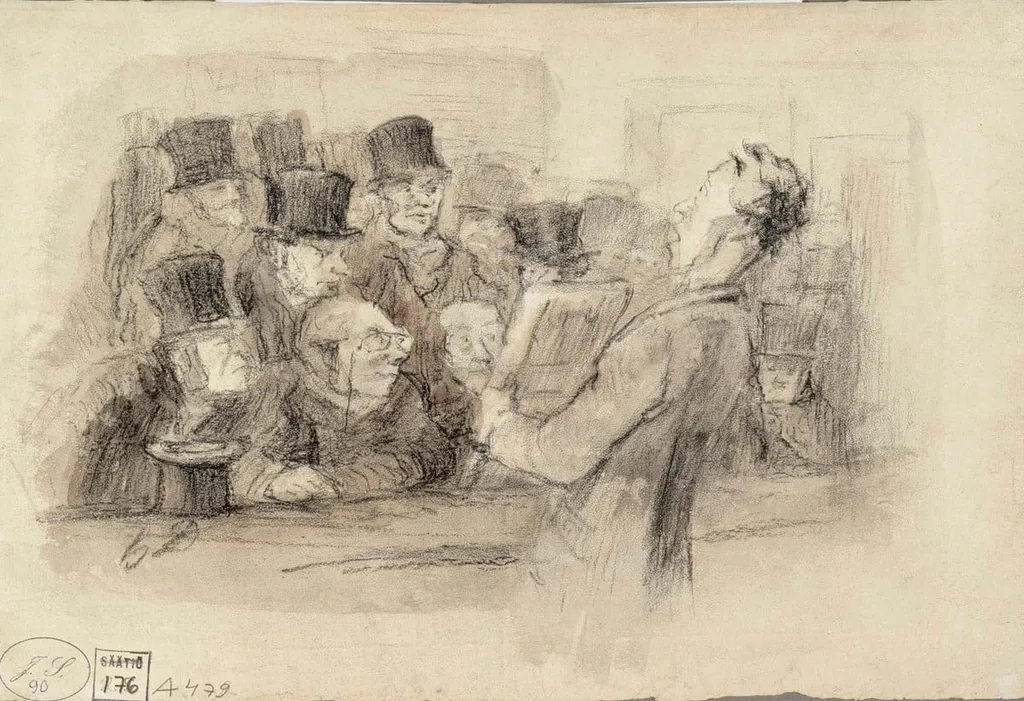
Tauluhuutokauppa is a drawing by Honoré Daumier. It dates from 1876 and is held in the collection of the Finnish National Gallery.
About this work
Overview
Unlike his more widely circulated political cartoons, this work lacks overt satire but retains his signature focus on everyday human behavior.
Created around 1876, this lithograph by Honoré Daumier captures a quiet, tense gathering in a dim interior. Unlike his more widely circulated political cartoons, this work lacks overt satire but retains his signature focus on everyday human behavior. The scene suggests a formal or bureaucratic meeting, rendered with minimal detail yet full of implied tension. Daumier’s quick, gestural lines convey motion and atmosphere rather than polished realism.
Subject & Meaning
A group of men, distinguished by their tall hats and solemn postures, appear engaged in a private discussion. One figure gestures as if speaking, while others lean in or hold documents, suggesting deliberation or decision-making. The absence of clear context invites interpretation: is this a council, an auction, or a clandestine meeting? Daumier avoids moralizing, instead presenting the scene as a candid observation of authority in quiet operation.
Technique & Style
Daumier employed loose, rapid lithographic lines to suggest form and movement rather than define them. Shadows are built through cross-hatching and tonal contrasts, with light falling sharply from one side to emphasize the contours of hats and shoulders. The roughness of the drawing enhances the sense of immediacy, as if the scene was captured mid-moment. Details are implied, not rendered—faces are barely suggested, yet their focus is unmistakable.
History & Provenance
This work belongs to Daumier’s later period, after his tenure at satirical journals had waned. It was likely produced for personal or private circulation rather than mass publication. Its survival reflects its value as a study in observation, distinct from his public caricatures. No definitive record of its early ownership exists, but it aligns with other intimate works from his final decades, preserved by collectors drawn to his unvarnished realism.
Context
In 1870s France, political instability followed the fall of the Second Empire and the turmoil of the Paris Commune. Daumier, once a vocal critic of power, turned increasingly toward quiet, observational works. This piece reflects a shift from overt satire to subtle documentation—capturing the weight of institutional routines without overt judgment. The tall hats, common among bourgeois and official classes, subtly signal social hierarchy without caricature.
Legacy
Daumier’s late works like this one influenced later realist and expressionist artists who valued emotional truth over idealized form. His ability to convey psychological depth through minimal means became a model for capturing the unspoken dynamics of social life. Though less celebrated than his political cartoons, these intimate sketches reveal the depth of his perception and his enduring interest in the quiet rituals of power.
Artist & collection
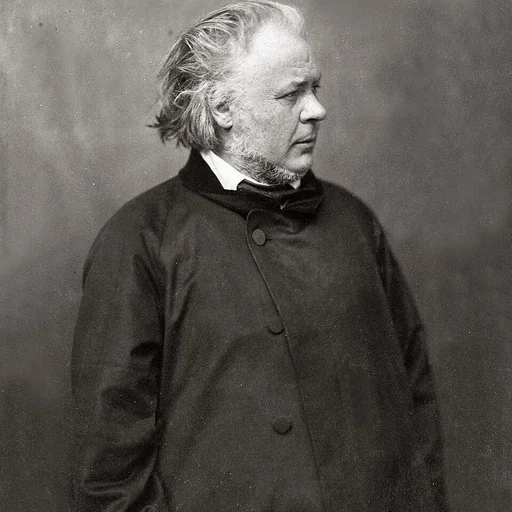
Artist
Honoré-Victorin Daumier was a French painter, sculptor, and printmaker, whose many works offer commentary on the social and political life in France, from the Revolution of 1830 to the fall of the Second French Empire in 1870.









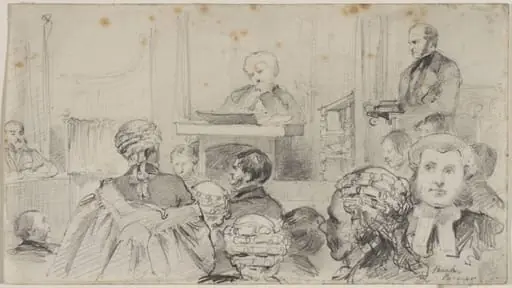 Sheets of studies of participants in a legal action
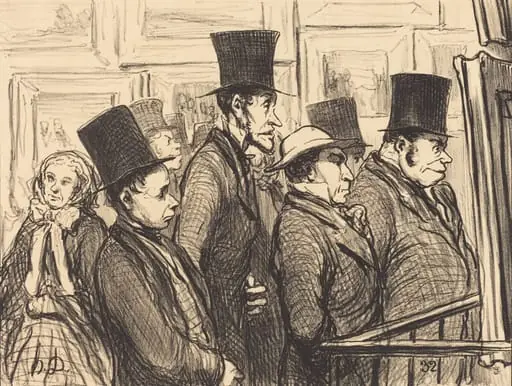 Cristi... v'la-t-y un boeuf qui est bien fait!...
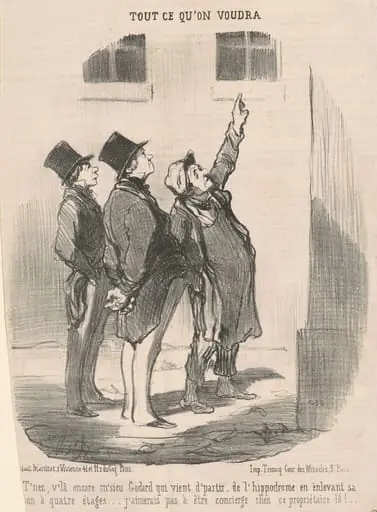 T'nez, v'la encore M'sieu Godard ...
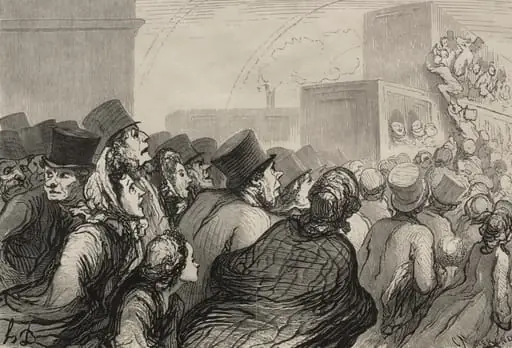 The Railway: The Sunday Excursion
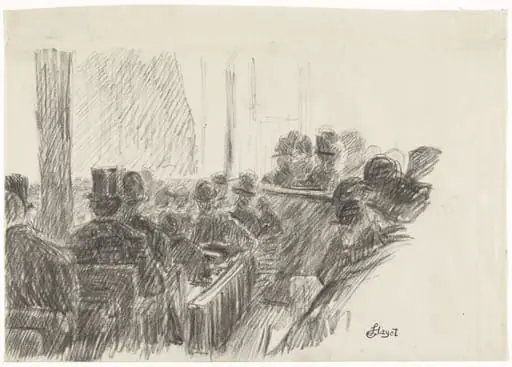 Untitled
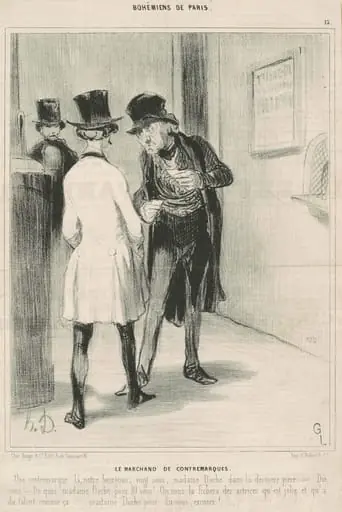 Le marchand de contremarques
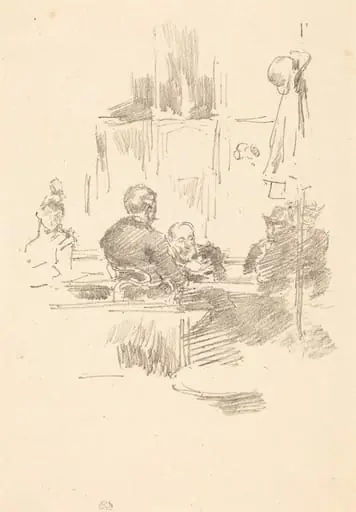 Late Picquet
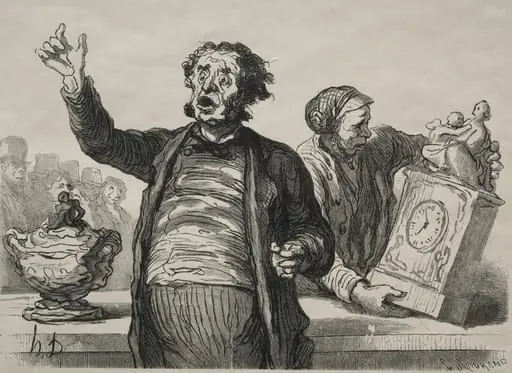 The Auction House: The Town Crier
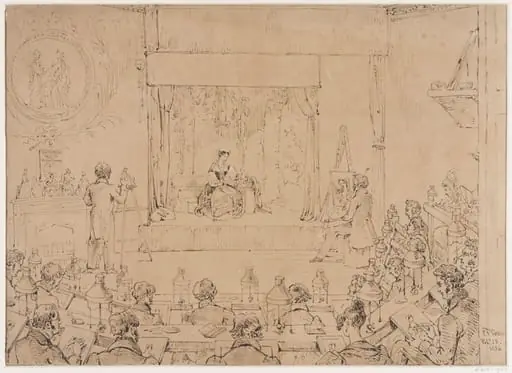 Untitled
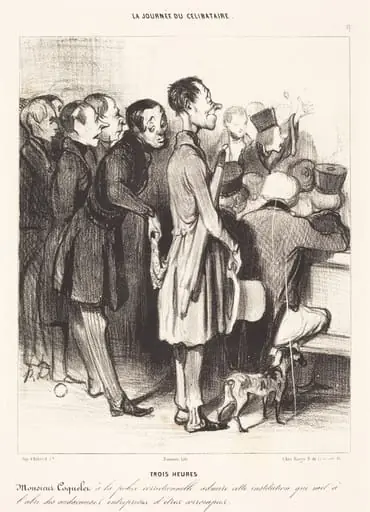 Trois heures
 Longshoremen
 Oh! Monsieur, quel talent possède ...