Artwork
Architectural drawing
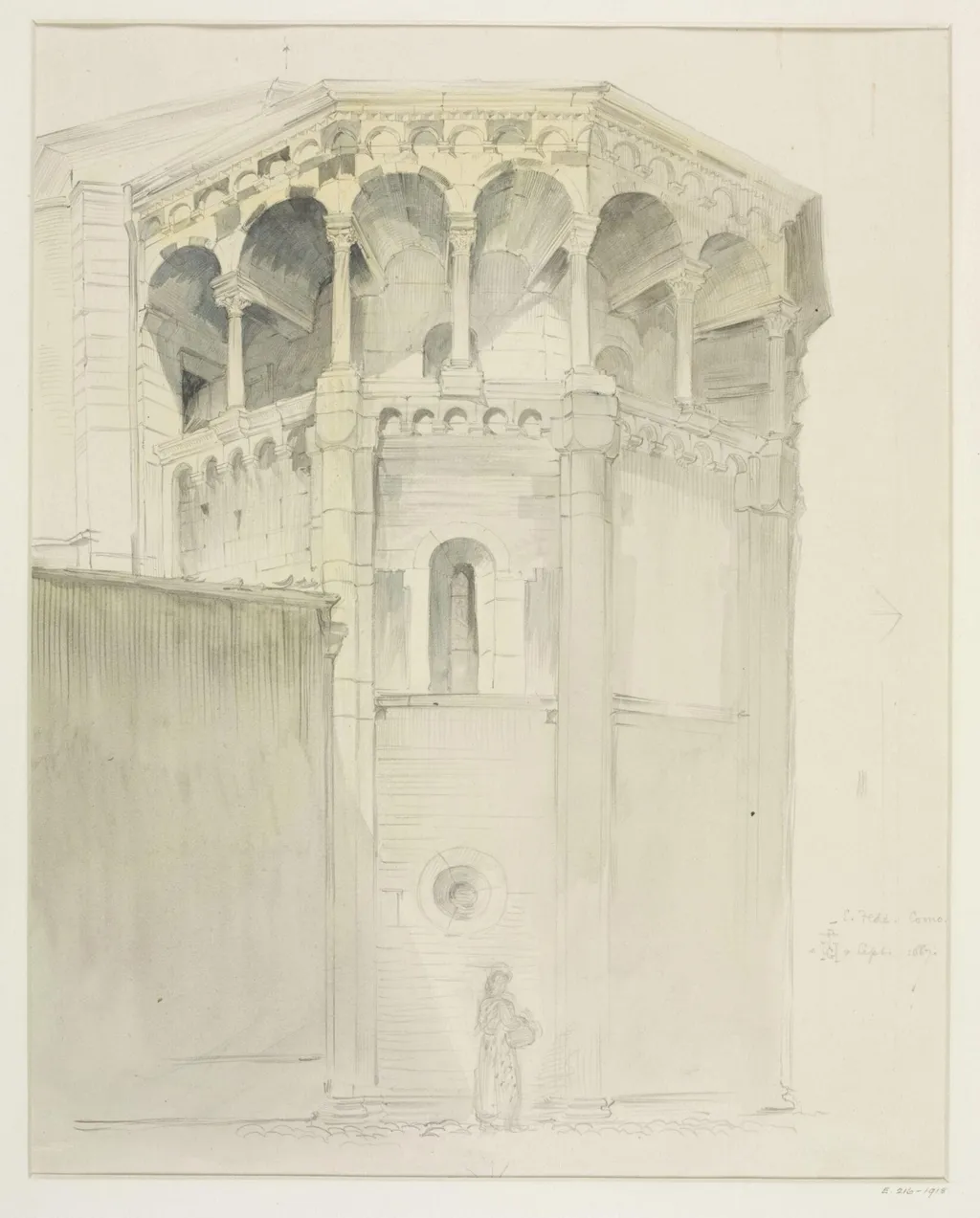
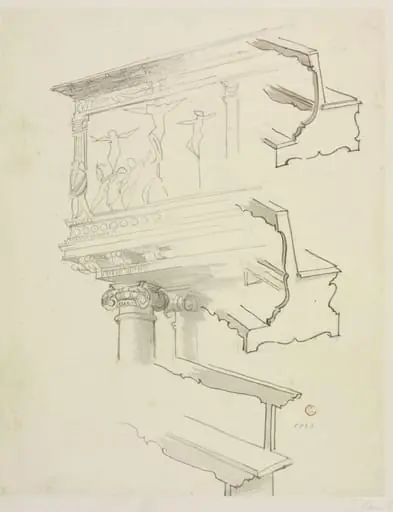
Architectural drawing is a drawing by the Impressionist artist Gerald Callcott Horsley. It dates from 1887 and is held in the collection of the Victoria and Albert Museum. This pencil sketch captures a simplified architectural form: a tall, hollow structure with an apse and an upper gallery.
About this work
Overview
This pencil sketch captures a simplified architectural form: a tall, hollow structure with an apse and an upper gallery. The rendering is minimal, emphasizing mass and silhouette over ornamentation. Light, fluid strokes define the walls and roofline, while the absence of fine detail suggests it was made as a rapid observational study rather than a finished presentation.
Subject & Meaning
The subject is a religious or ceremonial building, likely inspired by Romanesque architecture, with horseshoe arches supporting a raised gallery. The solitary figure at the base introduces scale and human presence, but does not engage with the structure. The focus remains on the building’s form, suggesting an interest in spatial volume rather than narrative or function.
Technique & Style
The drawing employs loose, rapid pencil strokes to suggest volume and shadow. Hatching is subtle and uneven, avoiding precise definition. The roof’s small, repeated marks imply openings without detailing them, and the walls are rendered in faint outlines. This approach prioritizes light, form, and composition over architectural accuracy, aligning with sketchbook practices of observational study.
History & Provenance
The drawing’s origin and creator are undocumented. Its sketch-like quality and lack of inscription suggest it was made privately, possibly during travel or study. No record of exhibition or ownership exists prior to its current location, indicating it was likely retained by the artist or a close associate as a working note.
Context
The form echoes Romanesque ecclesiastical architecture, particularly in the use of rounded, horseshoe arches and elevated galleries. Such features were common in medieval Spanish and southern French religious buildings. The sketch may reflect the artist’s engagement with regional styles, possibly during a period of study or pilgrimage, though no specific site has been identified.
Legacy
As a fragmentary study, the drawing holds no direct influence on later works or movements. Its value lies in its quiet documentation of an artist’s process—how form was observed, reduced, and recorded without embellishment. It stands as a quiet example of how architectural ideas were absorbed through direct, unpolished observation.
Artist & collection
Artist
Gerald Horsley spent his days sketching the city like a human camera, stopping mid-walk to press pencil to paper outside a shop or up a church aisle.

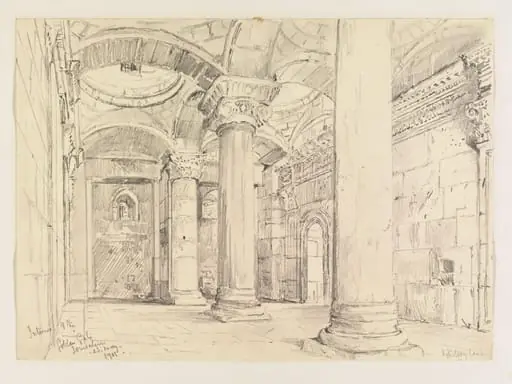 Interior of the Golden Gate Jerusalem
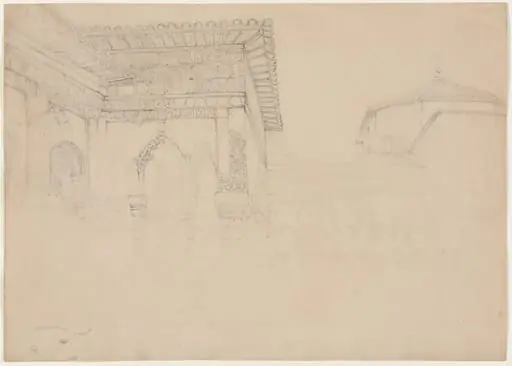 The Court of the Lions, Alhambra
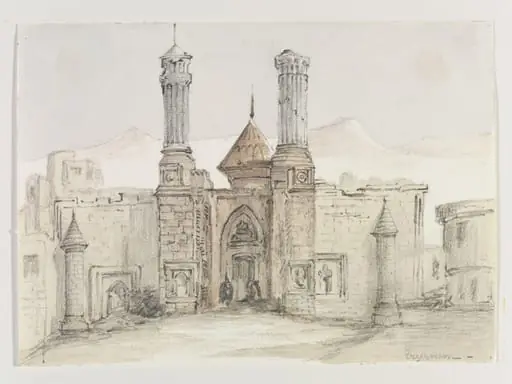 Erzeroum
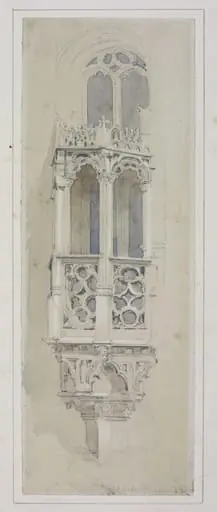 Sketch of a window and balcony, Hotel de Ville, Brussels
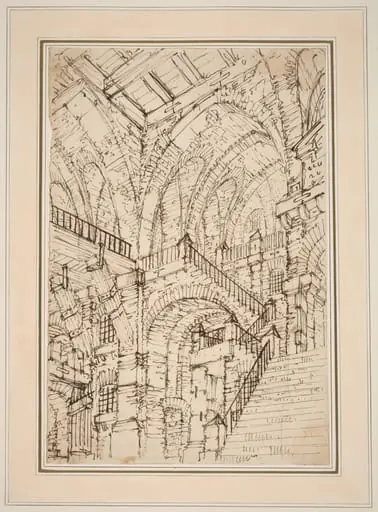 A Prison Interior with a Monumental Staircase
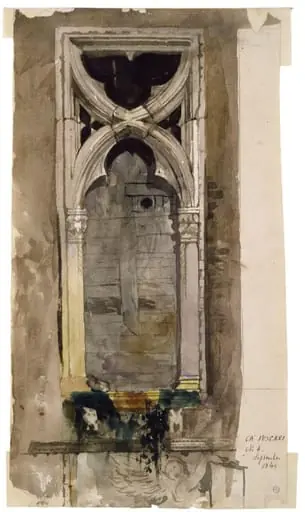 Window in the Foscari Palace, Venice
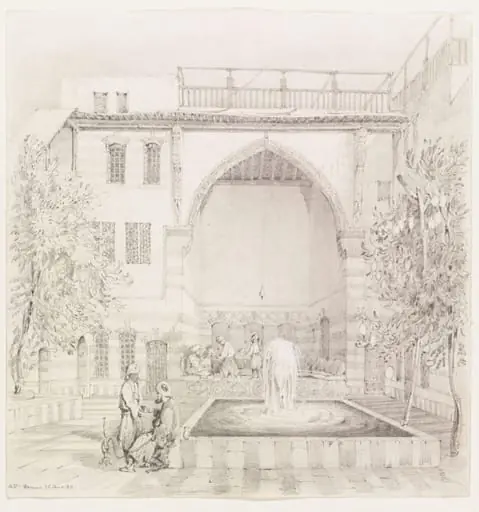 Damas
Damas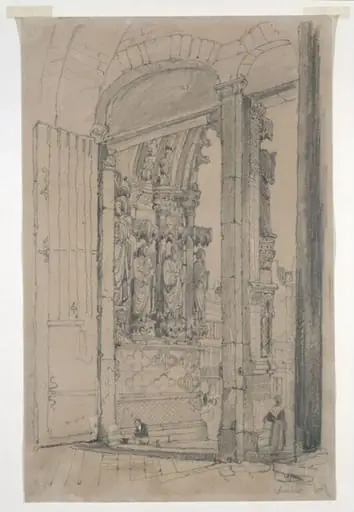 Amiens Cathedral
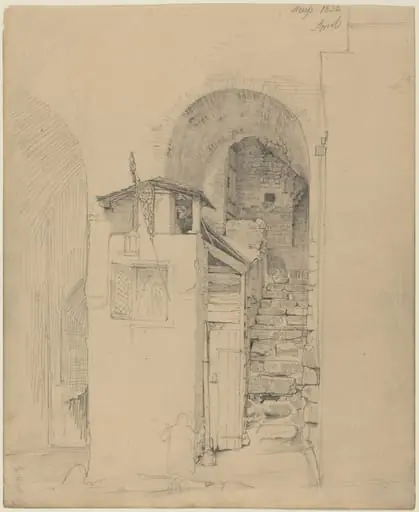 Ruined Stairs at Neuss
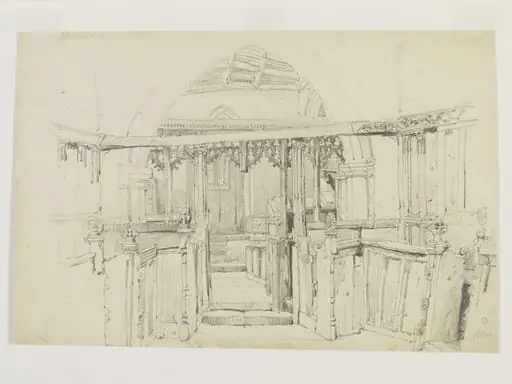 Blore-Ray Church in Staffordshire
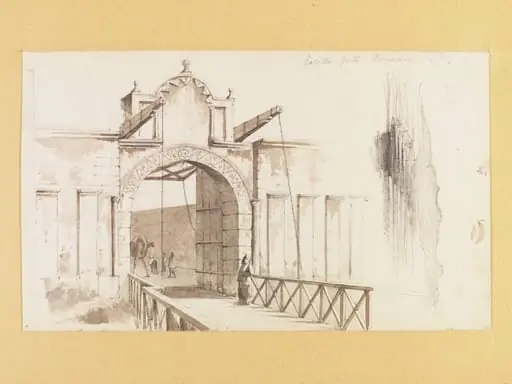 Rosetta Gate, Alexandria
 Untitled