Artwork
Bobiță
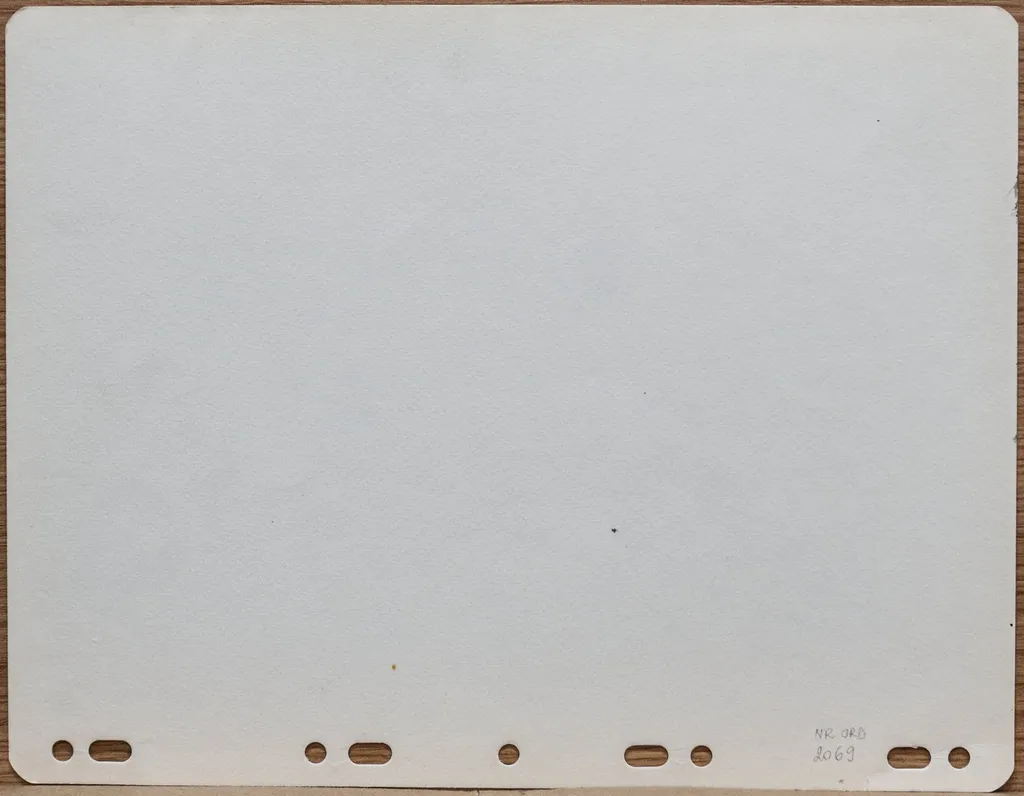
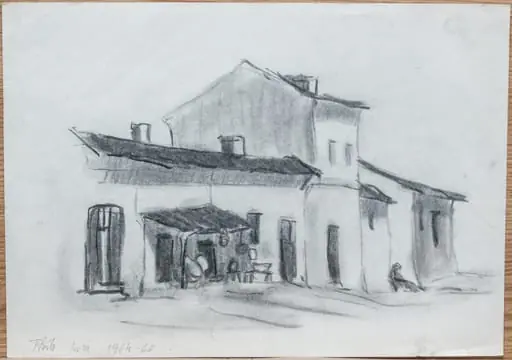
Bobiță is a drawing by Teodor Hrib. It dates from 1950 and is held in the collection of the Gavrila Simion Eco-Museum Research Institute Tulcea.
About this work
Overview
“Bobiță,” executed around 1950 by Romanian artist Teodor Hrib, is a minimalist drawing preserved in the Museum of Ethnography. The work consists of an unadorned white sheet punctuated by a handful of faint marks, a solitary blue dot near the centre, a subtle yellowish smudge to the right, and a series of six tiny rectangular cut‑outs along the lower edge.
Subject & Meaning
The composition’s stark emptiness invites contemplation of absence and the materiality of the paper itself. The isolated blue point and the muted yellow smudge function as focal gestures, while the perforated rectangles suggest a tactile, perhaps ritualistic, intervention, prompting viewers to consider the interplay between presence and void.
Technique & Style
Hrib employed a restrained hand, using light pencil or charcoal strokes for the faint marks and a small ink application for the blue dot. The rectangular apertures were likely produced with a precision cutting tool, emphasizing the artist’s interest in subtractive processes and the physical alteration of the support.
History & Provenance
Created circa 1950, “Bobiță” entered the collection of the Museum of Ethnography, where it remains on display. The work’s acquisition date is not recorded publicly, but its presence in the museum aligns with the institution’s focus on objects that blur the boundaries between fine art and ethnographic material.
Context
The piece emerges from a post‑World‑II period in which many Eastern European artists explored reductionist aesthetics and the material properties of everyday media. Hrib’s minimal intervention reflects broader trends toward abstraction and conceptual inquiry, positioning the work within a mid‑century dialogue about the essence of drawing.
Artist & collection
Artist
Teodor Hrib shaped small plaster figures and ink drawings in the 1800s academic tradition.
Museum
Gavrila Simion Eco-Museum Research Institute Tulcea
Continue through works from the same source collection.
 S 32 - Peisaj la Sulina (Dunăre și maluri pierdute în pete de culoare)
 S 33 - Peisaj la Sulina (Dunăre și faleză cu tufe de flori grena)
 S1 - Peisaj la Sulina (Casă și pomi)
 S5 - Peisaj la Sulina (Stradă cu pomi și casă)
 S 14 - Omagiul meu Sulinei (Mal de Dunăre cu trandafir și bărci)
 Peisaj (cu stradă)
 Pavagii
 În portul Tulcea
 S 35 - Peisaj la Sulina (Maluri de Dunăre la răsărit)
 Iarna pe faleză
 Peisaj de iarnă