Artwork
Young Woman Peeling Apples (dummy board)
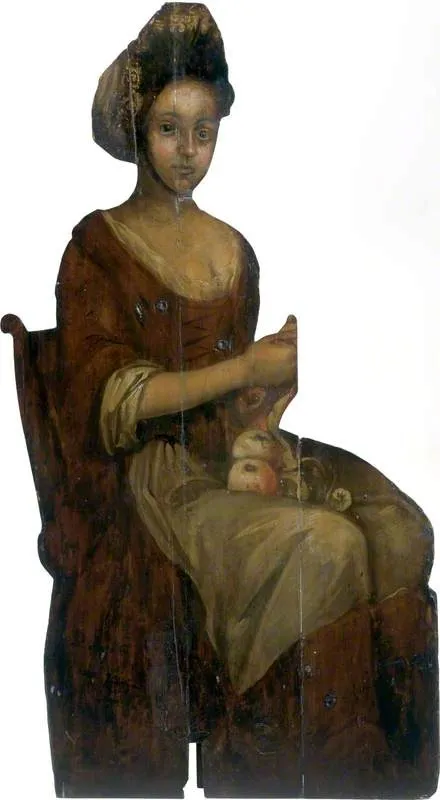
Young Woman Peeling Apples (dummy board) is an unspecified painting by the Dutch Golden Age artist Unknown. It dates from 1696 and is held in the collection of the Victoria and Albert Museum. This small panel painting depicts a young woman engaged in the quiet act of peeling apples.
About this work
Overview
The plain white background isolates her, drawing attention to her posture and the subtle play of light across her form.
This small panel painting depicts a young woman engaged in the quiet act of peeling apples. Rendered in oil on wood, it captures a moment of domestic labor with restrained realism. The composition is tightly focused, eliminating extraneous detail to emphasize the figure and her task. The plain white background isolates her, drawing attention to her posture and the subtle play of light across her form.
Subject & Meaning
The woman, dressed in modest attire with a white cap and apron, represents an everyday laborer rather than an idealized figure. Her focused gaze and deliberate motion suggest routine, not narrative drama. The apples, a common household item, imply themes of sustenance and domestic order. The absence of symbolic embellishment points to a quiet celebration of ordinary life, typical of genre scenes in early modern Dutch art.
Technique & Style
The artist employs chiaroscuro to model the woman’s form, using soft transitions between light and shadow to suggest volume and texture. The folds of her apron, the curve of her hand, and the sheen of the apple are rendered with careful attention to surface and weight. Brushwork is precise but unobtrusive, avoiding theatricality. The limited palette—browns, whites, and muted tones—enhances the painting’s intimate, unadorned character.
History & Provenance
The painting is a dummy board, a type of panel used to simulate a three-dimensional object in a still-life setting, often hung in kitchens or pantries. Such objects were popular in 17th-century Dutch households as decorative illusions. Its original context suggests it was meant to blend into domestic space, functioning as both art and illusion. Its survival as a standalone work reflects later appreciation for genre scenes.
Context
Created during the Dutch Golden Age, this work aligns with a broader trend of depicting humble domestic activities with dignity. Artists of the period increasingly turned to everyday subjects—cooking, cleaning, reading—as worthy of artistic attention. The absence of religious or mythological themes reflects the secular values of the emerging middle class, who commissioned such works to reflect their own lives.
Legacy
Though unsigned and attributed to an anonymous hand, the painting exemplifies the quiet precision of Dutch genre painting. It influenced later realist traditions by demonstrating how ordinary moments could be rendered with emotional resonance through careful observation. Today, it is valued not for its fame but for its unpretentious insight into daily life in early modern Europe.
Artist & collection

 Domestic Scene
 Giacomo and Cardinal Marco, investing Andrea, Abbot of San Zeno, with his Benefice
 The Nymph of Fontainebleau
 Portrait of a Woman
 Madonna and Child with Saints in the Enclosed Garden
 Venus and Minerva
 Family Group of Four on Sofa
 Wall painting from Room H of the Villa of P. Fannius Synistor at Boscoreale
 Female Street Player with a Guitar (dummy board)
 Boy with an Arrow (dummy board)
 Saint Ann
 Portrait of Irena Solska
 Child Beggar
 Standing Female Figure (decorative panel)
 Standing Female Figure (decorative panel)
 Efect de lumină
 A Lady Seen from Behind
 Buchet cu flori de lămâi; pandant: Buchet de flori cu anemone
 Ceres
Ceres Woman with a Mirror (dummy board)