Artwork
Helios on the chariot. Allegory with the coats of arms of Trąby (Woyna) and Nałęcz (Górski)
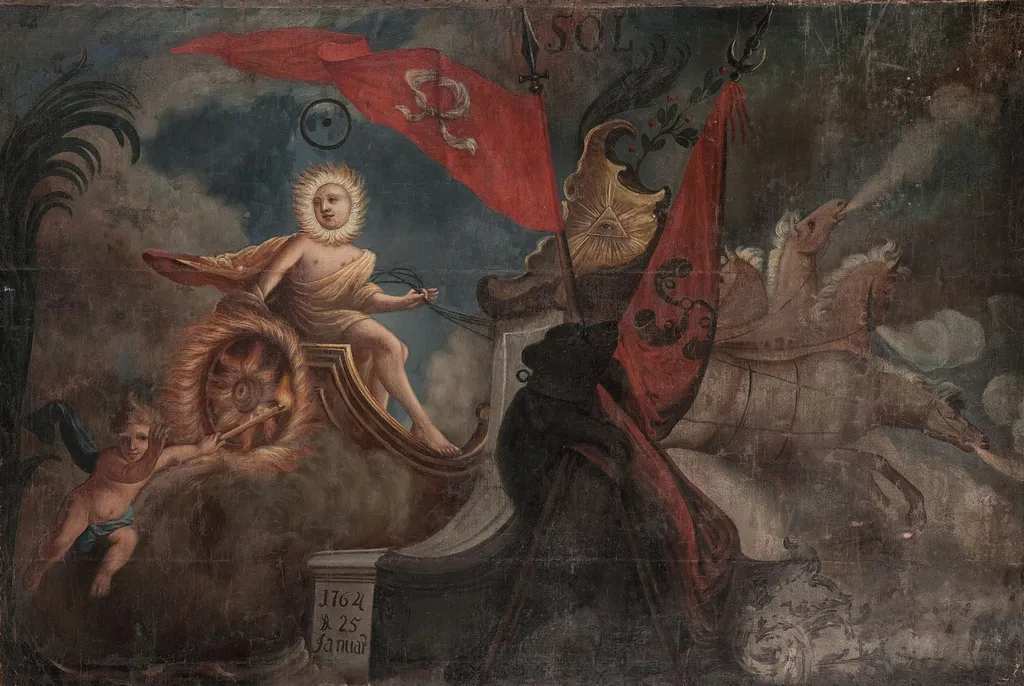
Helios on the chariot. Allegory with the coats of arms of Trąby (Woyna) and Nałęcz (Górski) is an oil painting by the Rococo painting artist Unknown. It dates from 1764 and is held in the collection of the National Museum in Warsaw. The work, executed in oil on canvas, depicts a winged rider steering a blazing chariot drawn by a pair of horses.
About this work
The sky is dark with swirling clouds, and the chariot driver holds the reins while a small cherub looks on.
This painting shows a winged figure riding a flaming chariot pulled by two horses. The sky is dark with swirling clouds, and the chariot driver holds the reins while a small cherub looks on. Red flags with symbols and a golden sun emblem wave behind them.
The date "1764" is written on a pedestal in the scene, hinting this was made long ago. The flags might represent families or groups from history.
Look up chiaroscuro to see how artists use light and shadow like this.
Overview
The work, executed in oil on canvas, depicts a winged rider steering a blazing chariot drawn by a pair of horses. Dark, turbulent clouds dominate the sky, while a diminutive cherubic figure observes from the foreground. Behind the procession, two red banners bearing heraldic devices flutter, and a golden sun motif crowns the scene. A pedestal within the composition bears the inscription 1764, indicating its date of creation.
Subject & Meaning
The central figure represents the sun god Helios, traditionally shown traversing the heavens in his fiery vehicle. The accompanying cherub serves as a symbolic attendant, emphasizing the divine nature of the journey. The inclusion of the Trąby and Nałęcz coats of arms on the flags suggests a commemorative function, linking the mythological narrative to specific noble families and possibly celebrating their patronage or lineage.
Technique & Style
Rendered in oil, the painting employs pronounced chiaroscuro, contrasting the luminous chariot and sun emblem against the brooding, cloud‑filled backdrop. The artist’s handling of light creates a dramatic sense of movement, while the detailed rendering of the horses’ musculature and the intricate heraldic symbols demonstrate a meticulous approach typical of late Baroque portraiture combined with allegorical motifs.
History & Provenance
The date inscribed on the pedestal places the piece in the mid‑18th century, a period when allegorical commissions were common among the Polish‑Lithuanian nobility. The presence of the Trąby (Woyna) and Nałęcz (Górski) arms indicates that the work likely originated as a private commission for members of these families, though its subsequent ownership record remains limited.
Context
In 1764, the Polish–Lithuanian Commonwealth was experiencing political turbulence, and noble families often employed allegorical art to assert status and convey virtues such as enlightenment and continuity. By aligning themselves with Helios, the patrons could associate their lineage with the sun’s regenerative power and the timeless order it symbolized within a shifting sociopolitical landscape.
Artist & collection

 Domestic Scene
 Giacomo and Cardinal Marco, investing Andrea, Abbot of San Zeno, with his Benefice
 The Nymph of Fontainebleau
 Portrait of a Woman
 Madonna and Child with Saints in the Enclosed Garden
 Venus and Minerva
 Family Group of Four on Sofa
 Wall painting from Room H of the Villa of P. Fannius Synistor at Boscoreale
 Juno and Luna
 Diana's Admission to Olympus
 Mars on his chariot pulled by wolves
 Alegoría de la Aurora
 Saint Michael Archangel attacking the dragon
 Apollo in his Chariot
 Allegory of the donation of the Casino to Queen María Isabel de Braganza by the Municipality of Madrid
 Figure of the Royal Magnificence, Immortality and Progress in the Fine Arts
 The Chariot of Phoebus
 Putti with a Festoon
 Apotheose der Maria Anna Luisa de' Medici
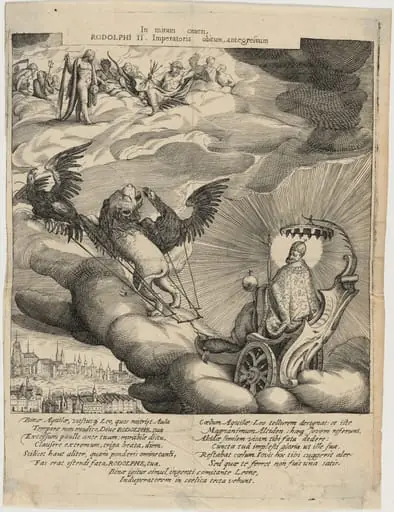 Rudolph II in Chariot Drawn by Lion and Eagle