Artwork
From the Farhang-i Jahangiri (Persian-language Dictionary) compiled by Mir Jamal al-Din Husayn Inju of Shiraz (Persian, d. 1626)
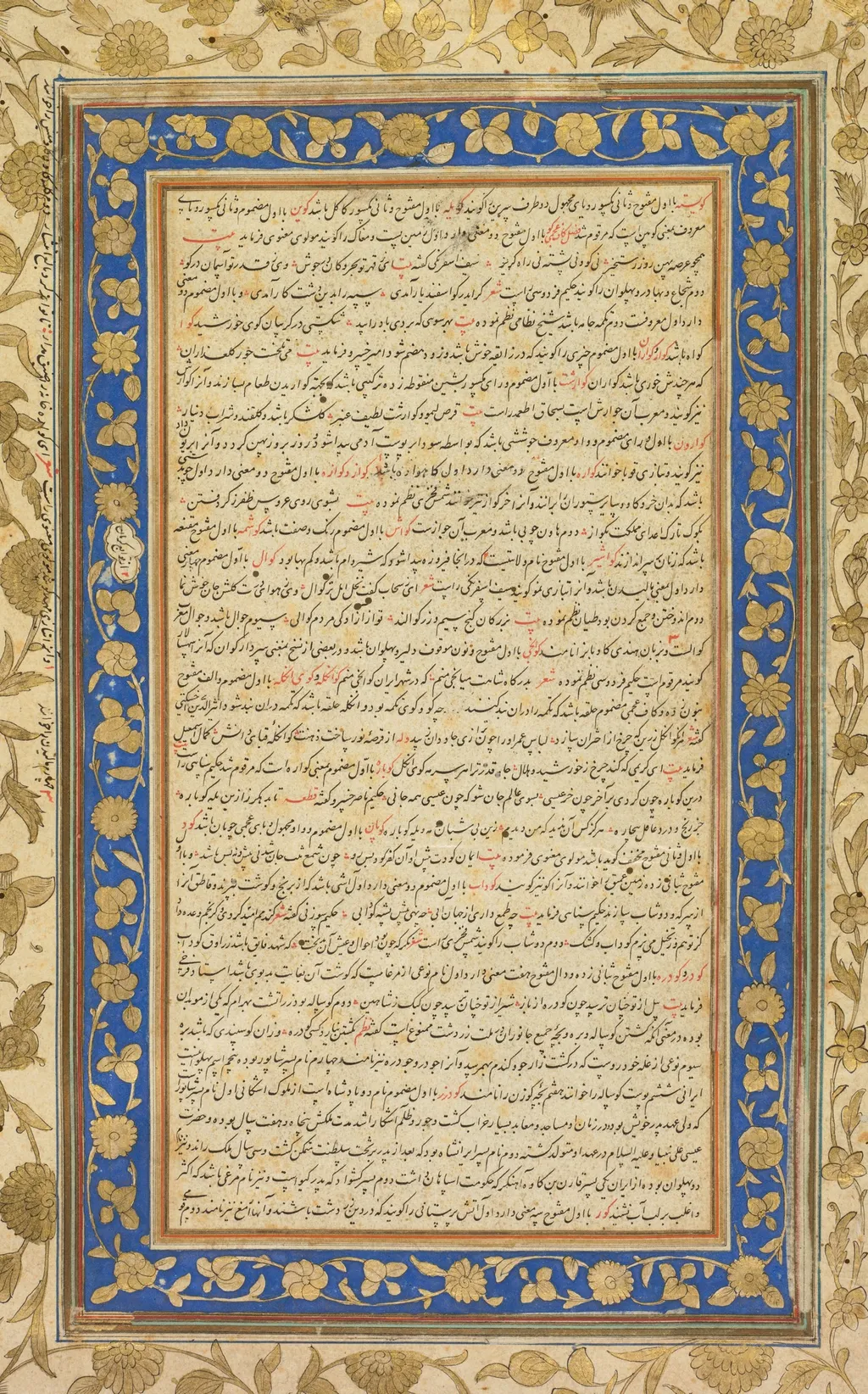
From the Farhang-i Jahangiri (Persian-language Dictionary) compiled by Mir Jamal al-Din Husayn Inju of Shiraz (Persian, d. 1626) is an unspecified painting. It dates from 1607 and is held in the collection of the Cleveland Museum of Art.
About this work
Overview
This illuminated page originates from the Farhang-i Jahangiri, a Persian dictionary compiled by Mir Jamal al‑Din Husayn Inju of Shiraz, who died in 1626.
This illuminated page originates from the Farhang-i Jahangiri, a Persian dictionary compiled by Mir Jamal al‑Din Husayn Inju of Shiraz, who died in 1626. The manuscript features dense black Arabic calligraphy arranged in tight rows, set against a light background that accentuates the ink. Decorative borders of blue and gold, populated with stylized flowers and vines, frame the text, while red dots highlight particular letters.
Subject & Meaning
The page serves as a lexical reference, presenting entries from the dictionary rather than a narrative illustration. The ornamental motifs—floral vines and gold accents—function as visual enhancers, guiding the reader’s eye across the script and underscoring the scholarly importance of the work.
Technique & Style
The calligraphy is executed in a precise, black ink, typical of Persian manuscript tradition, with uniform spacing that maximizes legibility. The surrounding border combines painted and gilded elements: blue pigments form a patterned field, over which gold leaf or paint creates intricate floral designs. Red ink is used sparingly to mark specific letters, a common practice for emphasis in Persian texts.
History & Provenance
Compiled in the early 17th century under the patronage of Mir Jamal al‑Din Husayn Inju, the dictionary reflects the scholarly activity of Safavid Shiraz. The manuscript’s survival suggests it was valued as a reference work and possibly circulated among literate elites of the period.
Context
During the Safavid era, Persian dictionaries were essential tools for poets, scholars, and administrators. The integration of elaborate illumination with functional text exemplifies the period’s aesthetic, where even utilitarian books received artistic treatment to reflect cultural prestige.
Legacy
Pages such as this illustrate the convergence of literary scholarship and visual art in early modern Iran, informing contemporary understandings of Persian manuscript production. Their decorative schemes continue to influence modern interpretations of Safavid artistic conventions.
Artist & collection

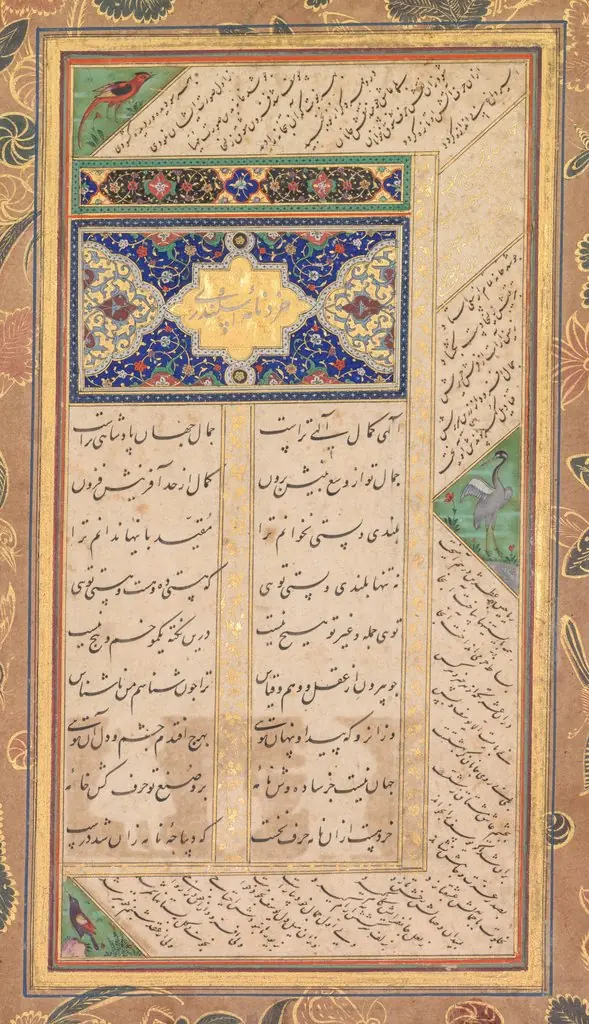 Illuminated page (verso), from a Panj Ganj (Five Treasures) of Abd al- Rahman Jami (Persian, 1414–1492) with two Persian masnavis: Yusuf va Zulaykha (Joseph and Zulaykha) and Khirad-nama-i Iskandari (Alexander’s Book of Wisdom)
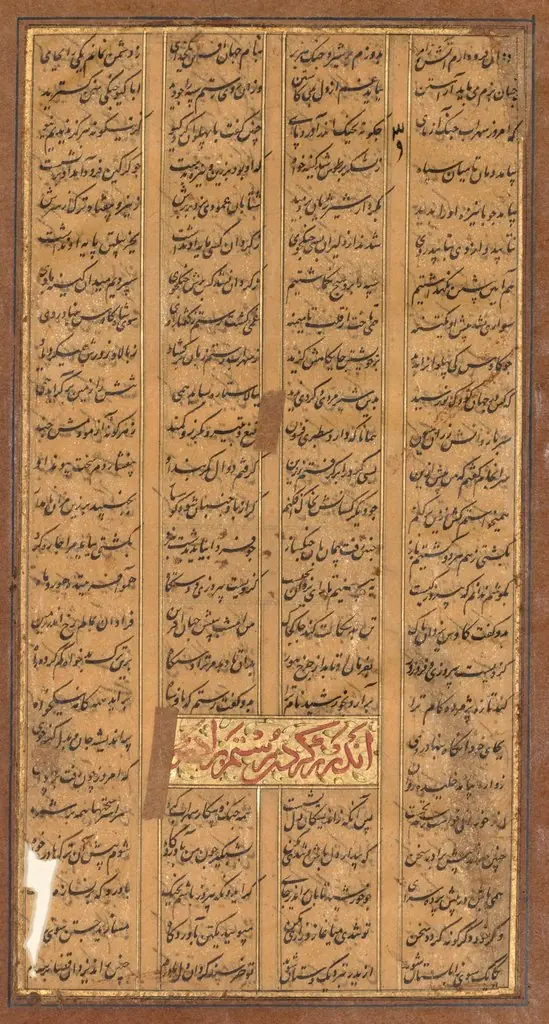 Text of Rustam and Suhrab, from the Shah-nama of Firdausi (Persian, c. 934–1020) (recto)
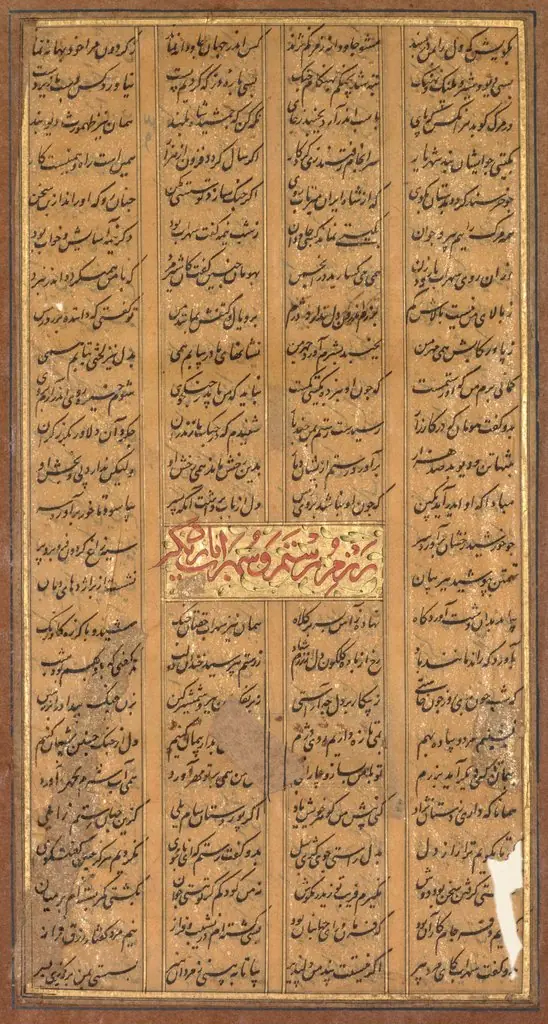 Text of Rustam and Suhrab, from the Shah-nama of Firdausi (Persian, c. 934–1020) (verso)
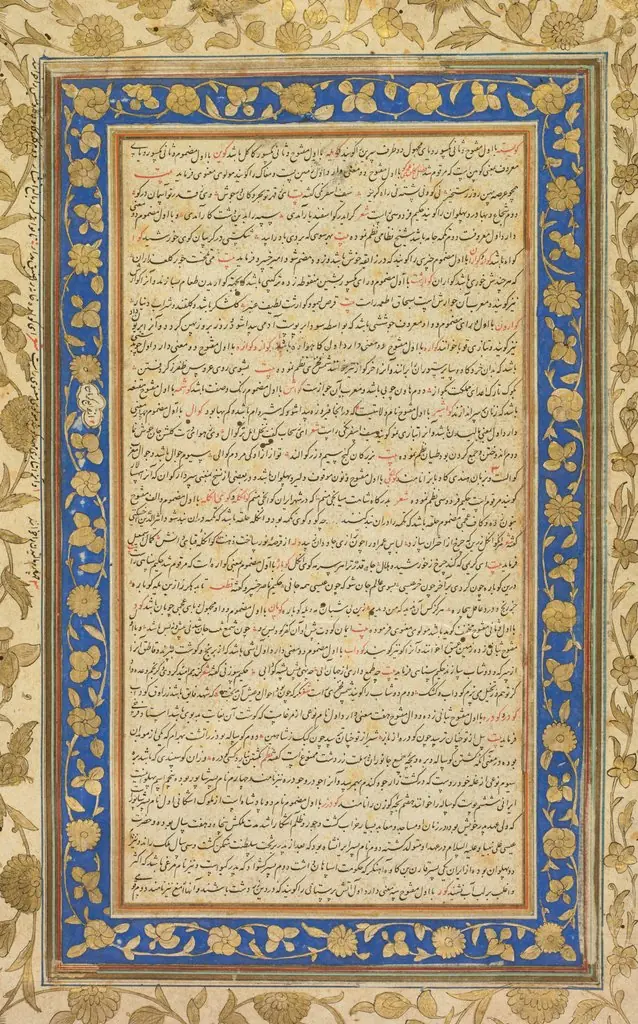 An Illuminated Folio from the Royal Manuscript of the Farhang-i Jahangiri (recto)
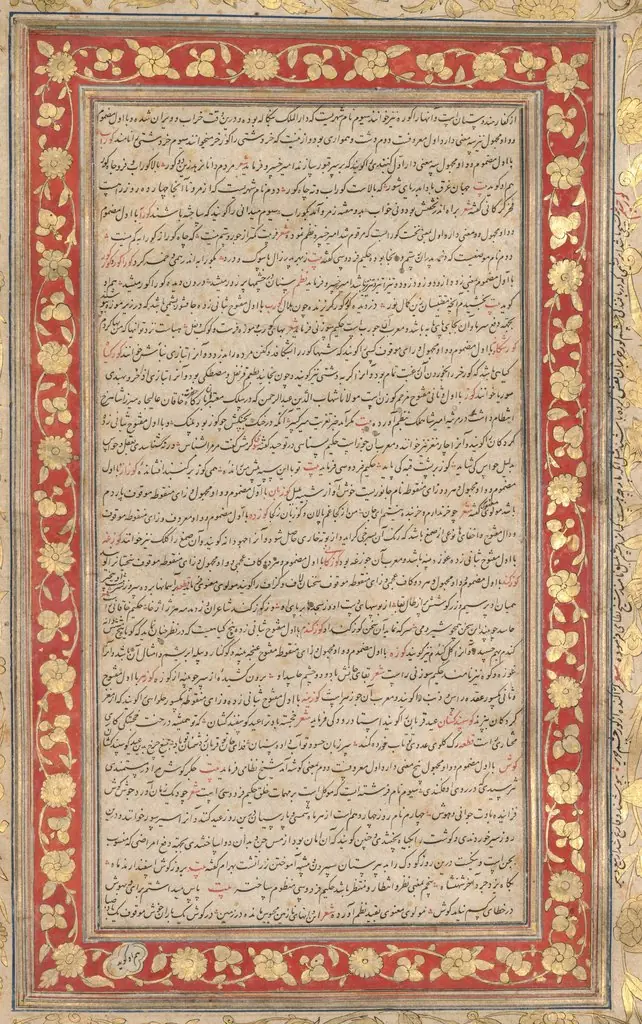 An Illuminated Folio from the Royal Manuscript of the Farhang-i Jahangiri (verso)
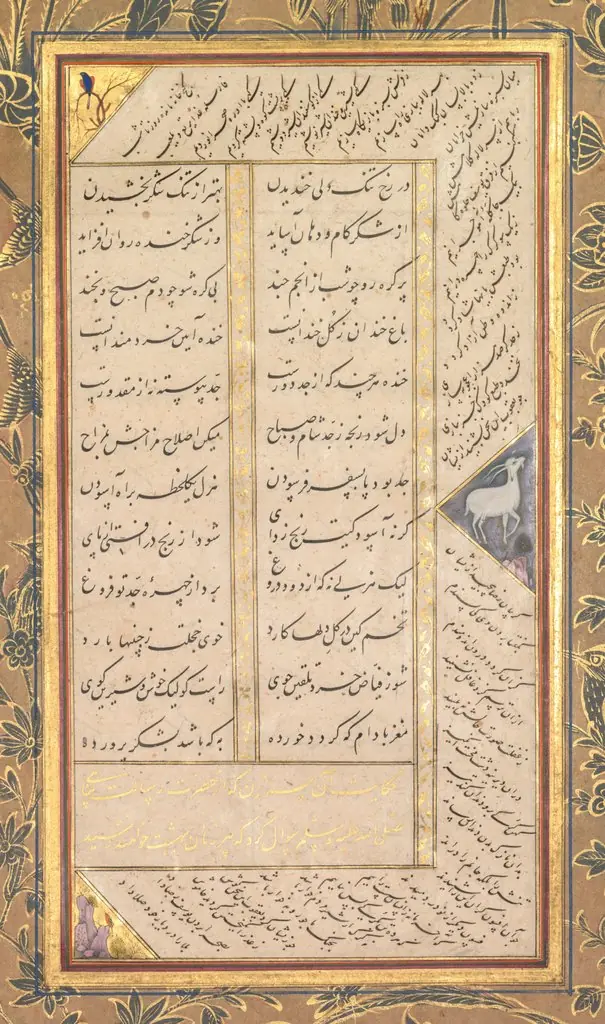 Page from a Panj Ganj (Five Treasures) of Abd al-Rahman Jami (Persian, 1414–1492), with two Persian masnavis: Yusuf va Zulaykha (Joseph and Zulaykha) and Subhat al-abrar (Rosary of the Righteous) (verso)
 Page from Tales of a Parrot (Tuti-nama): text page