Artwork
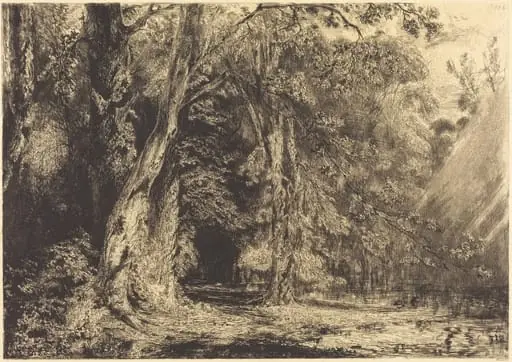
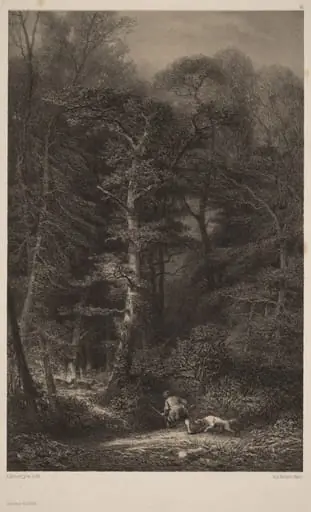
Entrance to the Forest
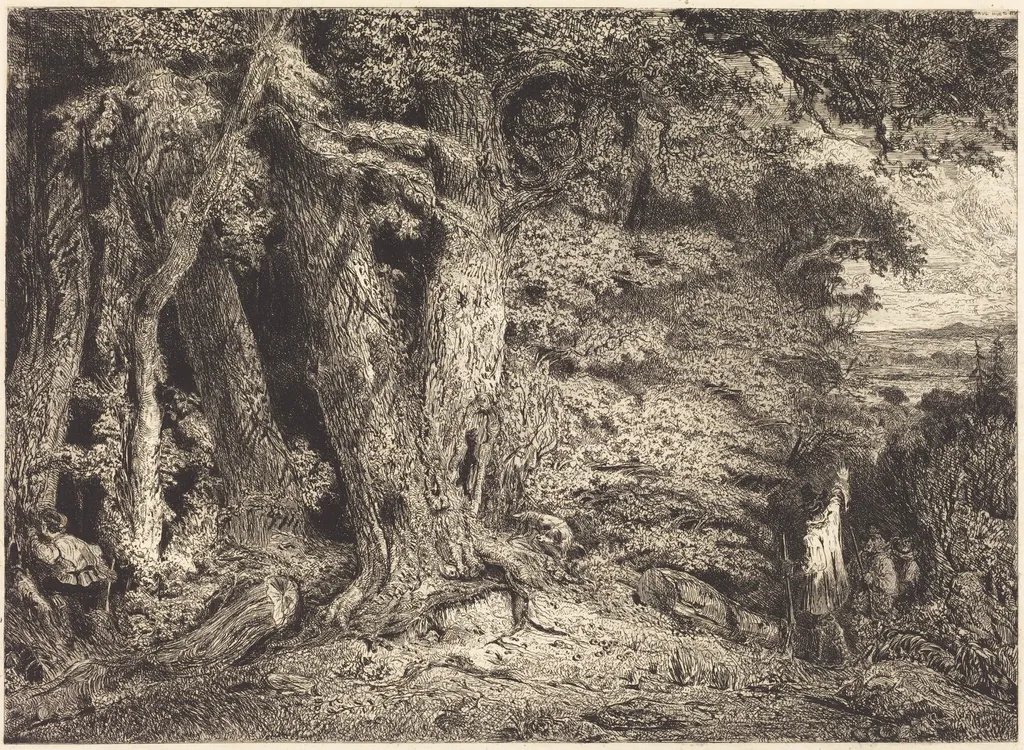
Entrance to the Forest is an ink print by the Romanticist artist Paul Huet. It dates from 1846 and is held in the collection of the National Gallery of Art.
About this work
Overview
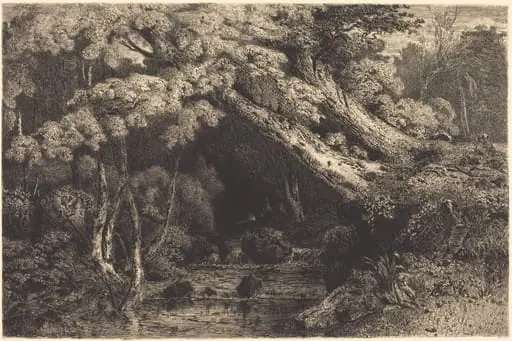
The work captures a dense woodland scene rendered in subtle tonal gradations, emphasizing depth and atmosphere over detail.
Created around 1846, Entrance to the Forest is an etching on chine collé by French artist Paul Huet. The work captures a dense woodland scene rendered in subtle tonal gradations, emphasizing depth and atmosphere over detail. The technique involves incising lines into a metal plate, which are then inked and pressed onto thin paper adhered to a heavier support, enhancing the print's delicate texture and tonal range.
Subject & Meaning
The composition presents an impenetrable thicket of trees and undergrowth, with minimal light filtering through the canopy. No figures or clear paths are visible, suggesting isolation and the untamed character of nature. The absence of human presence invites contemplation of wilderness as a force beyond control, reflecting Romantic-era fascination with nature’s mystery and sublimity.
Technique & Style
Huet employed fine, controlled etching lines to model form and texture, building volume through layered hatching and cross-hatching. The use of chine collé—attaching a thin sheet of paper to a sturdier backing—allowed for greater nuance in delicate areas. The restricted palette of grays and blacks enhances the somber mood, while the precision of the lines conveys the tactile density of the forest.
History & Provenance
This print is identified as a proof, suggesting it was pulled during the artist’s working process rather than for commercial distribution. As such, it offers insight into Huet’s iterative approach to composition and tone. Its survival indicates it was likely retained by the artist or a close associate, preserving a moment in the evolution of the final image.
Context
Huet worked during a period when French landscape art was shifting from idealized views toward more intimate, emotionally charged natural scenes. Influenced by the Barbizon School’s emerging focus on direct observation, he sought to convey the psychological weight of forests rather than their picturesque qualities, aligning his work with broader Romantic sensibilities in mid-19th-century France.
Legacy
Though less widely known than his contemporaries, Huet’s prints like Entrance to the Forest contributed to the redefinition of landscape as a vehicle for mood and introspection. His technical mastery in etching influenced later printmakers interested in atmospheric effects, helping to elevate printmaking as a medium for serious artistic expression beyond reproductive purposes.
Artist & collection


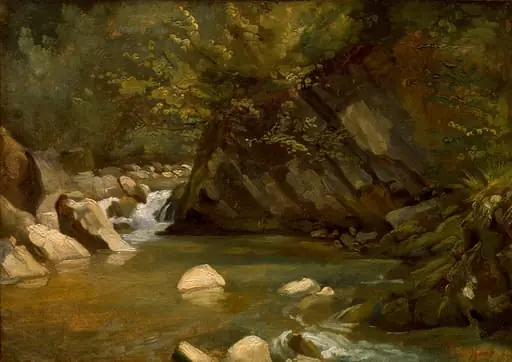
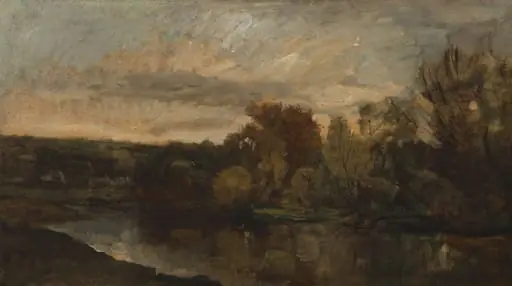
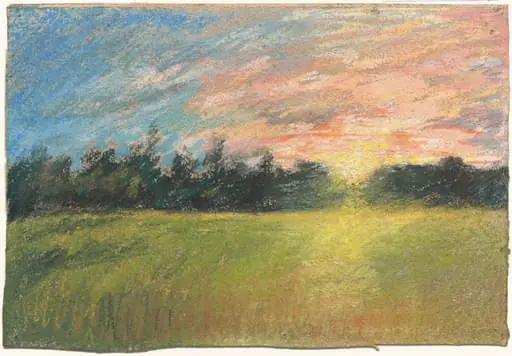
 Saint-Pierre Stream near Pierrefond (Ruisseaude Saint-Pierre, pres Pierrefond)
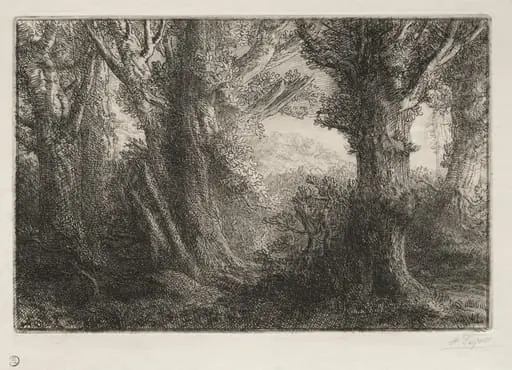 In the Forest at Conteville
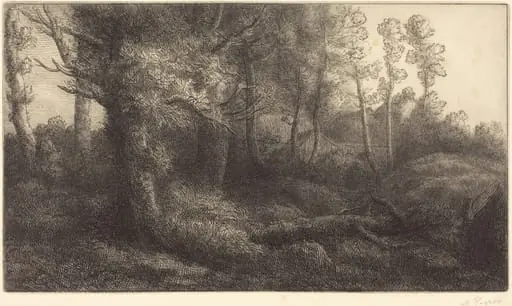 In the Forest (Lisiere de foret)
 Flooding in the Forest of the Ile Séguin
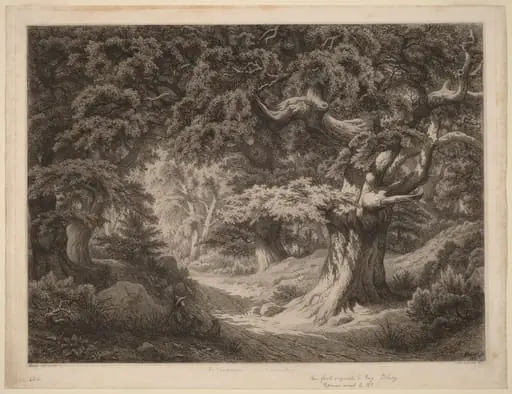 Le Charlemagne (forêt de fontainebleau)
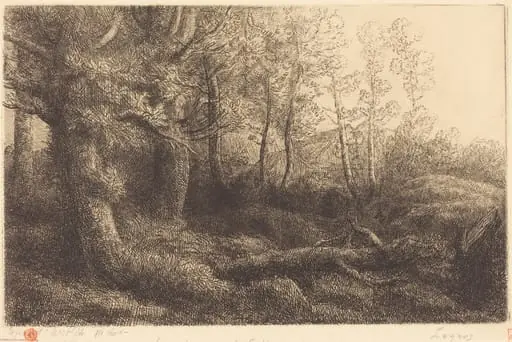 In the Forest (Lisiere de foret)
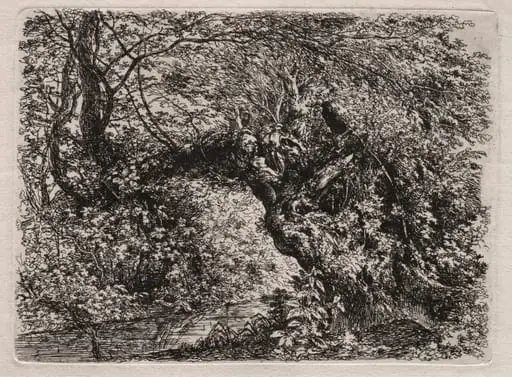 The Old Willow at a Brook
 A Dead Oak Tree
 Flooding in the Forest of the Ile Séguin
 En Foret a Breau
 Oeuvres de A. Calame: No. 52
 Intérieur de Forêt