Artwork
Dove House, Hurley
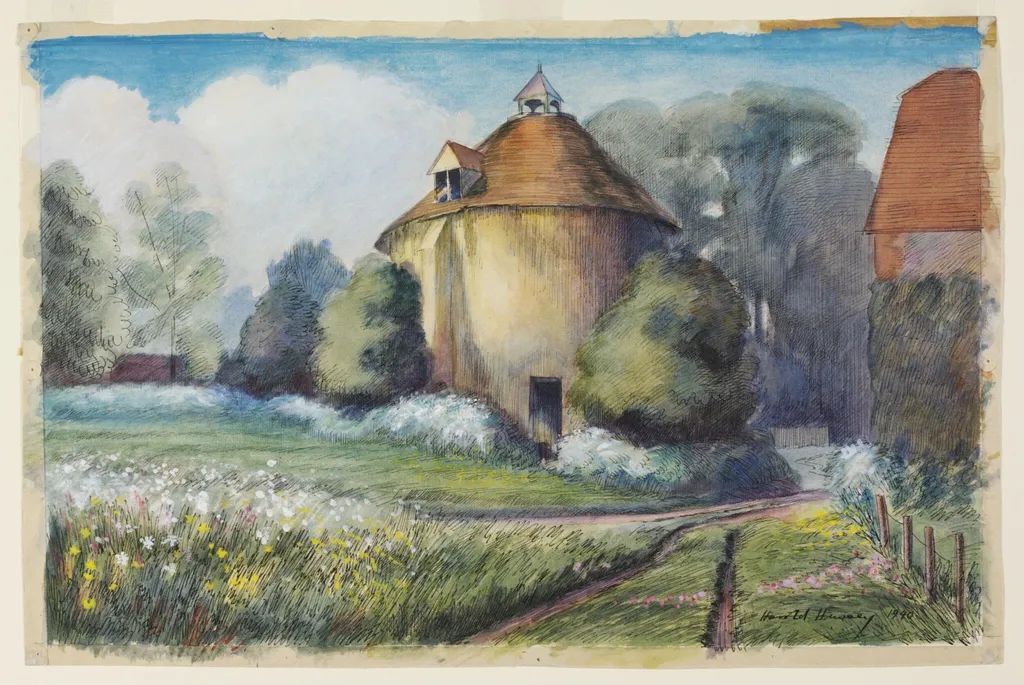
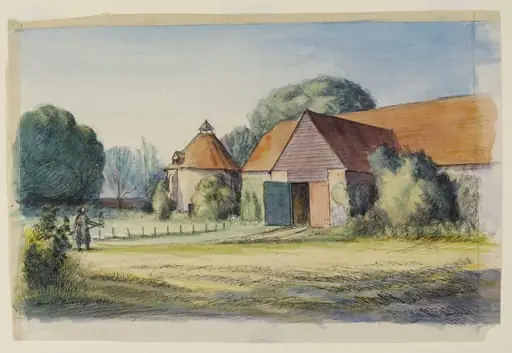
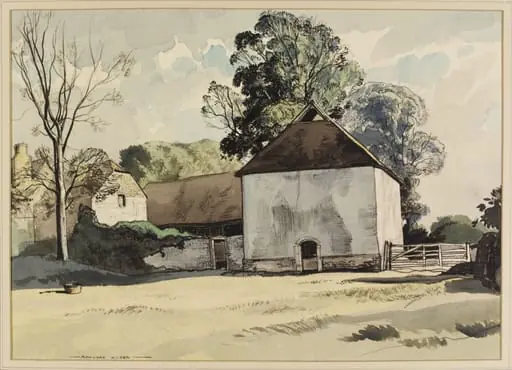
Dove House, Hurley is a watercolor work on paper by Philip Hussey. It is held in the collection of the Victoria and Albert Museum. Painted in 1940, this watercolour captures a medieval dovecote in Hurley, Berkshire.
About this work
Overview
The piece is signed and dated by its artist, contributing to a national collection assembled under official cultural preservation efforts.
Painted in 1940, this watercolour captures a medieval dovecote in Hurley, Berkshire. Created during World War II as part of the Recording Britain initiative, the work reflects a broader effort to visually archive rural architecture deemed vulnerable to wartime disruption and societal transformation. The piece is signed and dated by its artist, contributing to a national collection assembled under official cultural preservation efforts.
Subject & Meaning
The subject is a circular, timber-built dovecote, a functional structure once used to house pigeons for meat and fertilizer. Set within a quiet pastoral landscape, the building stands as a quiet emblem of pre-industrial rural life. Surrounding elements—wildflowers, a winding path, and enclosing trees—emphasize its integration into the land, suggesting continuity and quiet endurance amid broader societal upheaval.
Technique & Style
The artist employed loose, rapid brushwork to convey the play of light across the dovecote’s wooden surfaces and the surrounding grass. Watercolour was used with restraint, favoring muted greens, soft blues, and earthy browns to evoke natural tones without embellishment. The sky, rendered with delicate washes, adds atmosphere without detail, reinforcing the sketch-like immediacy of the observation.
History & Provenance
Commissioned by the Recording Britain scheme, the work was produced under the auspices of the Pilgrim Trust and the Ministry of Labour and National Service. Administered by Sir Kenneth Clark, the project aimed to employ artists during wartime while documenting at-risk vernacular architecture. This piece entered the national collection held by the Victoria and Albert Museum, where it remains part of a curated archive of British topographical art.
Context
The Recording Britain project emerged during a period of national uncertainty, when fears of bombing and urban change threatened historic landscapes. Artists were sent across England to record buildings and scenes considered emblematic of English identity. Dovecot structures, once common in rural estates, were increasingly rare, making their depiction a form of quiet cultural preservation.
Legacy
The watercolour contributes to a lasting visual record of England’s rural heritage, preserved through the discipline of topographical art. Unlike grand monuments, such works highlight modest, everyday structures, offering insight into the textures of ordinary life before widespread modernization. Today, the piece remains a reference point for understanding how art was mobilized for cultural memory during crisis.
Own this work as a print
Artist & collection
Artist
Philip Hussey (1713–1783), was an Irish portrait-painter. Hussey was born at Cloyne, in the county of Cork and his career began as a sailor. He was shipwrecked three times. He drew the figureheads and stern ornaments of…