Artwork
Secvențe din Muzeul Satului, icoană pe sticlă de Savu Moga: „Prăznicar- Sfinții militari”, Țara Oltului, Arpașul de Sus - 1884 (1988)
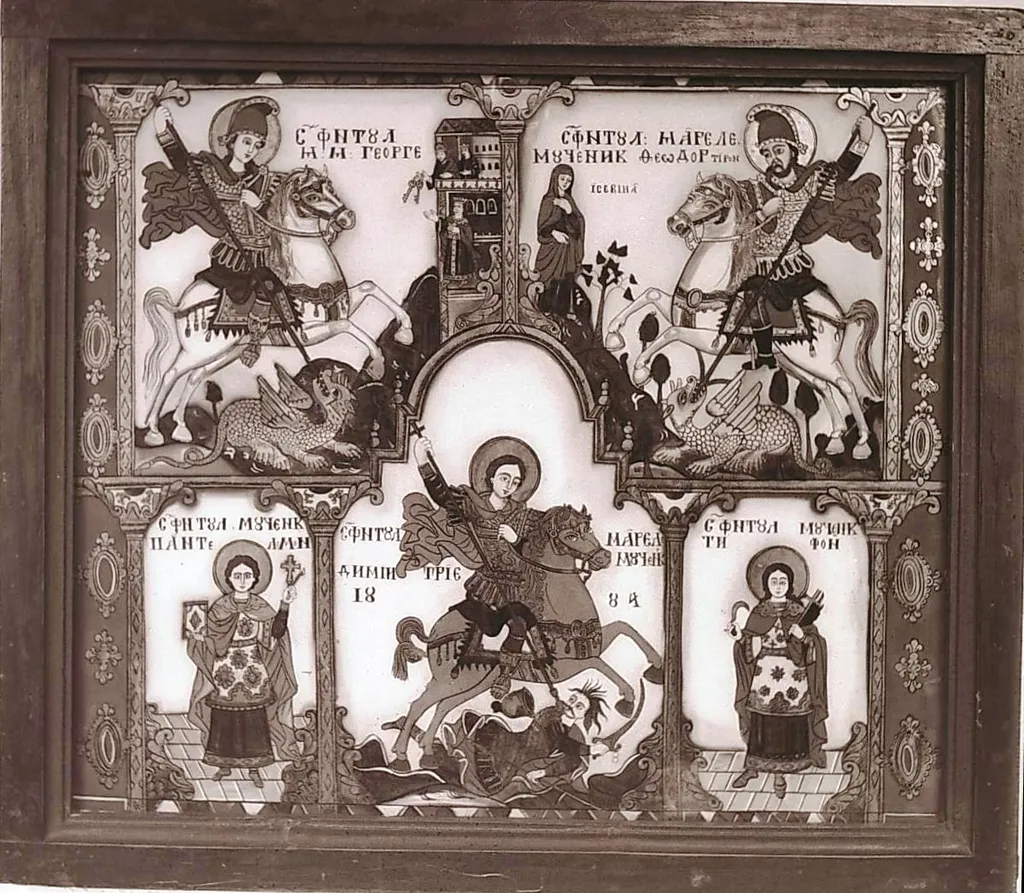
Secvențe din Muzeul Satului, icoană pe sticlă de Savu Moga: „Prăznicar- Sfinții militari”, Țara Oltului, Arpașul de Sus - 1884 (1988) is a drawing by Ioan George Andron. It dates from 1988 and is held in the collection of the "Dimitrie Gusti" National Village Museum. This glass icon, created by Savu Moga in 1884, originates from Arpașul de Sus in the Olt region of Transylvania.
About this work
Overview
Moga, a local artisan trained in the Făgăraș area, specialized in painting on glass, a technique that allowed for luminous effects and fine detail.
This glass icon, created by Savu Moga in 1884, originates from Arpașul de Sus in the Olt region of Transylvania. It depicts a group of military saints arranged in a structured, compartmentalized format typical of 19th-century Romanian iconography. Moga, a local artisan trained in the Făgăraș area, specialized in painting on glass, a technique that allowed for luminous effects and fine detail. The work is part of a broader tradition of village-based religious art in Transylvania.
Subject & Meaning
The icon portrays four military saints: George and Theodore Tiron in the upper register, each slaying a dragon; and Demetrius in the center lower panel, vanquishing a soldier, flanked by Panteleimon and Theophanes. These figures symbolize divine protection and spiritual warfare. The arrangement reflects liturgical and devotional priorities, emphasizing the saints’ roles as intercessors and defenders. The composition’s symmetry and hierarchical spacing reinforce their sacred status within the Orthodox tradition.
Technique & Style
Moga painted on glass using tempera and pigments, applying layers to achieve depth and luminosity. His technique emphasized fine linear precision, with intricate details in armor, architecture, and drapery. The borders feature alternating geometric patterns—rhombuses, crosses, and chromatic triangles—creating a framed, window-like effect. The use of white backgrounds enhances the figures’ visibility, a signature trait of his glass icons that distinguishes them from wood-panel works.
History & Provenance
Savu Moga was active in the mid-to-late 19th century, primarily in the villages of Făgăraș and Arpașul de Sus. He established a workshop in Upper Arpaș around 1843, producing icons for local churches and households. This particular work was documented in the 1988 inventory of the Museum of the Village, where it was cataloged as part of a regional collection. Its survival reflects the endurance of folk iconography despite modernization pressures in rural Transylvania.
Context
In 19th-century Transylvania, glass icons were common in villages where resources were limited and wood was scarce. Moga’s work emerged within a network of itinerant iconographers who adapted Byzantine models to local tastes. His compositions, rich in narrative detail and architectural elements, responded to community needs for visually compelling devotional objects. The inclusion of architectural motifs and ornamental borders aligns with broader folk artistic practices of the Carpathian region.
Legacy
Savu Moga’s glass icons are recognized for their narrative density and technical refinement within Romanian folk art. His work influenced later generations of artisans in the Făgăraș region and remains a reference point for studies of rural religious expression. The preservation of this icon in institutional collections ensures its role as a material witness to the continuity of Orthodox devotional culture in Transylvanian villages during a period of social change.
Artist & collection
Artist
Naïve painters from the 1980s like Petru Mihuțe recorded village life in bold colors straight from tubes.
Museum
"Dimitrie Gusti" National Village Museum
Continue through works from the same source collection.
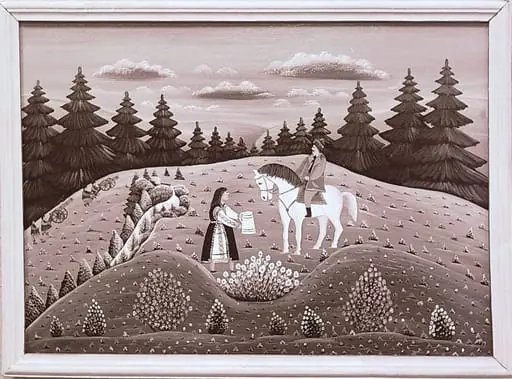 Sequences from the Village Museum, naive painting by Petru Mihuțe - Avram Iancu and Romania (1988)
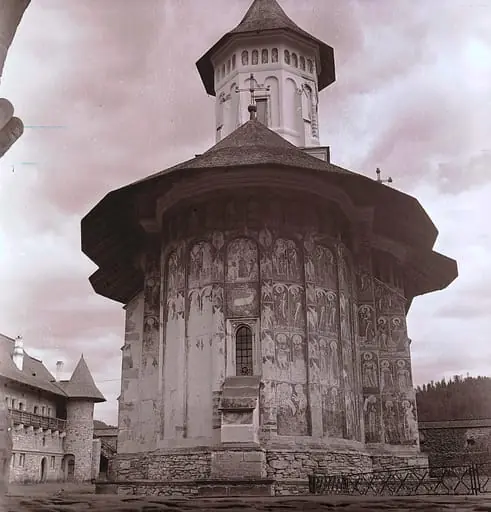 Research Bucovina, Vatra Moldovița. The Monastery And The Church - View With The Absida And The Turla Of The Church (1980)
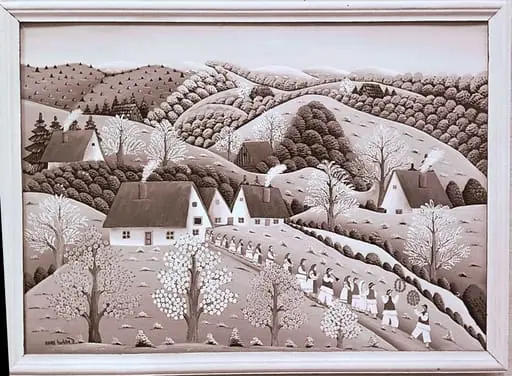 Sequences from the Village Museum, naive painting by Petru Mihuțe - Spring Wedding (1988)
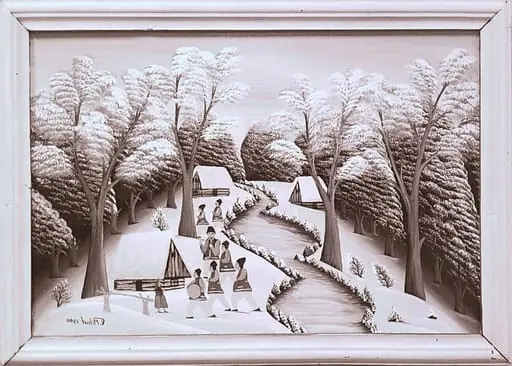 Sequences from the Village Museum, naive painting by Petru Mihuțe - Winter with van (1988)
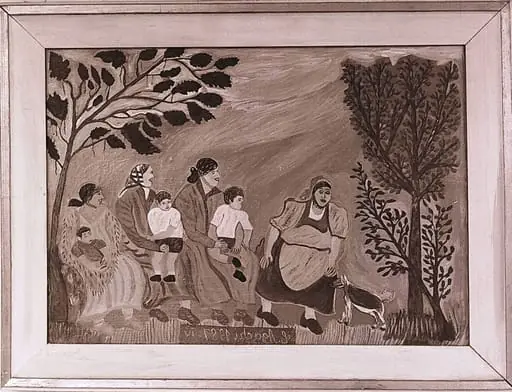 Sequences from the Village Museum, Naive painting by Costache Agachi - The gossip (1988)
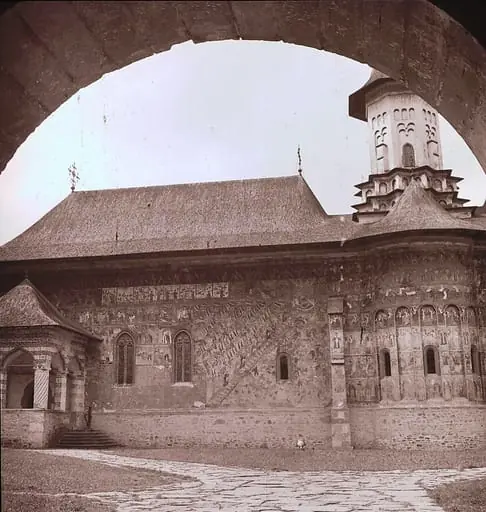 Research Bucovina. Sucevița Church - overview with exterior painting from one of the longitudinal walls (1980)
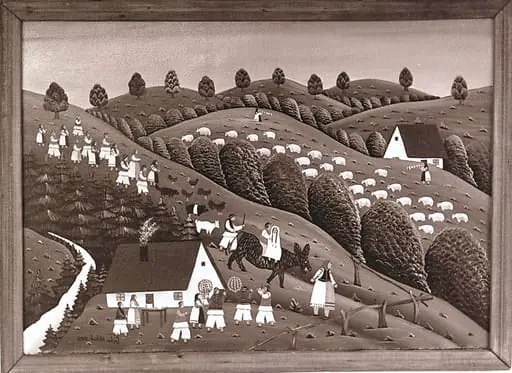 Sequences from the Village Museum, naive painting by Petru Mihuțe - The wedding of the poor boy (1988)
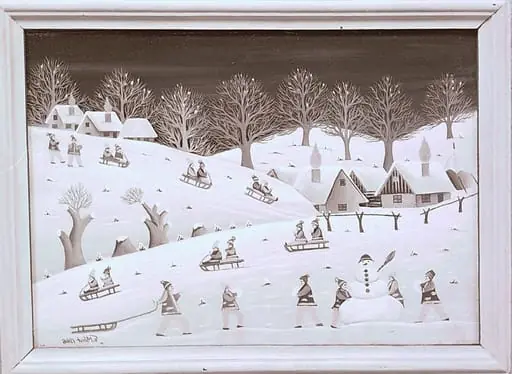 Sequences from the Village Museum, naive painting by Petru Mihuțe - Children at sling (1988)
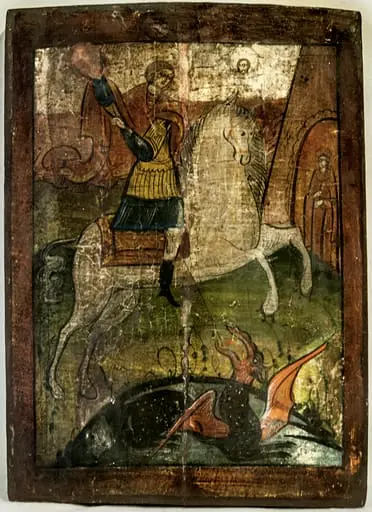 Tema iconografică este "Sfântul Gheorghe omorând balaurul". În prim plan, Sf. Gheorghe, în veșminte ostășești, călare pe un cal alb, cambrat, ridicat în două picioare, omoară balaurul plasat în registrul inferior. Veșmintele sfântului au o tentă țărănească(tunica albastră acoperită 3/4 de lorica argintie, pantaloni albi, cu motiv floral, cizme înalte. Calul are ambii ochi vizibili, coama bogată, coada în fuior. Partea dinspre privitor a ansamblului cal cu călăreț este supradimensionată, creând o impresie optică de înălțare a sfântului. În partea dreaptă, fata de împărat pe care o salvează sfântul, sub portalul palatului. privind scena. Veșminte lungi, simple, coroană împărătească. Înveșmântată în haine simple, lungi, cu coroană pe cap, privește scena cu brațele la piept. În colțul din stânga dreapta sus, Iisus Hristos așa cum apare pe sfântul Keramion. Nimbul cruciger. Balaurul plasat în registrul inferior asemănător unui grifon, corp diform, terminat cu o coadă în săgeată, aripile și capul roșii. Motiv mai elaborat decât în alte icoane unde redarea balaurului este minimizată. Compoziția este dinamică, chipurile expresive, gesturile bine realizate. Linia desenului variază, contribuind la efectul optic. Fondul foiței argintii(superior), relief din benzi late în tonuri de brun, brun roșcat, galben, alb, verde, cu elemente de vegetație. Bordura roșiatică lată, specifică icoanelor de tip krashnuska. Inscripție pe chenar, în partea superioară.
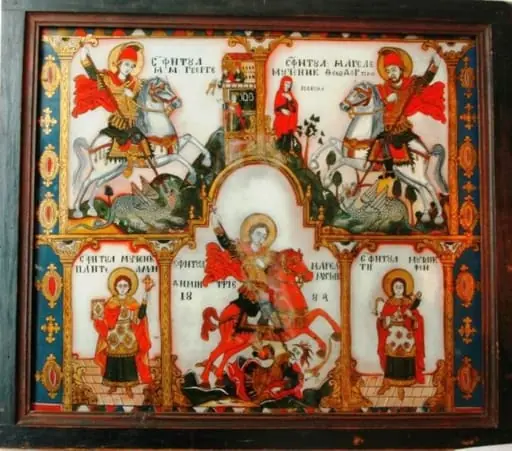 Sfinții militari
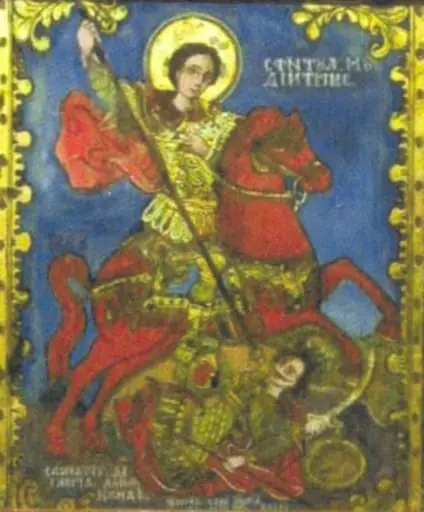
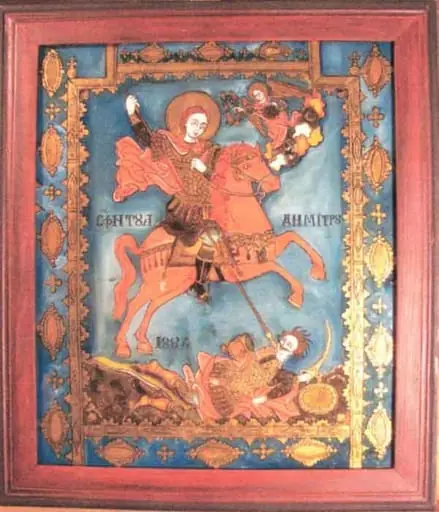 Sfântul Dumitru
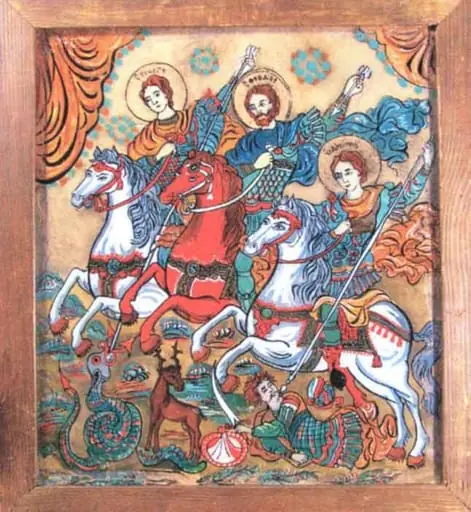 Sfinții Militari Gheorghe, Theodor - Tiron și Dimitrie
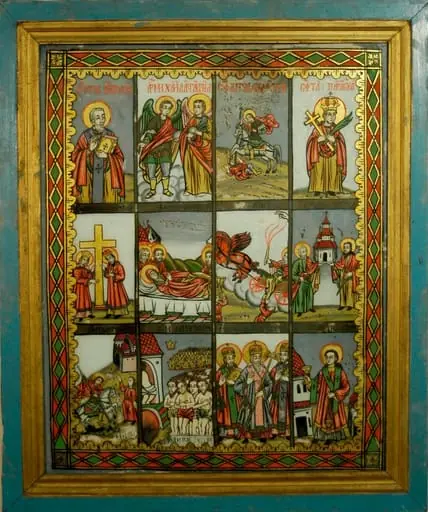 prăznicar cu sfinți
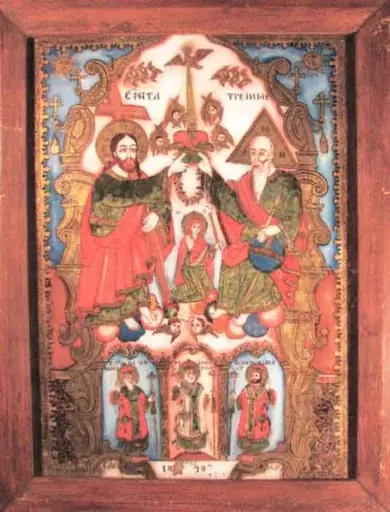
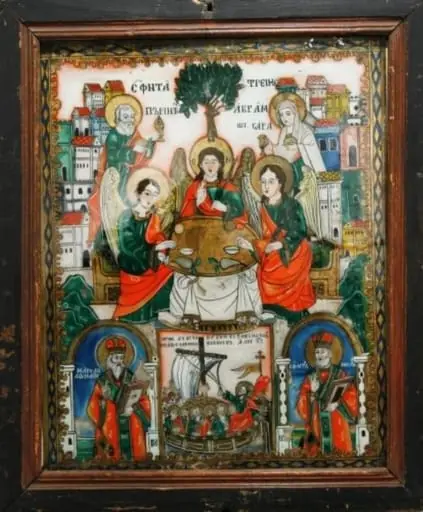 Sfânta Treime (Sfânta Troiță, Filoxenia, Cina de la Mamvri)
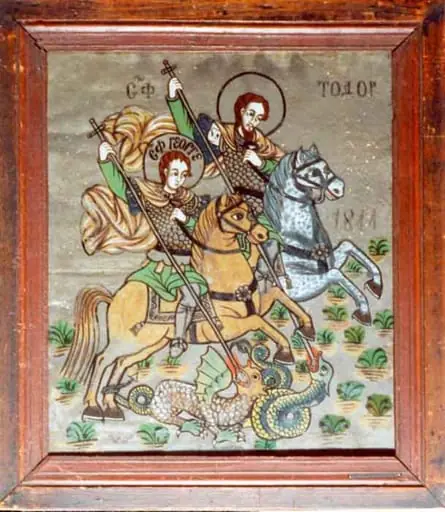 Sfinții Gheorghe și Teodor
 Sfânta Treime
 Sfântul Dumitru