Artwork
Fourth Knot
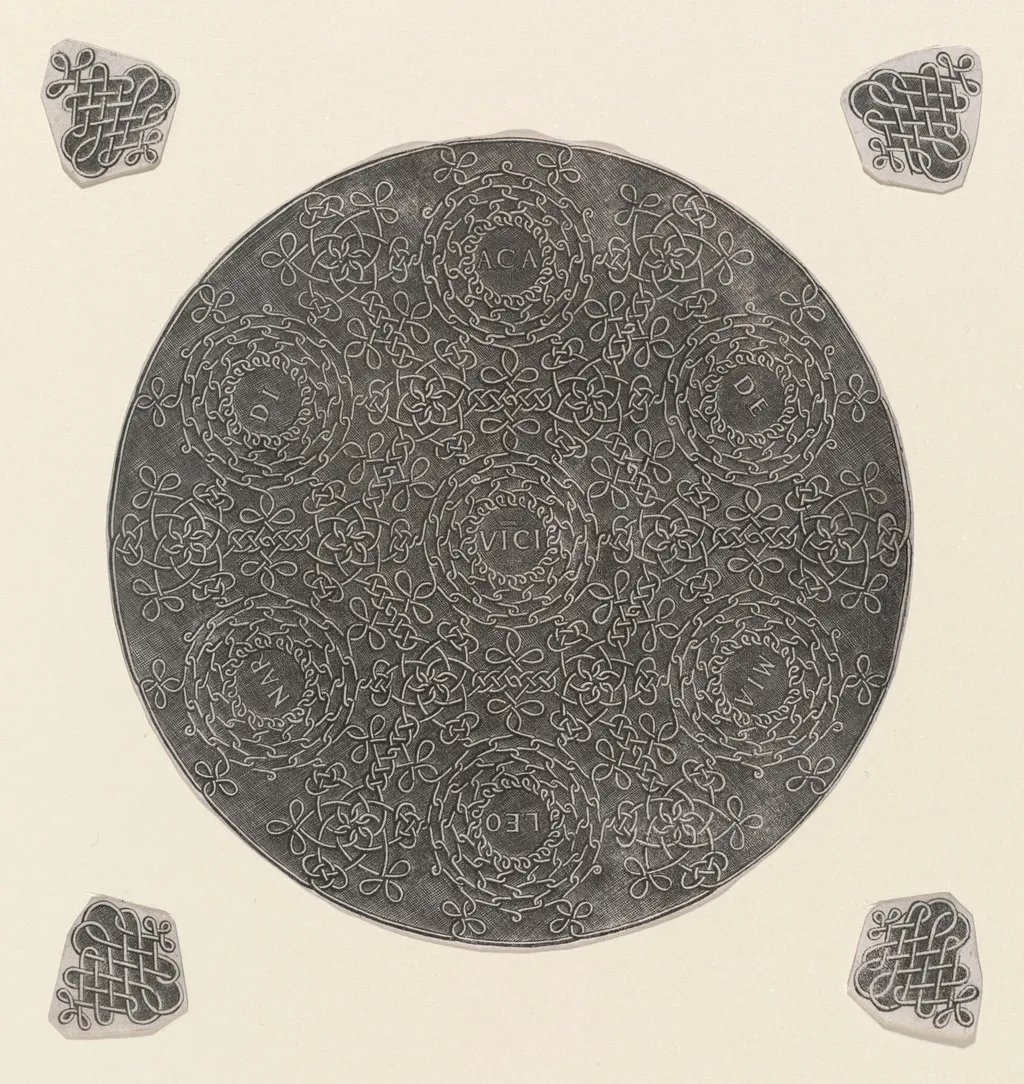
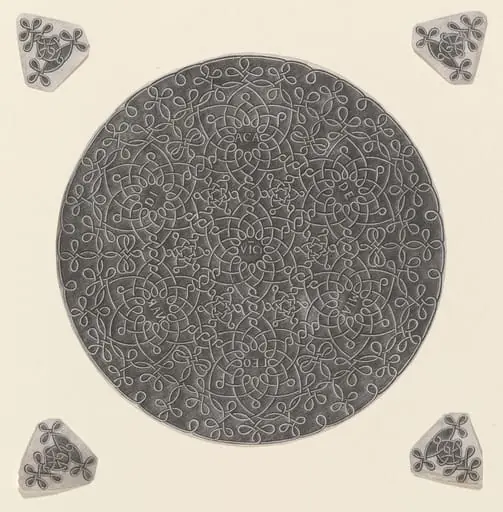
Fourth Knot is an ink print by the Renaissance artist Italian 15th Century. It dates from 1495 and is held in the collection of the National Gallery of Art.
About this work
Overview
Peripheral elements include diminutive floral and cross-like forms, and four corner fragments appear to have been cut from the same original sheet.
Fourth Knot is an engraved print executed on laid paper, composed of a single sheet that has been trimmed to isolate the central motif. The composition consists of a circular, monochrome arrangement of interlacing lines that form a complex knot pattern, with the letters “VICIT” and “LE” integrated into the design. Peripheral elements include diminutive floral and cross-like forms, and four corner fragments appear to have been cut from the same original sheet.
Technique & Style
The work was produced by incising a metal plate with fine, controlled lines, then transferring the image onto paper through pressure—a traditional engraving process. The precision of the incisions yields a range of tonal values, from deep shadows to delicate highlights, giving the knot its three‑dimensional illusion. The overall aesthetic reflects a meticulous, linear approach characteristic of early modern printmaking.
Subject & Meaning
The central motif is a stylized knot, a visual metaphor often associated with continuity, complexity, or entanglement. The embedded inscription “VICIT” (Latin for “conquers”) paired with “LE” may suggest a personal or allegorical statement, though the exact significance remains ambiguous. The surrounding floral and cruciform motifs provide a decorative counterbalance to the dense central geometry.
History & Provenance
The print is known as Fourth Knot, indicating it belongs to a series of similarly structured works. It was created as a single sheet that was later divided into five parts, with the four corner pieces retained as separate elements. Documentation of its original ownership or exhibition history is limited, and the work is primarily catalogued through print collections.
Context
Engraving was a dominant medium for disseminating intricate designs in the period when Fourth Knot was produced, allowing for reproducibility and detailed line work. The use of a knot motif aligns with contemporary interests in ornamental patterns and symbolic imagery, often found in decorative arts, bookplates, and heraldic devices.
Artist & collection

Artist
This anonymous Italian engraver from the 1490s carved images that could be peeled apart like paper dolls—each knot in the "First Knot" print was cut from a single sheet so you could lift the loops right off the page.

![The Destruction of the Egyptian Idols [verso], by Italian 15th Century](https://artifactworldgallery.com/img/italian-15th-century--the-destruction-of-the-egyptian-idols-verso--646d3c2b8098cfee-w320.webp)
![The Flight into Egypt [recto], by Italian 15th Century](https://artifactworldgallery.com/img/italian-15th-century--the-flight-into-egypt-recto--8f4d5275d7f90f98-w320.webp)