Artwork
Ornament in Hexagonal Shape
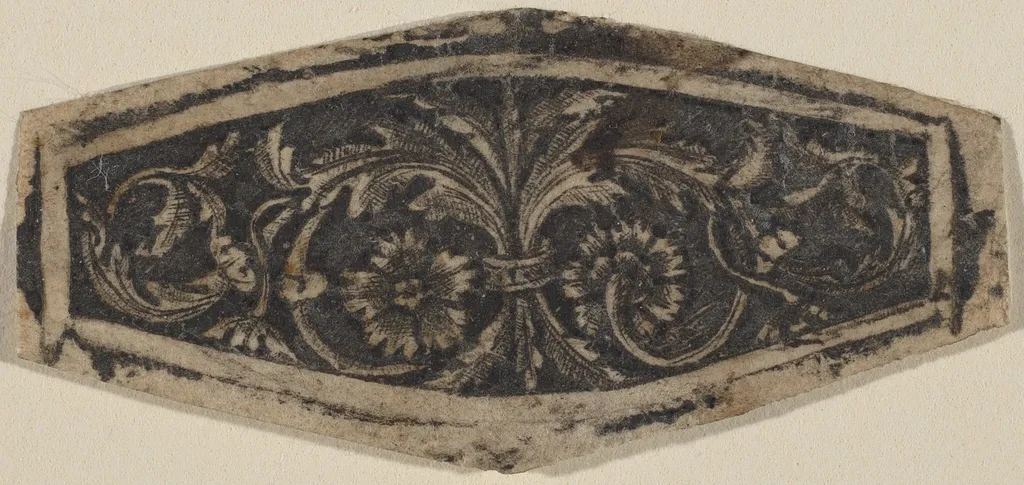
Ornament in Hexagonal Shape is a print by the Renaissance artist Italian 15th Century. It dates from 1480 and is held in the collection of the National Gallery of Art.
About this work
Overview
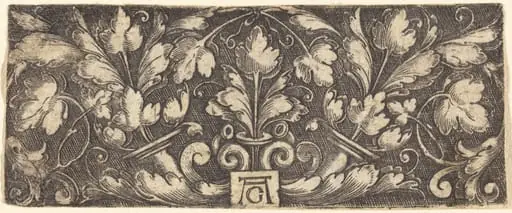
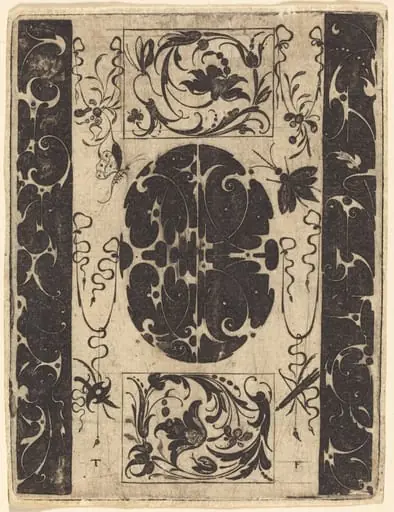
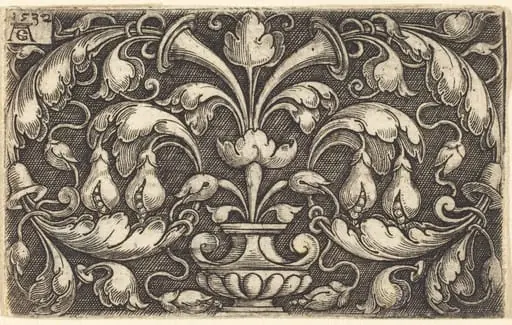
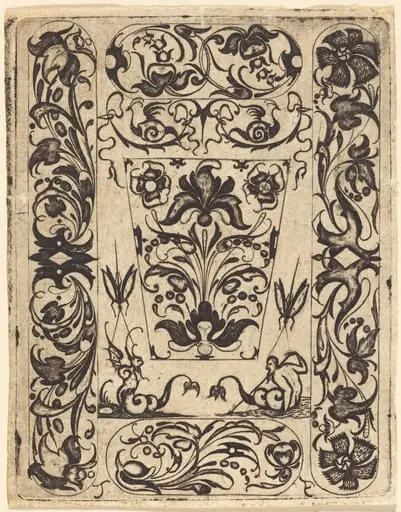
The work is a niello print titled “Ornament in Hexagonal Shape.” Executed in the traditional metal‑inlay technique, the image presents a dark, almost black field punctuated by swirling decorative motifs. The composition is framed by a hexagonal outline, its edges appearing worn, giving the impression of a fragment of a larger tile.
Subject & Meaning
Central to the design are two oversized floral forms, each surrounded by stylized leaves and curling vines. The repeated arrangement of these botanical elements creates a balanced, rhythmic pattern that reflects the Renaissance fascination with nature as an orderly, decorative principle.
Technique & Style
Niello, a method that fuses powdered metal alloy into engraved metal surfaces, yields the deep, velvety black background characteristic of the piece. The ornamental motifs echo the symmetrical, repetitive designs popular in Renaissance decorative arts, where geometric precision and natural forms were often combined.
History & Provenance
The print belongs to a period when niello was employed for both functional objects and ornamental panels. While specific ownership details are not recorded, its stylistic affinities place it within the broader European tradition of Renaissance metalwork and decorative prints.
Context
During the Renaissance, artists frequently integrated floral and vegetal motifs into architectural and decorative schemes, using symmetry to convey harmony. This piece exemplifies that aesthetic, aligning with contemporary patterns found in tile work, manuscript borders, and metal panels.
Artist & collection

Artist
This anonymous Italian engraver from the 1490s carved images that could be peeled apart like paper dolls—each knot in the "First Knot" print was cut from a single sheet so you could lift the loops right off the page.

![The Destruction of the Egyptian Idols [verso], by Italian 15th Century](https://artifactworldgallery.com/img/italian-15th-century--the-destruction-of-the-egyptian-idols-verso--646d3c2b8098cfee-w320.webp)
![The Flight into Egypt [recto], by Italian 15th Century](https://artifactworldgallery.com/img/italian-15th-century--the-flight-into-egypt-recto--8f4d5275d7f90f98-w320.webp)