Artwork
Bust of Livy
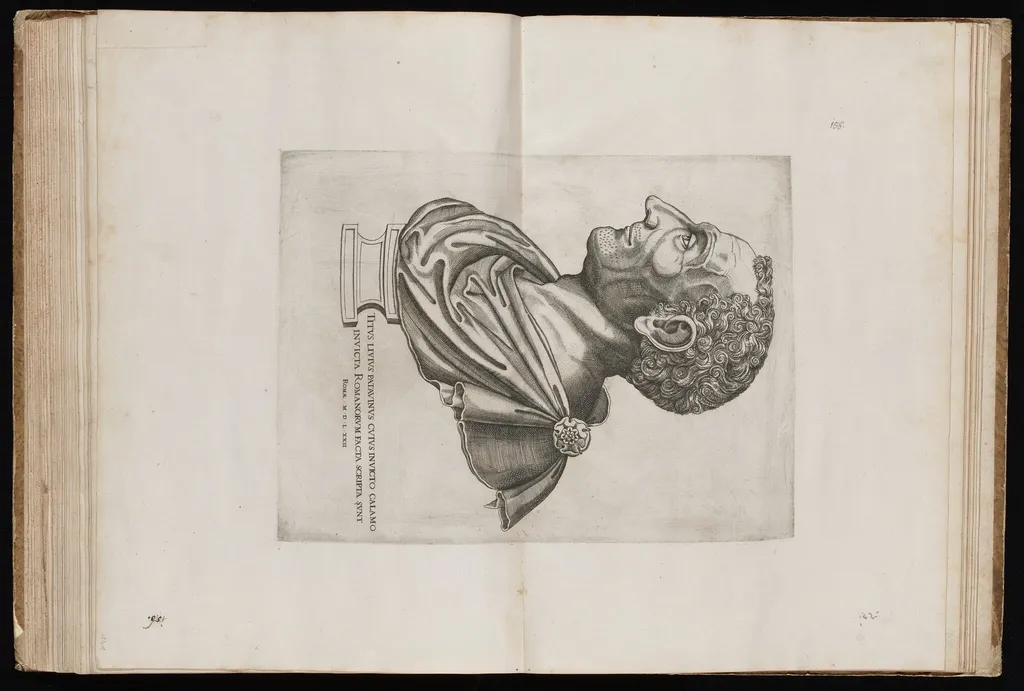
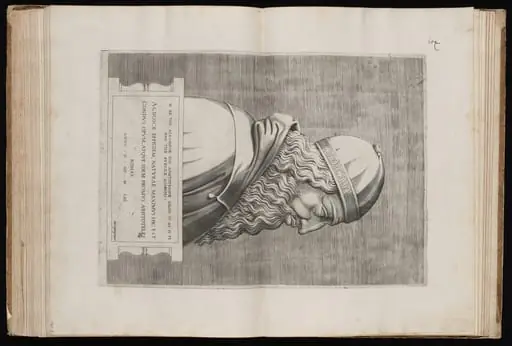
Bust of Livy is an ink print by the Renaissance artist Italian 16th Century. It dates from 1572 and is held in the collection of the National Gallery of Art.
About this work
Overview
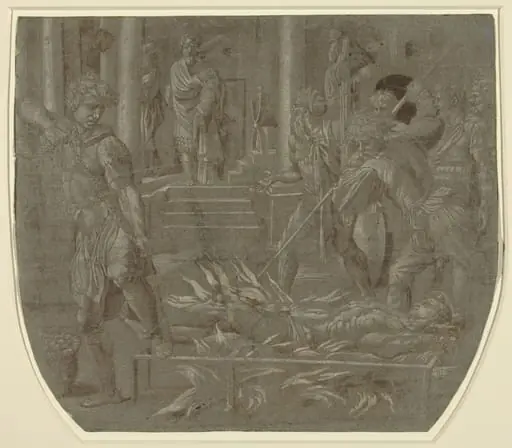
The print, titled Bust of Livy, is a 16th‑century Italian engraving that presents a crowded oval composition of figures from antiquity. Central to the scene is a man in a toga clutching a scroll, surrounded by other robed individuals. The work resides in the collection of the National Gallery of Art in Washington, D.C.
Subject & Meaning
The central figure represents the Roman historian Livy, identified by his scholarly pose and the scroll he holds, a conventional attribute of a writer. The surrounding characters, rendered in classical dress, evoke a broader intellectual milieu, suggesting the collective memory of Roman historiography that Livy embodied.
Technique & Style
Engraved on a metal plate, the image employs fine cross‑hatching to model volume and convey shadows across the crowded oval space. The line work creates a sense of depth despite the flat medium, while the oval format frames the scene in a manner reminiscent of contemporary relief sculpture.
History & Provenance
The engraving is based on an earlier three‑dimensional bust of Livy, translating the sculptural model into a printable image. Produced in Italy during the 1500s, the print entered the National Gallery of Art’s holdings through acquisition in the 20th century, where it remains on display.
Context
In the Renaissance, artists frequently adapted classical statues into prints to disseminate antiquarian knowledge. This work reflects that practice, merging a revered Roman figure with the era’s print technology, thereby making the image of Livy accessible to a broader audience beyond the limited reach of the original sculpture.
Artist & collection

Artist
A 16th-century Italian sculptor left us small bronze works in dark brown and gold.